Endangered
Summers' poison frog
Summers' poison frog
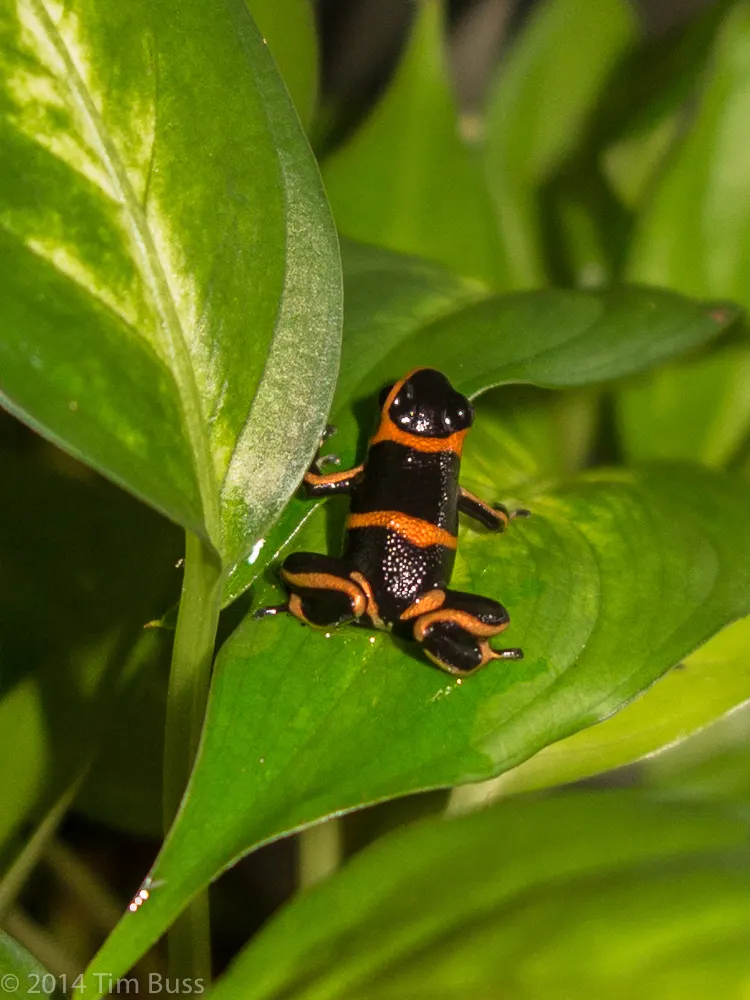
Summers' poison frog (Summers' poison frog) is a tiny orange and black banded dart frog from the foothill forests of central Peru. The IUCN Red List rated it Endangered in 2018. It has a very small range, and habitat clearing and collection for the pet trade both press on it.
How to recognise it
Adults measure roughly 15.5 to 20.4 mm from snout to vent, and males and females are about the same size. The body is banded in orange and black, with a dark mask running through the eye and over the eardrum.
It looks a lot like Zimmermann's poison frog (Ranitomeya variabilis), which it reportedly mimics, and like Ranitomeya imitator, which in turn copies it. Sound is the easiest way to tell them apart. Summers' frog gives a soft buzz that carries less than a metre, while the imitator calls loudly enough to be heard from around 5 m.
Where it lives
The species is known only from Peru. Records come from a small area of San Martín in the central Huallaga River valley, around the towns of Sauce and Chazuta. The IUCN puts its extent of occurrence at about 243 square kilometres, and it has been found between 180 and 700 m above sea level.
Its habitat is dry and moist lowland forest. Its range lies near Cordillera Azul National Park, but the IUCN states that it is not known to occur in any protected area.
Pins are Wikidata “endemic to” fields. Orange dots, when present, are GBIF occurrence tiles — survey bias included.
How it lives
It is active by day and spends most of its time on the ground. Females lay small clutches of 6 to 9 eggs in leaf litter. After hatching, the male carries the tadpoles to small pools of water, either in tree holes or in the leaf axils of Dieffenbachia plants.
Until 2008 these frogs were treated as a form of Ranitomeya fantastica. Brown and colleagues described them as a separate species that year. A 2011 Zootaxa study of the genus included a frog from near Chazuta in its genetic analysis and found that it supported the classification based on appearance.
Why it is in trouble
The IUCN lists farming as the main driver of habitat loss, both large agro-industry operations and small-holder plots. Its population is severely fragmented and still declining.
Collection is the second pressure. These frogs are prized in the terrarium trade, and a small legal export took place around 2001. Reportedly, almost every one kept as a pet today is an illegal capture or descended from one.
What is being done
The frog is covered by international trade controls, and the IUCN lists policy and regulation, along with habitat protection, among the conservation actions that apply. It is not recorded from any protected area, so most of its habitat has no formal safeguard.
Sources
Written for this catalog in our own words from the sources below, checked against them on 12 November 2026. Population figures are estimates and carry the year they were made. Status and assessment year: IUCN. 2026. The IUCN Red List of Threatened Species. Version 2026-1. iucnredlist.org.




