Endangered
Ranitomeya claudiae
Andinobates claudiae
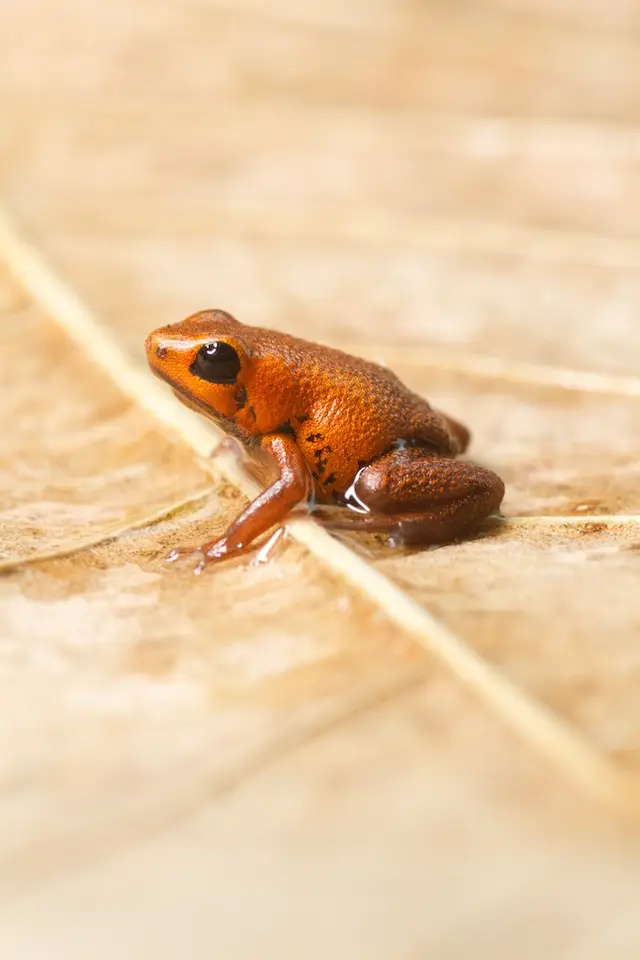
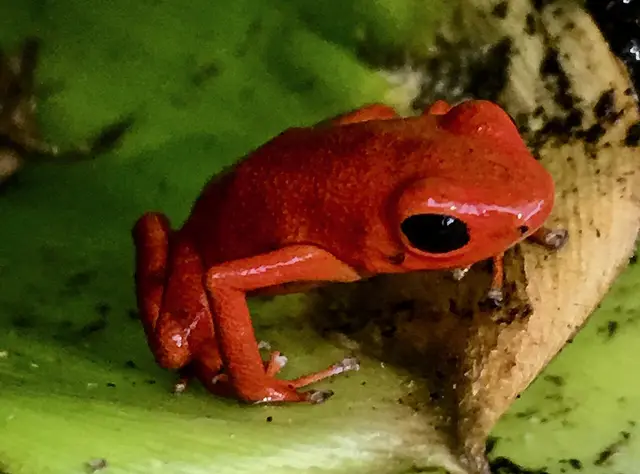
Andinobates claudiae, formerly known as Ranitomeya claudiae, is a tiny poison frog from the lowland forests of Bocas del Toro in Panama. It barely passes a centimetre in length. The IUCN Red List moved it from Data Deficient to Endangered in 2023, citing forest loss and collection.
How to recognise it
This is one of the smallest poison frogs in Central America, along with its relative Andinobates minutus. Both barely pass 1 cm in length. It is also secretive. A 2017 article in Anima Mundi magazine calls it highly secretive, and describes one found on Isla Colón that gave away its presence with an unusual call, then escaped by hopping much farther than expected.
The tadpoles have a complete row of small papillae along the back edge of the mouth disc. A 2022 Zootaxa note by Higgins and Ibáñez lists only a few other Andinobates species with the same feature, and says it sets them apart from other described species in the group.
Where it lives
The species is endemic to Panama and is recorded from the Bocas del Toro area, on both the islands and the mainland. The IUCN puts its extent of occurrence at about 1,257 square kilometres, from near sea level (5 m) to 140 m, in moist lowland forest. In many localities it can be quite abundant.
Taxonomy has shifted over the years. The frog has been called Dendrobates claudiae and Ranitomeya claudiae, and it now belongs to Andinobates, a genus proposed in 2011 for a group of species formerly placed in Ranitomeya.
Pins are Wikidata “endemic to” fields. Orange dots, when present, are GBIF occurrence tiles — survey bias included.
How it lives
Like other poison frogs, it lays its eggs on the ground. After they hatch, an adult carries the tadpoles to small pools of water held in plants, where they finish developing. It does not migrate.
Why it is in trouble
The IUCN lists small-scale farming and grazing as one threat, with a continuing decline in forest area, especially on the mainland, and a habitat that is severely fragmented. It also lists intentional use, with the species as the target. The frog is reportedly caught for the illegal pet trade, though how much is unknown.
The rating is recent. The species was Data Deficient in 2004 and again in 2015, so earlier assessments did not have enough information to rate it.
What is being done
The IUCN assessment records no protected area within its range, and it calls for site protection and habitat protection. It does note that the species is subject to international trade controls. No population count exists.
Sources
Written for this catalog in our own words from the sources below, checked against them on 12 November 2026. Population figures are estimates and carry the year they were made. Status and assessment year: IUCN. 2026. The IUCN Red List of Threatened Species. Version 2026-1. iucnredlist.org.