Critically Endangered
Geminis' dart frog
Andinobates geminisae
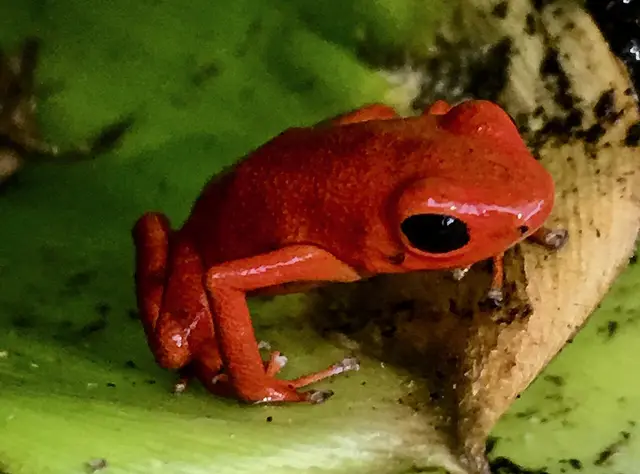
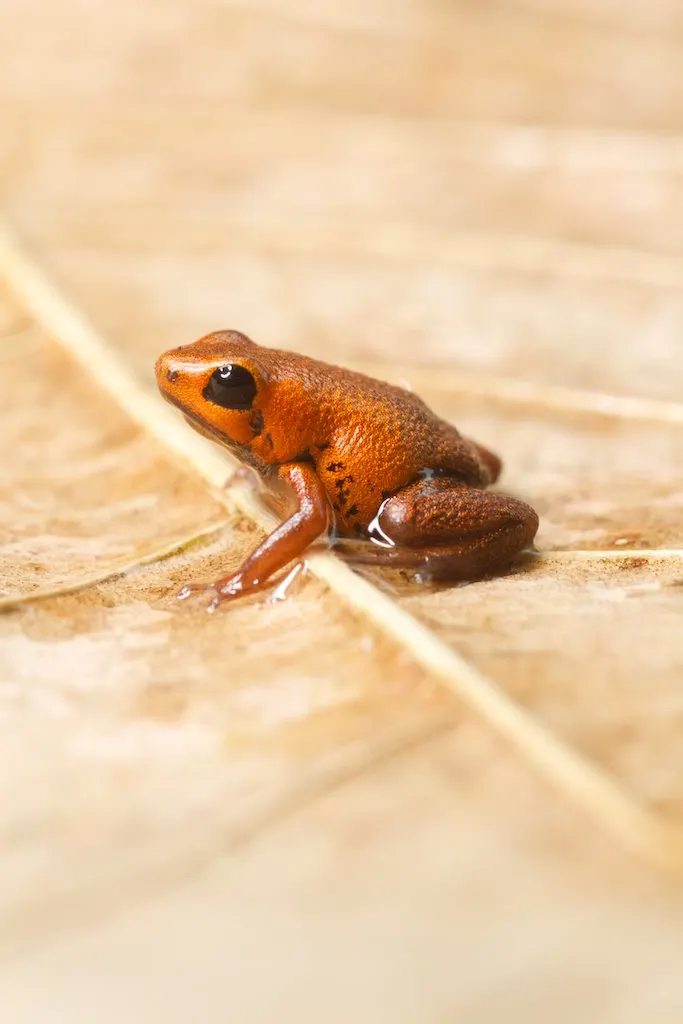
Geminis' dart frog (Andinobates geminisae) is a tiny orange poison frog known only from a small area of lowland rainforest in Panama. Described in 2014, it was assessed as Critically Endangered in 2019, and a captive population is held as insurance.
How to recognise it
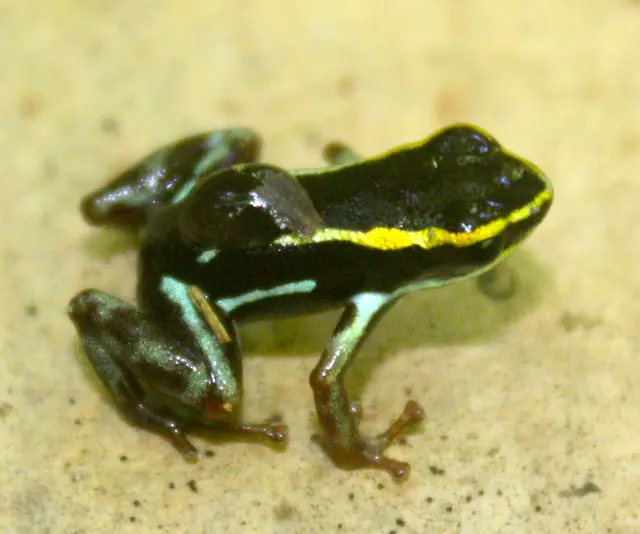
Adults are about 11 to 13 millimetres long, and the IUCN gives up to 14 millimetres. The skin is smooth and uniformly orange over the whole body. The feet have no webbing, and females are slightly larger than males.
Its advertisement call is a buzz with many pulses per note, and it differs from those of other Panamanian Andinobates. It belongs to the group around the blue-bellied poison frog, Andinobates minutus.
Where it lives
It is endemic to Panama and has been found in the Donoso district of Colón Province, between the Río Coclé del Norte and the Río Belén. The first specimen was collected on 21 February 2011 at the headwaters of the Río Caño. The IUCN counts a single location, a very small extent of occurrence of about 15 square kilometres, and an elevation of 50 to 136 metres.
The frogs shelter under rocks and logs, near tree roots and in leaf litter in lowland moist forest.
Pins are Wikidata “endemic to” fields. Orange dots, when present, are GBIF occurrence tiles — survey bias included.
How it lives
Eggs are laid in cupped leaves and in water-holding tree hollows, with bromeliads preferred. Males have been photographed carrying tadpoles on their backs.
No population size is available. The describers called for studies of its population ecology, calls, breeding biology and parental care, since so little is known.
Why it is in trouble
The IUCN reports continuing decline in habitat and rates small-holder farming and plantations as medium-impact pressures across more than 90 percent of the range, with housing and mining also listed. Copper mining, agriculture and settlement are reported to press on the Donoso region.
The chytrid fungus Batrachochytrium dendrobatidis is listed as a threat, though its effect is unclear. The describers also named collection for the pet trade as a risk to such a small population.
What is being done
The frog is part of the captive breeding programme of the Panama Amphibian Rescue and Conservation Project, which works against chytrid disease and habitat loss. At the time of the 2019 assessment, the IUCN recorded no protected area, no monitoring scheme and no recovery plan, and recommended habitat and site protection.
Sources
Written for this catalog in our own words from the sources below, checked against them on 12 November 2026. Population figures are estimates and carry the year they were made. Status and assessment year: IUCN. 2026. The IUCN Red List of Threatened Species. Version 2026-1. iucnredlist.org.