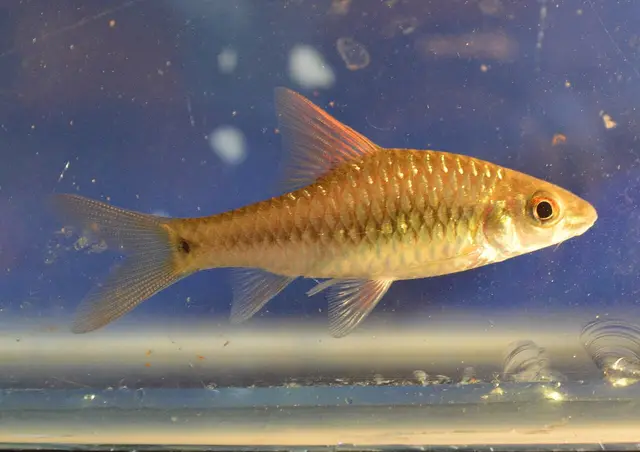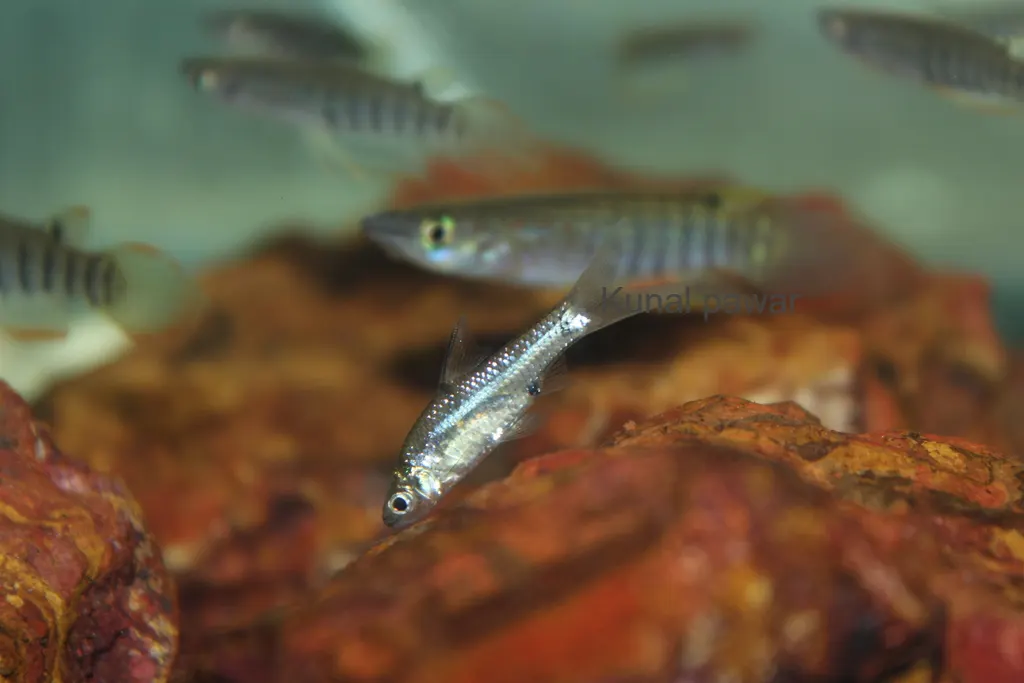
Endangered
Dharna barb
Puntius fraseri
The Dharna barb (Puntius fraseri) is a tiny freshwater fish of the hill streams of Maharashtra, western India, and it is known from a single river system. The IUCN Red List has rated it Endangered since its 2011 assessment, citing a small range and a continuing decline in the area it occupies.
How to recognise it
This is a small minnow-like barb, reaching about 4.6 cm in total length at most. It has one pair of maxillary barbels, and its body is fairly deep, about four times in standard length in the key used by Indian fish taxonomists.
It is easy to confuse with close relatives. A 1992 description of a similar barb, Puntius sharmai, separated the two by body shape: the Dharna barb has a deeper body, a larger head and shorter fins, and its lateral line pores run back to about the eighth to tenth scale.
Where it lives
The Dharna barb is endemic to India. It was described from the Darna River at Deolali near Nashik, an upper tributary of the Godavari system in the Western Ghats. Most reviews restrict it to that one river.
A 1956 report from the Panchaganga River in the Krishna system has not held up. An extensive survey of the Krishna basin in 1995 did not find the fish, and a later review considers its presence there highly unlikely. The IUCN assessment counts five locations and gives an extent of occurrence of 2,500 to 3,000 square km.
It lives in hill streams, and the IUCN lists permanent rivers and streams as its habitat.
Pins are Wikidata “endemic to” fields. Orange dots, when present, are GBIF occurrence tiles — survey bias included.
How it lives
Very little is recorded. Diet, spawning habits and lifespan have not been documented in the sources available. It is of no interest to fisheries, though local people reportedly catch it and sell it in markets.
The scientific name honours Albert Glen Leslie Fraser, reportedly an amateur herpetologist who collected the type specimen at Deolali.
Why it is in trouble
The 2011 assessment (criterion B1ab(iii)) rates the species Endangered because its range is small and the area it occupies keeps shrinking. It records the population trend as decreasing. The threats listed are sewage entering the river and an unspecified species-related threat.
The assessment names ecosystem degradation and species disturbance as the stresses on the fish. It records no recovery plan and no systematic monitoring scheme, and none of the population is in a protected area. Site protection is the action it lists.
Sources
Written for this catalog in our own words from the sources below, checked against them on 12 November 2026. Population figures are estimates and carry the year they were made. Status and assessment year: IUCN. 2026. The IUCN Red List of Threatened Species. Version 2026-1. iucnredlist.org.