Endangered
Onaç spring minnow
Pseudophoxinus ninae
The Onaç spring minnow is a small freshwater fish found only in central Anatolia, Türkiye, at three known locations. The IUCN lists it as Endangered (assessed 2023, published 2026), with a decreasing population squeezed by dams, water abstraction and drought.
How to recognise it
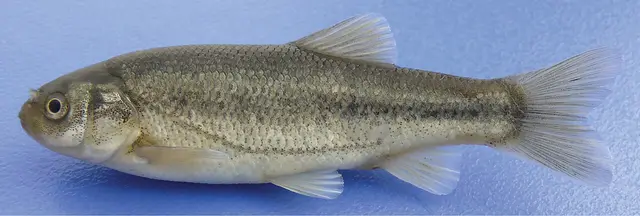
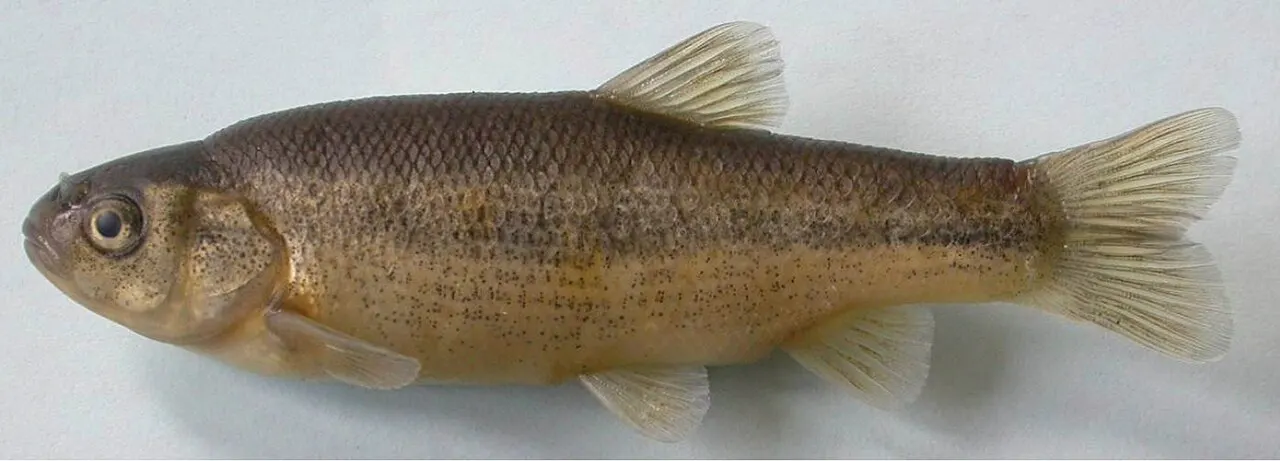
The Onaç spring minnow (Pseudophoxinus ninae) is a small member of the carp and minnow group, the Leuciscidae. FishBase gives a maximum standard length of 7.5 cm. Its lateral line is incomplete, and the lateral series has 46 to 52 scales. A faint, diffuse dark stripe runs from the eye back to the base of the tail fin.
Freyhof and Özuluğ described it as a new species in 2006, from central Anatolia. The name honours the Russian fish scientist Nina Bogutskaya, who has published widely on Anatolian Pseudophoxinus.
Where it lives
The species is known only from Türkiye. A ZooKeys study of Anatolian Pseudophoxinus gives its type locality as Onaç Stream at Bucak and also lists Kestel Swamp, a second wetland at Bucak. The IUCN counts three locations, calls the range restricted, and gives an extent of occurrence of about 100 km2.
The IUCN habitat list includes freshwater springs, permanent streams and large artificial water-storage areas. It treats the fish as a resident that does not migrate.
Pins are Wikidata “endemic to” fields. Orange dots, when present, are GBIF occurrence tiles — survey bias included.
Why it is in trouble
The 2026 assessment records a decreasing population and continuing loss of habitat area. It lists seven threats, all ongoing and all causing slow but significant declines. Small dams and pumping of groundwater for farming each affect most of the range. Drought is rated the most serious, with an effect across the whole range. Smaller threats are surface-water and domestic water abstraction, and sewage.
The assessment estimates a past population reduction of about 30%, inferred from habitat decline, and projects a further 20 to 30%. For a fish tied to springs and slow water, anything that lowers the water table or dries a channel hits hard. An earlier listing, assessed in 2013 and still shown by FishBase, put it in the higher Critically Endangered category.
What is being done
The assessment records no conservation measures already in place. It calls for protection of the species' sites and habitat, site management, action at national and sub-national level, public awareness and species recovery work. Research priorities include population trends, habitat trends, life history, threats and a recovery plan.
Sources
Written for this catalog in our own words from the sources below, checked against them on 12 November 2026. Population figures are estimates and carry the year they were made. Status and assessment year: IUCN. 2026. The IUCN Red List of Threatened Species. Version 2026-1. iucnredlist.org.