Endangered
Burdur spring minnow
Pseudophoxinus burduricus
The Burdur spring minnow (Pseudophoxinus burduricus) is a small silvery fish found only in springs, streams and lake margins around Lake Burdur and Lake Salda in southwestern Turkey. It was described in 2013. The IUCN Red List rated it Endangered in 2026.
How to recognise it
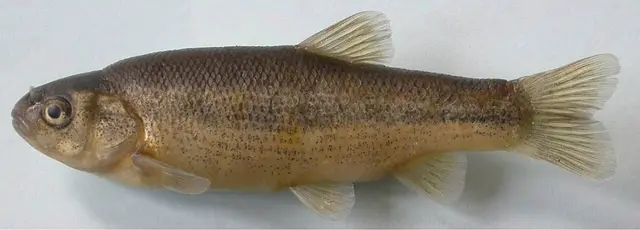
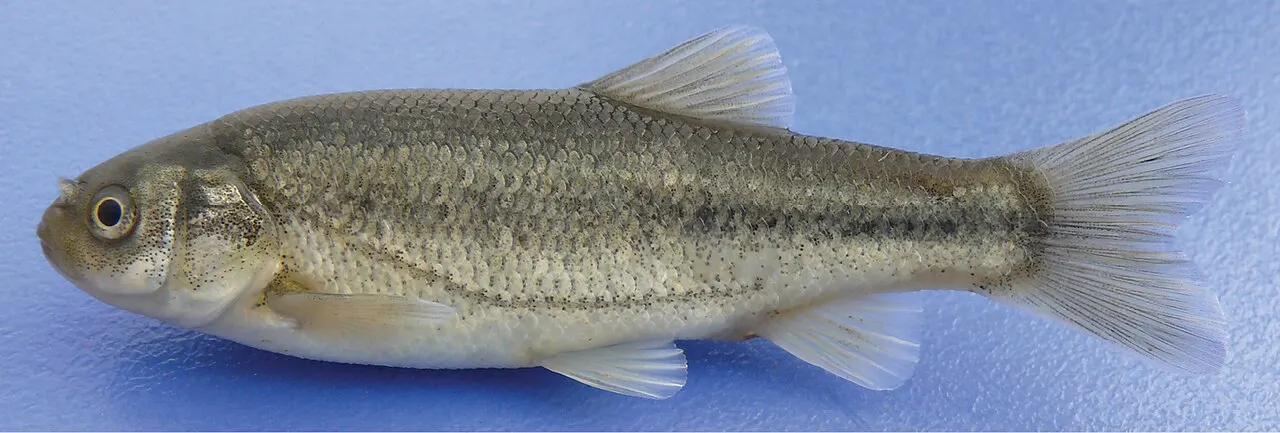
It's a small minnow. The largest specimen measured in the original description was 86.69 mm long (standard length). The body is silvery with a light brown to olive-green back, and a faint dark stripe runs from the eye to the base of the tail. Fish over 50 mm have small spots on the skin, and the fins are whitish or light grey with black-spotted rays.
The head is short and the snout rounded, with a slightly under-slung mouth. The lateral line is incomplete. Males have longer pelvic and pectoral fins and a slimmer tail base than females. In the original description, males from Lake Salda carried small bumps (tubercles) over the body and fins, while males from Degirmendere Creek had none on the head or snout.
Where it lives
It is found only in the Lake Burdur closed basin in Turkey. The 2013 description lists Degirmendere Creek, Lake Karatas, Duger and Sazak springs, Dereköy Stream, Lake Salda and Salda Stream. The IUCN assessment counts five locations and an area of occupancy of 280 square km.
Its habitats are permanent streams, freshwater springs and permanent lakes. Some of the places it lives are not natural: Karatas is an artificial lake, and Degirmendere Creek runs into a reservoir where the minnow lives along the shallow margins.
Pins are Wikidata “endemic to” fields. Orange dots, when present, are GBIF occurrence tiles — survey bias included.
How it lives
The IUCN assessment describes it as congregating year-round and not migratory. Little else is recorded about diet or breeding.
Other fish sharing its waters include Chondrostoma fahirae and the stone loach Oxynoemacheilus anatolicus. At Salda Stream the only other fish recorded was Aphanius splendens. The 2013 study separated the minnow from the similar Pseudophoxinus ninae by fin-ray and gill-raker counts and head shape.
Why it is in trouble
The IUCN lists a long set of threats, nearly all about water: water taken from rivers, springs and groundwater for farming, homes and business, small dams, drought, sewage and run-off. Two named species are also listed as threats. The 2013 paper noted that rainbow trout had escaped from fish farms into the Karamanli reservoir, where the minnow lives.
Dams have also altered its range: a reservoir built in 1970 cut off Dereköy Stream from the lake it once drained into. The IUCN records the trend as decreasing, with past habitat-driven reduction of about 20 percent and a projected 30 to 40 percent.
What is being done
The 2026 assessment lists species recovery, site protection and management, awareness work, habitat protection, policies and regulations, and control of invasive species as conservation actions needed. It records no conservation actions as in place.
Sources
Written for this catalog in our own words from the sources below, checked against them on 12 November 2026. Population figures are estimates and carry the year they were made. Status and assessment year: IUCN. 2026. The IUCN Red List of Threatened Species. Version 2026-1. iucnredlist.org.