Critically Endangered
Pseudogibbula duponti
Pseudogibbula duponti
Pseudogibbula duponti is a tiny, dark-shelled snail known from the lower Congo River in the Democratic Republic of the Congo. The IUCN Red List rates it Critically Endangered (assessed 2010) because it is known from a single location, where erosion and silt threaten its river habitat.
How to recognise it
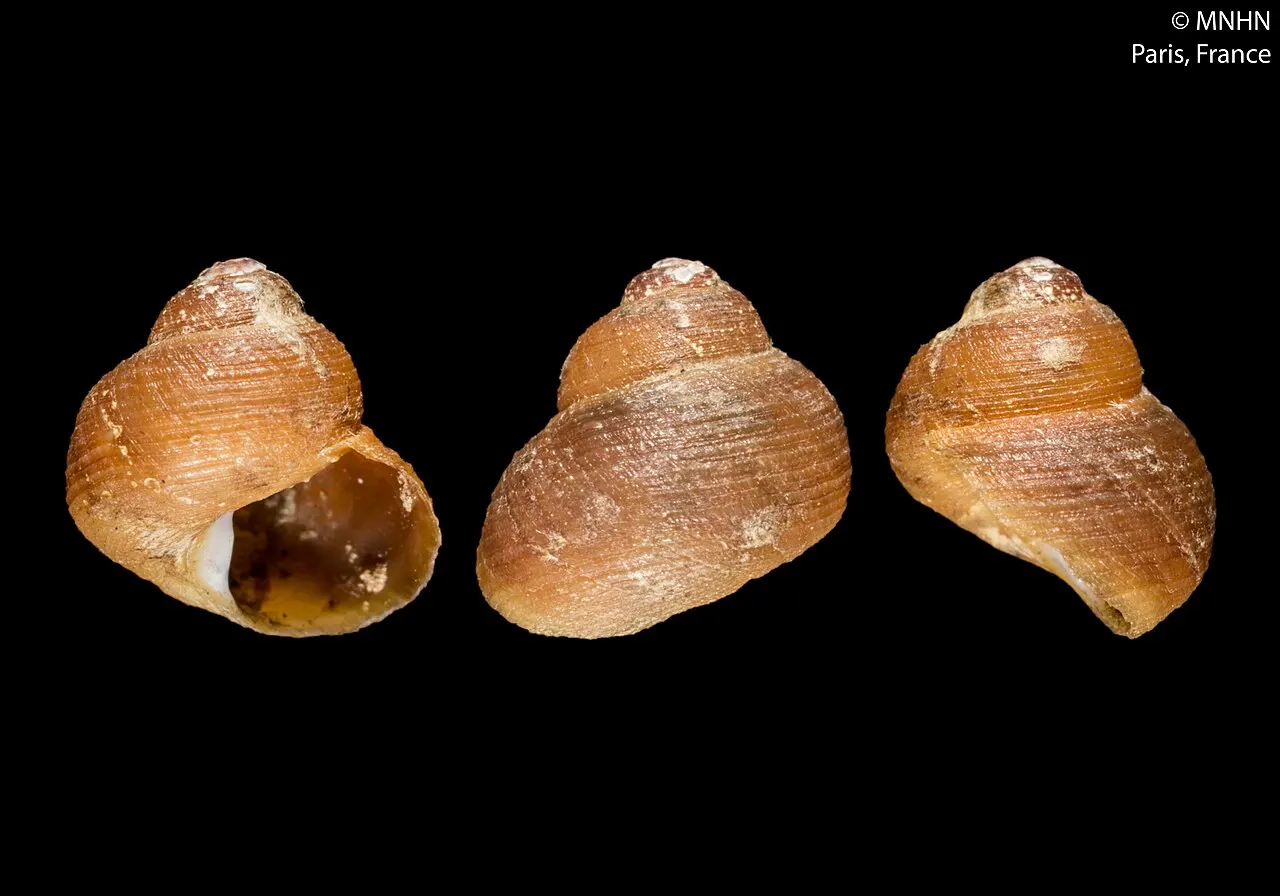
This is a small snail, with a shell about 7 millimetres long and about 7 millimetres across. The shell is thin, shaped like a cone, and has no opening in the base around the central axis. It is a uniform dark maroon-brown except for a white inner pillar.
The tip of the shell is blunt and is nearly always worn away. Three to four slightly rounded whorls make up the spire, and the last whorl has two angles. Around ten spiral cords run across the next-to-last whorl. The mouth is rhomboid, and the thin horny lid (operculum) that seals it is a clear yellowish-brown.
Where it lives
The species belongs to the family Assimineidae and is recorded from the Democratic Republic of the Congo. The French malacologist Philippe Dautzenberg described it in 1891 from shells collected in the Congo by M. É. Dupont. A topotype from Vivi, on the lower river, is held in Brussels, and a syntype is held in Paris.
Of roughly 200 occurrence records in the GBIF database, most date from 1937 and 1938. Many come from the Matadi area, including a small island called Kalawanga, rocks across from Matadi port, and Vivi. The IUCN lists its habitat as permanent rivers and streams, including waterfalls. A few records in the same database lie across the border in Angola (2) and the Republic of the Congo (1), though the IUCN assessment lists the DRC alone.
Pins are Wikidata “endemic to” fields. Orange dots, when present, are GBIF occurrence tiles — survey bias included.
Why it is in trouble
The 2010 assessment counts one location for the species. Among its threat entries are soil erosion and sedimentation, scored as a future, low-impact threat, plus other threats of unrecorded type, and the stress listed for all of them is ecosystem degradation.
Its population trend is listed as unknown, and no population size has been estimated. The records on file are old, and the IUCN criterion used (B1ab(iii)) concerns a small range with declining habitat quality, not a count of animals.
What is being done
The assessment records no conservation actions in place. Nothing in the sources describes a recent survey of the river reaches where the species was collected, so whether it still survives there is not documented.
Sources
Written for this catalog in our own words from the sources below, checked against them on 12 November 2026. Population figures are estimates and carry the year they were made. Status and assessment year: IUCN. 2026. The IUCN Red List of Threatened Species. Version 2026-1. iucnredlist.org.




