Endangered
Pseudogaurotina excellens
Pseudogaurotina excellens
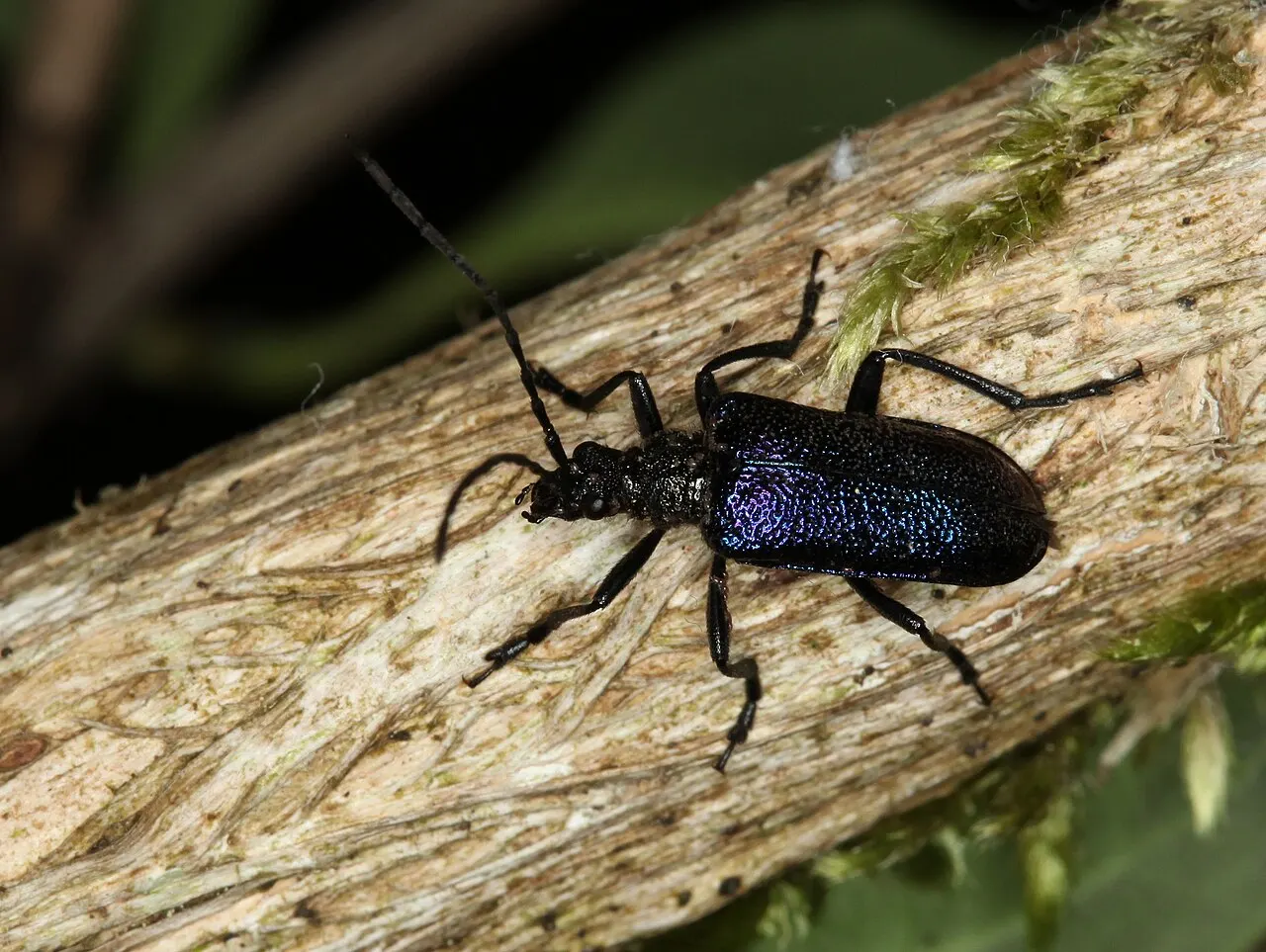
Pseudogaurotina excellens is a long-horned beetle found only in the Carpathian mountains, where its larvae develop in black honeysuckle growing in bright gaps in spruce and fir forest. The IUCN Red List rated it Endangered in 2017, with numbers declining and populations split into pockets.
How to recognise it
This is a flower longhorn, a member of the subfamily Lepturinae. Adults are usually found sitting on the leaves of the host shrub, black honeysuckle (Lonicera nigra), and are reportedly fed on it too. Adults swarm around the shrubs.
It was first named by Brancsik in 1874, under the genus Gaurotes, and has also been placed in Pachyta. Older literature may use either name.
Where it lives
It is a Carpathian endemic, and Polish monitors describe it as a relic from the Tertiary, an ancient lineage. The Red List records it from Poland, Slovakia, Romania and Ukraine. Museum and observation records include the High Tatras in Slovakia, the Polish Tatras and Babia Góra in Poland, and the Svydovets range in Ukraine, where a specimen was recorded in 1922.
The Red List gives its area of occupancy as about 260 square km, within a much larger extent of occurrence of roughly 142,800 square km. In other words, it is spread thinly over a large region but occupies only small patches. The habitats listed are temperate forest and shrubland. In Poland it is tied to mountain spruce and fir forest, with sites in the Tatras and Babia Góra. It was also reported from the Pieniny in the past.
Pins are Wikidata “endemic to” fields. Orange dots, when present, are GBIF occurrence tiles — survey bias included.
How it lives
The larvae feed inside black honeysuckle. A Polish survey of 21 sites in 2006 and 2007 found more than 1,500 honeysuckle shrubs, around 120 of them bearing larval galleries. Roughly 200 old galleries dated from the previous decade and about 20 were still occupied. Only 11 adult beetles were seen.
The beetle prefers bright, open spots. Big shrubs with a trunk base about 10 cm thick held the most galleries, while small ones carried only one or two.
Why it is in trouble
The beetle is only as secure as its shrub. In the Tatras, storm-felled and bark-beetle-damaged spruce forest first lets light in, and honeysuckle and the beetle often boom for two or three years. Then light-loving plants take over and the beetle collapses. On Babia Góra and elsewhere, young beech trees and closing tree canopies shade the honeysuckle out.
The Red List also names recreation, collecting and small-holder grazing and farming as threats. Polish monitors in 2006 and 2007 judged the extent of collecting impossible to measure but potentially serious, since systematically catching swarming adults could wipe out a small site within a few years. Their 2023 report describes trampling by walkers and collecting as marginal, limited to shrubs beside trails.
What is being done
The beetle has long been protected in Poland, and all but one of the 22 sites monitored in 2023 lie inside national parks or nature reserves. That monitoring rated the beetle's conservation status in the Polish Carpathians as bad overall, though the report's author judged it stable and in no immediate danger. Populations in the Tatras and on Babia Góra have held steady or crept upward over nearly 20 years, with several adults on one shrub for the first time. The beetle could not be found again in the Małe Pieniny.
Hands-on conservation has been minimal, mostly minor work protecting the best honeysuckle clumps on Babia Góra and some patrols along tourist trails during the swarming season. Recommendations include clearing shade around key shrubs and more frequent patrols when adults emerge.
Sources
Written for this catalog in our own words from the sources below, checked against them on 12 November 2026. Population figures are estimates and carry the year they were made. Status and assessment year: IUCN. 2026. The IUCN Red List of Threatened Species. Version 2026-1. iucnredlist.org.




