Critically Endangered
Pseudobithynia euboeensis
Pseudobithynia euboeensis
Pseudobithynia euboeensis is a tiny freshwater snail found only on the Greek island of Euboea (Evia), where it lives in a vegetated stream near Marmari. The IUCN Red List rated it Critically Endangered in its 2026 publication, with a known range of about 4 square km and a population that is shrinking.
How to recognise it
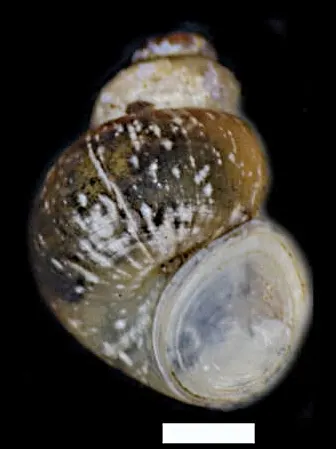
This is a small, glossy snail with a light brown to horn-coloured shell, finely striated, with four and a half to five slightly rounded whorls and a deep seam between them. Adults measure roughly 5.5 to 6.5 mm tall and 4.3 to 4.5 mm wide. The opening takes up about half the shell's height.
It is easily confused with a close relative, Pseudobithynia zogari, which also occurs on Euboea. The two are told apart by the lid (operculum) that seals the shell, which is not coiled in this species, and by the male organ, which is broad with a small tip.
Where it lives
The snail was first collected in April 1985 and described in 2010 by Peter Glöer, Andrzej Falniowski and Vladimir Pešić. The original site was a damp meadow with small pools, fed by a spring beside the sea near Marmari.
That spring dried up. By 2003 its water was being taken off with pumps and the habitat was gone. A later paper says the water went for irrigation. For years the species was known only from that site. On 26 November 2012, researchers found it again in a stream dense with water plants (cress and a relative of celery), on coastal flats 3.2 km northwest of Marmari. Some snails were on plant material and others under stones. The Red List assessment lists streams and springs as its habitat, counts a single location, and estimates the area it occupies at only 4 square km. The species is endemic to Greece.
Pins are Wikidata “endemic to” fields. Orange dots, when present, are GBIF occurrence tiles — survey bias included.
Why it is in trouble
Water is the problem. The assessment rates the taking of surface water for domestic use as the main ongoing threat, affecting essentially the whole population, with a medium impact and slow but significant declines. Drought is also listed as ongoing, though its effect is unknown. Tourism and recreation areas are judged a lower, minority threat. A 2013 survey of Greek freshwater snails noted that the stream where the snail was refound is probably influenced by summer tourism.
Because it is known from a single small area, local loss of water puts the whole species at risk.
What is being done
The assessment lists site protection, site management and habitat restoration as the actions needed. It records that it is unknown whether the snail lives in any protected area, and that it is not covered by international legislation or trade controls. The same 2013 survey, which recorded this species at its new site, concluded that the Red List status of some Greek endemic freshwater snails needed updating.
Sources
Written for this catalog in our own words from the sources below, checked against them on 12 November 2026. Population figures are estimates and carry the year they were made. Status and assessment year: IUCN. 2026. The IUCN Red List of Threatened Species. Version 2026-1. iucnredlist.org.




