Endangered
Pseudobatos percellens
Pseudobatos percellens
The chola guitarfish (Pseudobatos percellens) is a flat, shark-like ray of shallow sandy and muddy seabeds along the western Atlantic coast. The IUCN Red List assessed it as Endangered in 2020 after estimating a decline of 50 to 79 percent, driven mainly by fishing.
How to recognise it
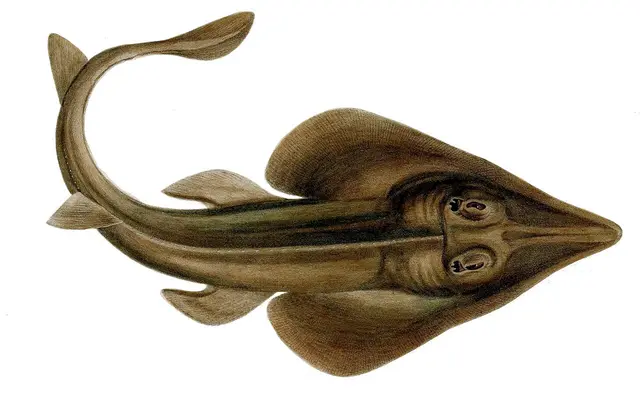
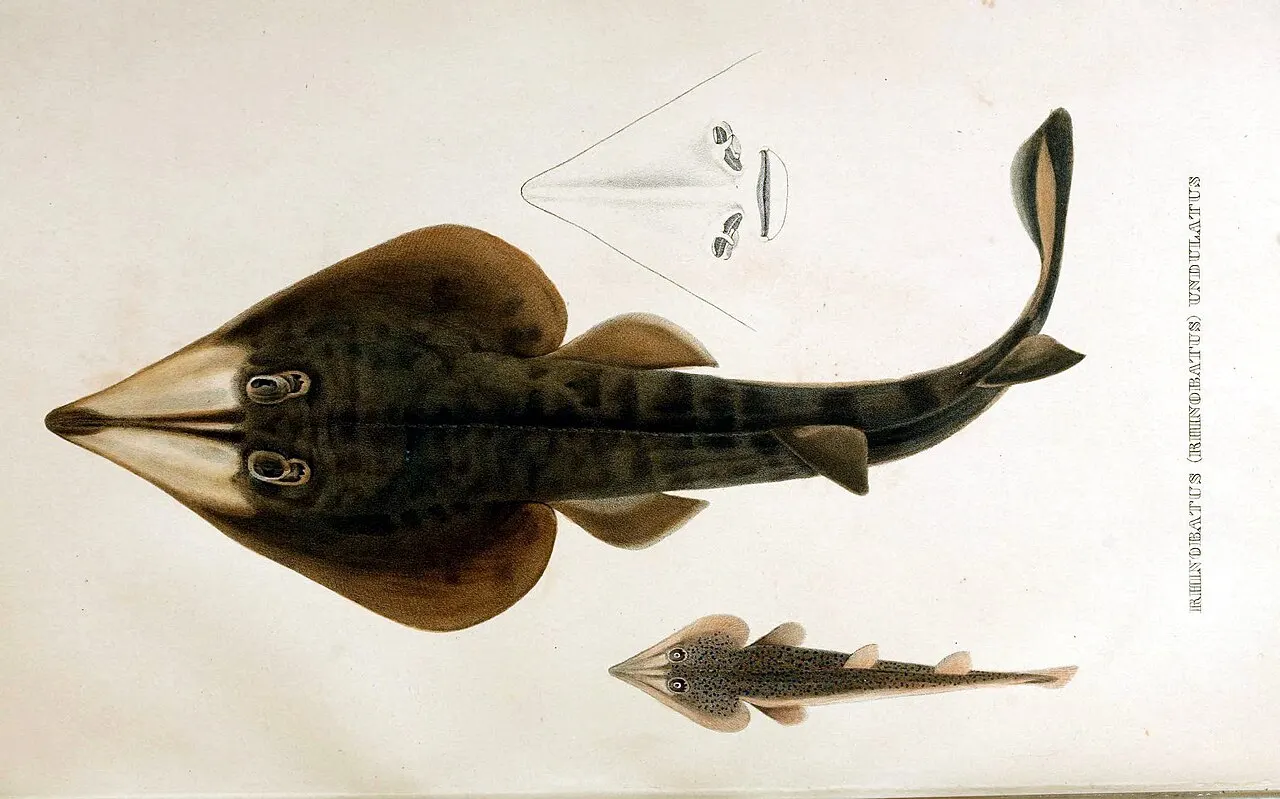
A guitarfish has the flattened front of a ray and the long tail and body of a shark. The chola guitarfish is olive grey, reddish brown or chocolate brown above, with darker blotches on the sides. Its underside is pale yellowish to dusky white, often with a dark smudge at the snout tip. FishBase gives a maximum length of 100 centimetres, with 70 centimetres more typical.
Where it lives
It lives on soft bottoms in shallow water, at depths from the surface to about 110 metres and usually less than 80 metres. The IUCN lists 19 countries and territories, from Guatemala, Mexico, Costa Rica and Panama through Colombia, Venezuela and the Guianas to Brazil, along with Caribbean islands such as Jamaica, Barbados and Trinidad and Tobago. FishBase also gives a southern limit near Mar del Plata, Argentina.
Pins are Wikidata “endemic to” fields. Orange dots, when present, are GBIF occurrence tiles — survey bias included.
How it lives
Females give birth to live young. The embryos feed first on yolk, then on nourishing uterine fluid. FishBase puts length at first maturity near 55 centimetres.
A 2019 study in the Journal of Fish Biology (Caltabellotta and colleagues) read growth bands in the vertebrae of three Brazilian guitarfish species, this one included, and found one band pair forms each year, from late winter to late spring. The IUCN gives a generation length of about 10 years, and FishBase calculates a minimum population doubling time of 4.5 to 14 years, so it recovers slowly after fishing.
Why it is in trouble
Fishing is the main cause. The IUCN lists bycatch in large-scale and small-scale fisheries and deliberate small-scale harvest, each with slow, significant declines. It estimated a past reduction of 50 to 79 percent. Coastal development, run-off, sewage, pesticides and sedimentation add lower-level pressure on its seabed habitat.
The fish is used as food, though FishBase calls the flesh low quality, and it is also sold for aquariums, for example in Ceará, Brazil.
What is being done
The IUCN lists harvest and trade management, species recovery and national-level measures among actions needed. It records no recovery plan, monitoring scheme or harvest management plan, and whether the species occurs in a protected area is unknown.
A 2023 genetic study in Diversity (Cruz and colleagues) used 3,329 DNA markers on fish from the Brazilian coast and found at least two distinct lineages, one in the north and northeast and one in the southeast and south, with a possible third. The team recommends managing populations separately and reviewing the taxonomy.
Sources
Written for this catalog in our own words from the sources below, checked against them on 12 November 2026. Population figures are estimates and carry the year they were made. Status and assessment year: IUCN. 2026. The IUCN Red List of Threatened Species. Version 2026-1. iucnredlist.org.