Critically Endangered
Brazilian guitarfish
Pseudobatos horkelii
The Brazilian guitarfish (Pseudobatos horkelii) is a ray with a shark-like tail that lives over sandy and muddy seabed on the shelf of southern South America. The IUCN Red List rated it Critically Endangered in 2020 after catches collapsed. Many of the fish caught inshore are pregnant females.
How to recognise it
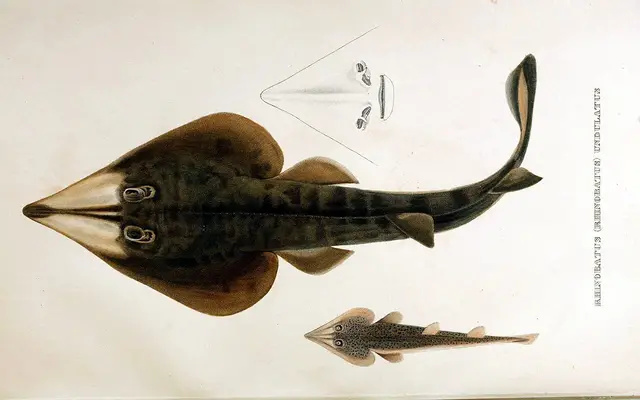
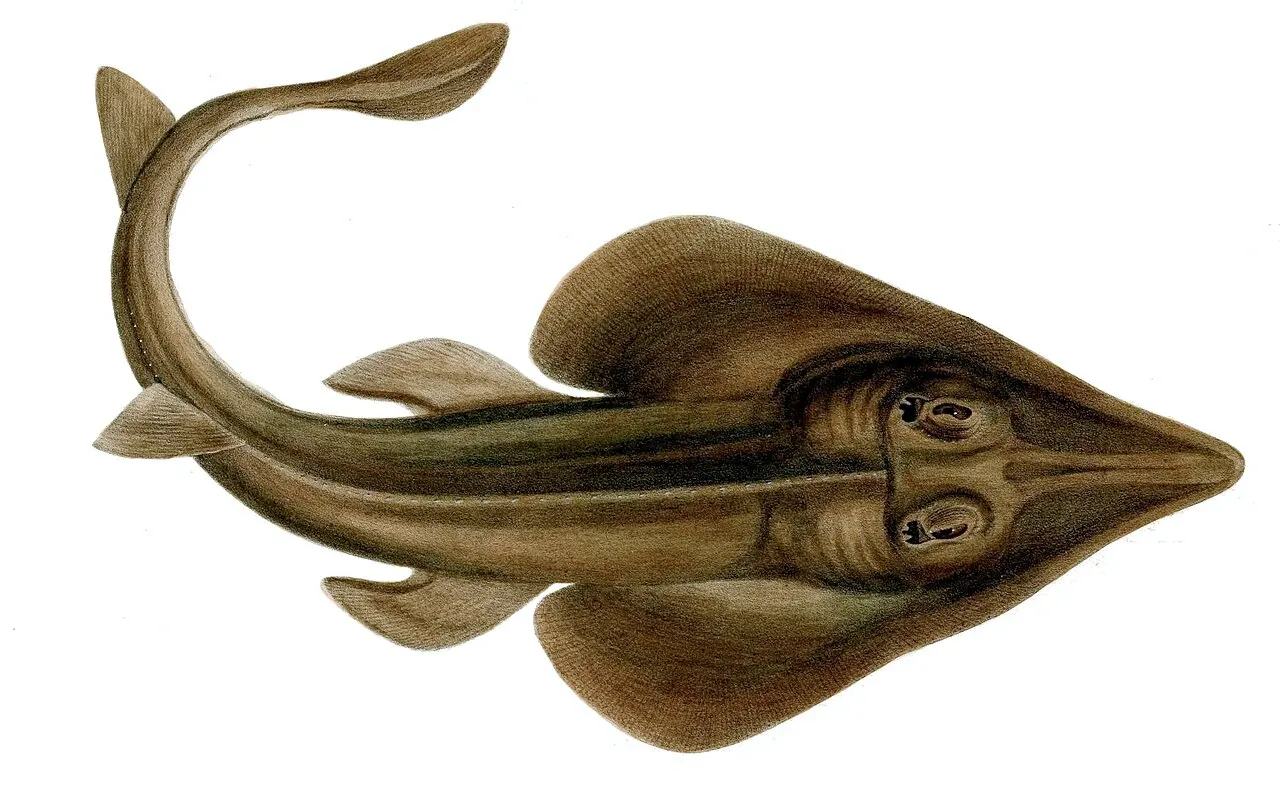
Like other guitarfishes, it has a flattened front half and a thick, shark-like tail. The upper surface is a plain olive-grey or brown, with a dark patch on the snout. Adults are usually around 60 cm long, though the largest recorded reach about 138 cm.
Where it lives
It ranges from the coast of Bahia in Brazil south to Uruguay and Argentina, and the IUCN assessment lists all three countries. Some descriptions call it endemic to Brazil, so its limits are described differently depending on the source.
It stays on sandy, sandy-mud and muddy bottoms of the continental shelf and in estuaries, from the surface down to about 150 m. A 2023 paper in a Uruguayan zoological journal describes it as a year-round resident, with high abundance only on the southern Brazilian shelf.
Pins are Wikidata “endemic to” fields. Orange dots, when present, are GBIF occurrence tiles — survey bias included.
How it lives
Pups develop inside the mother, fed at first from a yolk sac. On the southern Brazilian shelf the breeding cycle is synchronised across the population, and births fall in February and March. Females can mate again soon after giving birth, so a new pregnancy starts straight away.
Litters run from 4 to 12 pups. Reportedly, mating happens on the inner shelf in March, the fertilised eggs stay dormant until the female returns to shallow water in November, and pups are about 29 cm at birth.
Estimates of the age at which females mature range from about 4 years to 9 years, and the IUCN assessment gives a generation length of 18.5 years. Either way, a population recovers slowly once it has been cut down.
Why it is in trouble
The threat is fishing, both targeted and accidental, by large and small-scale fleets. Trawls, beach seines and gillnets all take it. The inner shelf is a nursery, and in the warmer months the adults that come inshore to breed are mostly pregnant females, which makes them easy to catch in large numbers.
Landings in Rio Grande do Sul, in southern Brazil, rose from 842 tonnes in 1975 to 1,804 tonnes in 1984, then fell to 157 tonnes by about 2001 or 2002, depending on the source. The population there is reported to have fallen by more than 80 percent since 1986, and the IUCN lists the overall trend as decreasing.
What is being done
Brazilian national law prohibits catching the species in Rio de Janeiro, São Paulo, Paraná, Santa Catarina and Rio Grande do Sul, according to the 2023 Uruguayan paper. Even so, accidental and illegal catches continue, and DNA studies have detected them. A university project working with the state environmental patrol in Rio Grande do Sul aims to enforce the bans on catching and landing endangered sharks and rays.
The IUCN assessment lists harvest management, trade management and site protection among the actions needed, and records no recovery plan and no systematic monitoring scheme in place.
Sources
Written for this catalog in our own words from the sources below, checked against them on 12 November 2026. Population figures are estimates and carry the year they were made. Status and assessment year: IUCN. 2026. The IUCN Red List of Threatened Species. Version 2026-1. iucnredlist.org.