Critically Endangered
Red-and-black Giant Skink
Pseudoacontias menamainty
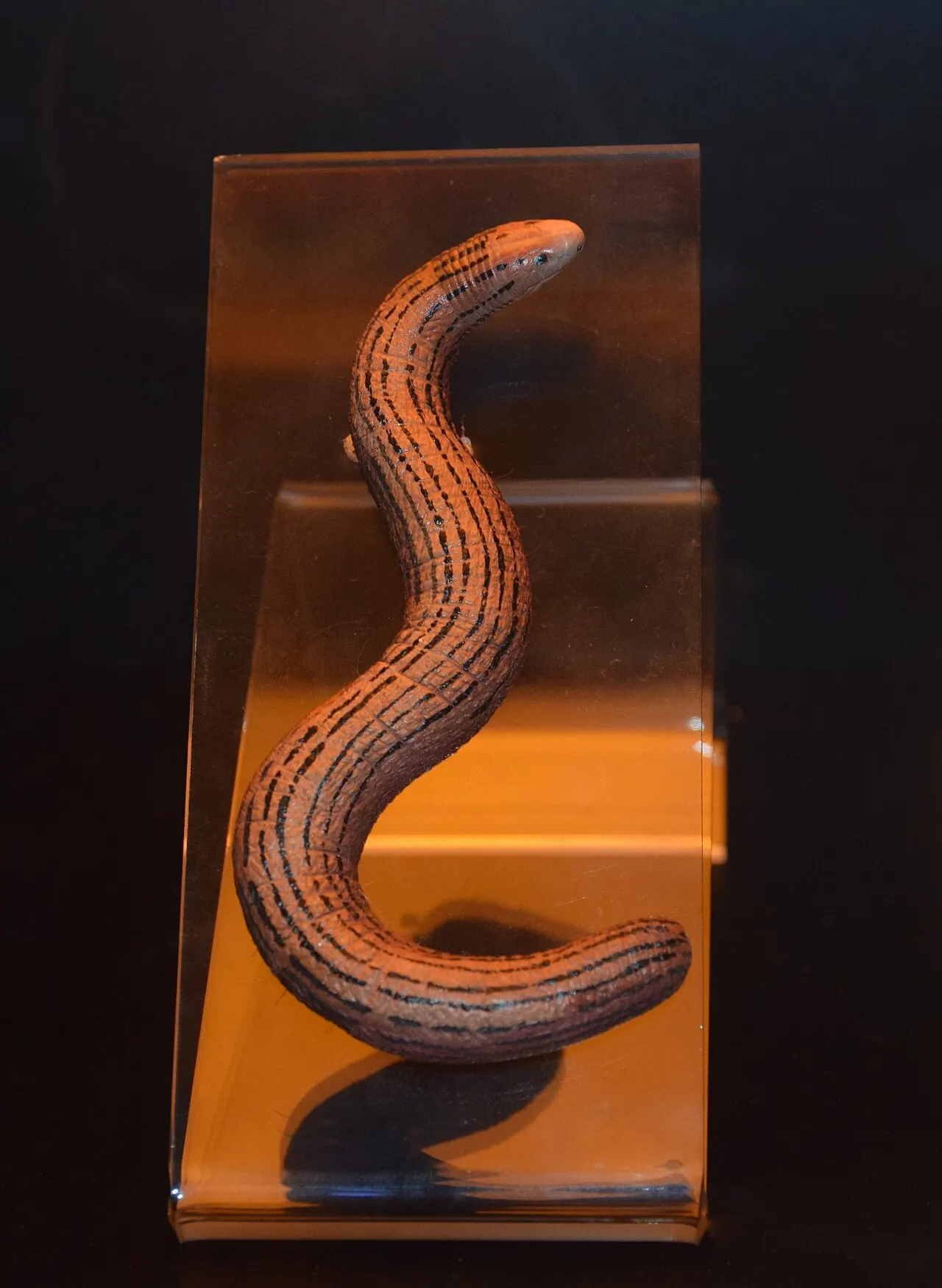
The red-and-black giant skink (Pseudoacontias menamainty) is a legless, burrowing lizard known only from the Sahamalaza Peninsula in northwest Madagascar. The IUCN Red List classed it as Critically Endangered in 2011. Only one specimen has ever been recorded, so almost nothing is known about how it lives.
How to recognise it
This is a skink that has given up its legs. It has no hind limbs at all, and each front limb is reduced to a single button-like scale. No ear openings are visible, which suits an animal that probably lives underground or in leaf litter.
Its species name joins two Malagasy words, one for red and one for black, and refers to the red and black stripes it shows in life. Scientists identify it by counting: 25 rows of scales around the middle of the body, five scales along the upper lip and four along the lower, and 67 vertebrae in front of the pelvis. No body size has been published in the sources available.
Where it lives
The one known specimen came from Berara Forest on the Sahamalaza Peninsula, at about 170 metres above sea level. The IUCN assessment describes the habitat as lowland forest and counts a single location, with a likely range of under 100 square kilometres.
The peninsula is now part of the Sahamalaza-Iles Radama National Park, which became a protected area in 2007 and is also a UNESCO Biosphere Reserve. The forest there is dense, semi-deciduous dry forest, but no large connected stretch of intact primary forest remains, and every surviving patch shows some human disturbance.
Pins are Wikidata “endemic to” fields. Orange dots, when present, are GBIF occurrence tiles — survey bias included.
How it lives
Very little is recorded. The species was formally described in 2002 by Franco Andreone and Allen Greer, and the single specimen is catalogued as MRSN R1826. The assessment says the lizard is probably burrowing and may be active at night in leaf litter, and that its body form hints at a diet of earthworms. These are inferences, not observations.
The Reptile Database lists the species as egg-laying, but only by inference from its relatives. Population size and trend are unknown.
Why it is in trouble
The Red List assessment lists shifting agriculture, where forest is cleared and burned for fields, and small-scale subsistence harvesting that affects the animal unintentionally. It records conversion and degradation of its forest habitat as the resulting pressures. Land clearance around the type locality is the basis for the Critically Endangered listing.
With a single record, nobody can say whether the lizard still survives at Berara or lives elsewhere in the peninsula's remaining forest.
What is being done
The species occurs within a protected area, and site and area management is the only conservation action recorded. The assessment says it is not known how well the area is managed in practice and calls for better management. It also calls for surveys to relocate the skink at Berara and nearby, and no species-specific programme exists.
Sources
Written for this catalog in our own words from the sources below, checked against them on 12 November 2026. Population figures are estimates and carry the year they were made. Status and assessment year: IUCN. 2026. The IUCN Red List of Threatened Species. Version 2026-1. iucnredlist.org.




