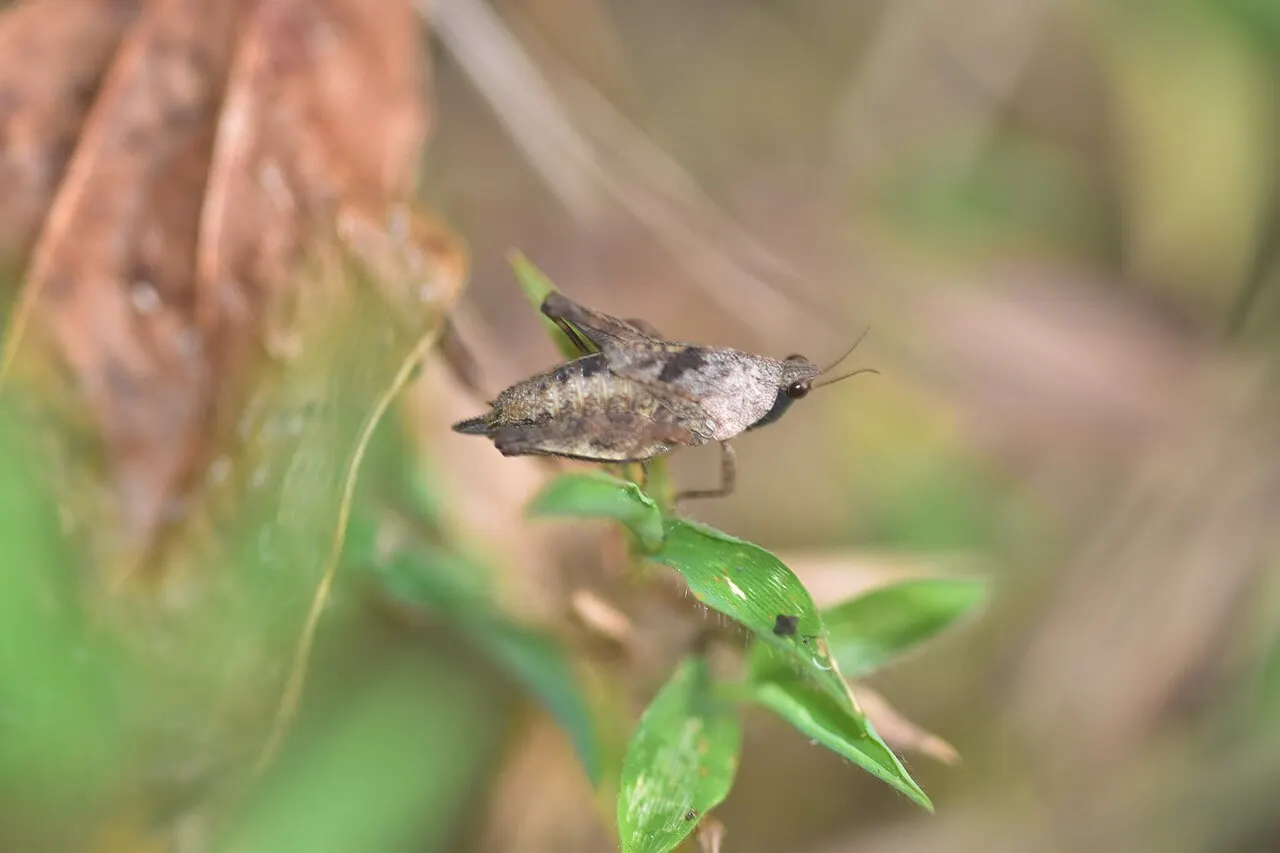
Critically Endangered
Small Snout Pygmy Grasshopper
Procytettix hova
Procytettix hova, listed by the IUCN as the Small Snout Pygmy Grasshopper, is a tiny insect known only from Madagascar. It was rated Critically Endangered in 2017, with a decreasing population, a single known location and almost nothing published about its way of life.
What kind of insect it is
It belongs to the pygmy grasshoppers (Tetrigidae), a family of small, often well-camouflaged insects. Across the family, adults are typically under 20 mm long and wear a long, pointed shield over the back (the pronotum) that can stretch over the abdomen. Many tetrigids feed on algae, moss, fungal threads and decaying plant matter. Those are family traits, and little has been recorded about this species in particular.
Procytettix hova was named by the entomologist J. A. G. Rehn in 1937, in a paper on new and little-known Madagascar grouse-locusts published in the Proceedings of the Academy of Natural Sciences of Philadelphia. The English name comes from the IUCN. Detailed descriptions of its body, behaviour and life cycle are hard to find.
Where it lives
The IUCN lists Madagascar as the only country and treats the species as living in a restricted area, counted as one location. It puts the area it occupies at about 16 square kilometres and its overall range at about 19. Its habitat is recorded as tropical and subtropical moist montane forest, and it is classed as not migratory.
Citizen-science records help fill in the map. Research-grade iNaturalist observations on GBIF, made in 2021 and 2024, fall in east-central Madagascar at roughly 18.6 to 19.0 degrees south, in the Toamasina and Antananarivo provinces. The public coordinates are deliberately blurred by about 30 km because the species is threatened. One 2021 observation was described as a last-stage nymph, and eight of the 2024 observations date from November.
Pins are Wikidata “endemic to” fields. Orange dots, when present, are GBIF occurrence tiles — survey bias included.
Why it is in trouble
The 2017 assessment records a shrinking population and continuing decline in habitat. The listed pressures are recreational activities and unintentional effects of small-scale harvesting, and the harm is described as conversion and degradation of the ecosystem, plus reduced reproductive success.
The Critically Endangered rating rests on criterion B1ab(iii,v), which covers a very small range, few locations and continuing decline in habitat quality and in numbers.
What is being done
The assessment records that the species occurs in at least one protected area, and it names site protection and site management as the actions needed. At the time of that assessment there was no species recovery plan, no systematic monitoring scheme and no invasive species control for it.
Sources
Written for this catalog in our own words from the sources below, checked against them on 12 November 2026. Population figures are estimates and carry the year they were made. Status and assessment year: IUCN. 2026. The IUCN Red List of Threatened Species. Version 2026-1. iucnredlist.org.




