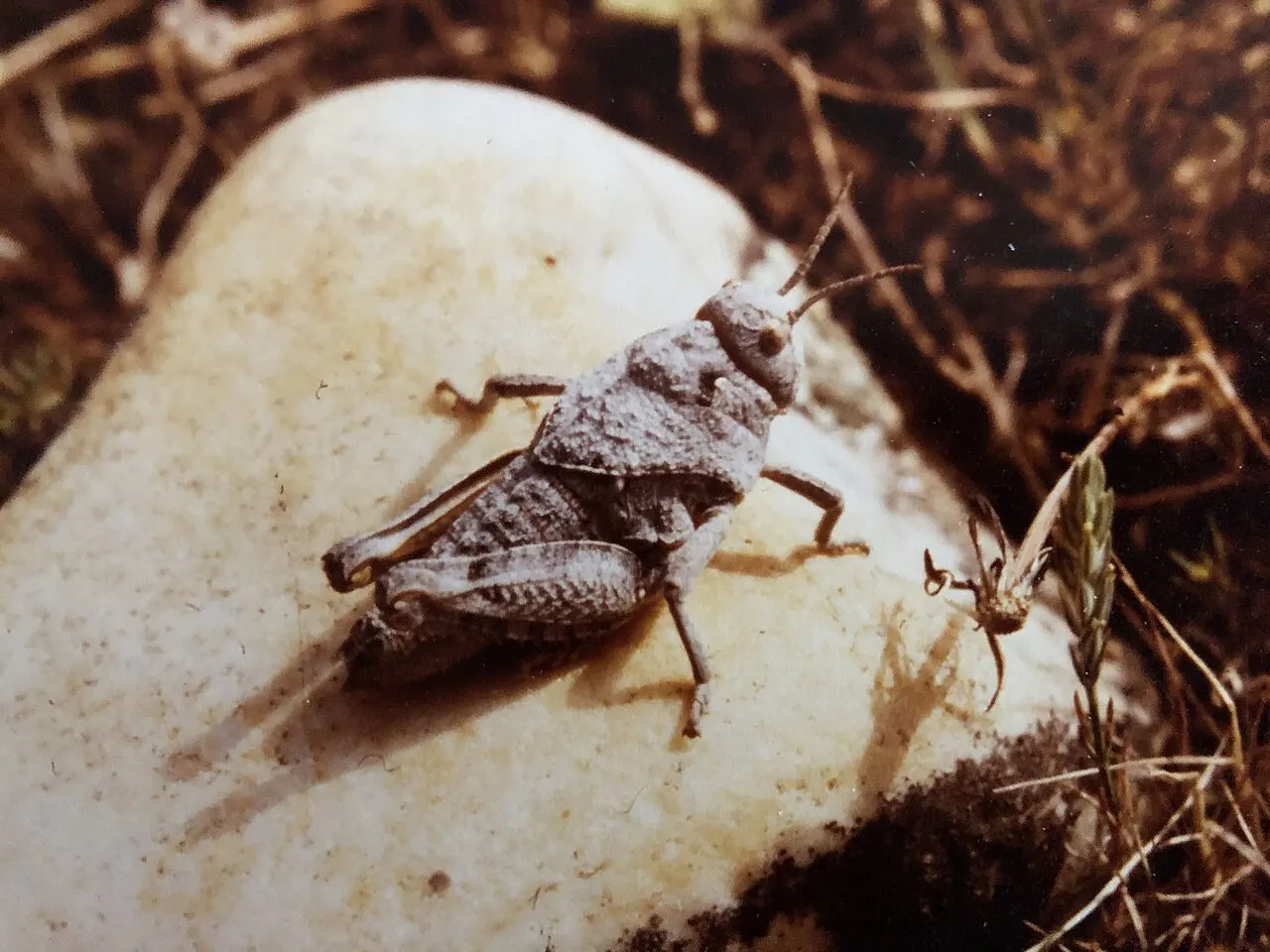
Critically Endangered
Crau Stone Grasshopper
Prionotropis rhodanica
The Crau plain grasshopper (Prionotropis rhodanica) is a large, flightless grasshopper found only on the Crau, a stony dry steppe in the south of France. The IUCN Red List rated it Critically Endangered in 2016. Only three small populations remain, and zoos and conservationists now breed and release it.
Where it lives
This species is endemic to the coussoul, the stony dry steppe of the Crau plain in Bouches-du-Rhone, and has been recorded nowhere else. The IUCN assessment lists temperate grassland and pastureland as habitat, gives an extent of occurrence of about 40 square km and an area of occupancy of 12 to 16 square km, and treats the whole range as a single location. A 2024 technical dossier from the regional nature conservancy estimates that over 90 percent of the species' known distribution was lost in the past 25 to 30 years.
It is a big insect: females reach about 45 mm in body length and males about 31 mm. Studies of the sites it still holds found it needs roughly 50 to 70 percent plant cover, mostly for feeding, and that occupied sites have denser, taller vegetation than the stonier, barer ground where it has vanished.
Pins are Wikidata “endemic to” fields. Orange dots, when present, are GBIF occurrence tiles — survey bias included.
How it lives
The grasshopper has one generation a year. Nymphs hatch in April, adults appear at the end of May and can be found until early July. Females lay their eggs in capsules called oothecae, in June in captivity. Wild females lay about 3 or 4 capsules in a season, while captive females have laid up to 14.
Captive breeding has taught keepers a good deal. Eggs incubated in the ground in outdoor breeding enclosures hatched at rates of 50 to 80 percent, while eggs kept indoors hatched at 0 to 12.5 percent. Keepers therefore alternate indoor rearing of nymphs and adults with burying the egg capsules in the steppe.
Some embryos may need two years to develop instead of one. Hatching from eggs incubated for two years was recorded in 2016, 2020 and 2023, though the dossier says this still needs confirming.
How many there are
The species declined sharply over the 20th century as steppe was turned into meadows, orchards, olive groves and industrial land, and it has fallen further since 2000 even inside the national nature reserve. The 2016 assessment suspected a 70 percent reduction over ten years and judged the total population likely to be under 5,000 mature individuals, with extreme swings in numbers from year to year. The remaining subpopulations are isolated by roads, and the insect cannot fly to recolonise lost sites.
Only three population cores are known today, at Calissane (the largest), Peau de Meau and BMW. A first mark and recapture count in one reserve population found just 38 mature adults. After the area was fenced against grazing during the nymph and adult season (April to June), an IUCN specialist group reports an estimated 673 individuals there in 2023. Exact sizes are uncertain: the 2024 dossier notes that estimates differ widely depending on the statistical model, giving 216 or 810 for Peau de Meau in 2023.
Why it is in trouble
The EU project that funds recovery work names four problems: a very small population, destruction of the steppe, climate change that may have reduced the steppe's resilience to traditional sheep grazing, and predation by flocks of insect-eating birds. Cattle egrets, jackdaws, rooks and lesser kestrels, whose numbers have grown on the Crau, are the birds of concern.
The Red List assessment adds that one remaining population lives on a military area and another on a car training course where a new road was planned. It describes the causes of decline inside the reserve as poorly understood, with predation, sheep medication, changes in grazing and droughts during the egg period all under study.
What is being done
A conservation strategy was drafted with the IUCN in 2014. Captive breeding has run since 2015 with zoos, and the LIFE SOS Crau Grasshopper project, coordinated by the regional nature conservancy CEN PACA with Zoo La Barben, the Bouches-du-Rhone chamber of agriculture and the Besancon zoo, runs from September 2021 to December 2026. Its targets include grazing management on at least 1,400 hectares, about 50 hectares of reopened habitat, and releases of 80 to 100 grasshoppers at each of 2 or 3 new sites.
The 2024 dossier planned first releases at two sites inside the national reserve, using temporary mobile fences to keep out sheep and birds. Because the breeding stock could not supply enough animals, it set a minimum of 60 captive-raised grasshoppers a year, topped up with wild adults from Calissane and buried egg capsules. The long-term aim is 10 wild population cores in 15 to 20 years. A translocation to a site where the species once lived took place in 2024, and how well the released animals survive has not been reported yet.
Sources
Written for this catalog in our own words from the sources below, checked against them on 12 November 2026. Population figures are estimates and carry the year they were made. Status and assessment year: IUCN. 2026. The IUCN Red List of Threatened Species. Version 2026-1. iucnredlist.org.
- IUCN Red List assessment (2016)
- LIFE SOS Crau Grasshopper project page, European Commission
- IUCN SSC Grasshopper Specialist Group, Recovery of the Crau Plain Grasshopper
- CEN PACA technical dossier, translocation of the Crau grasshopper (2024)
- Broder et al. 2018, Intensive grazing as a threat in protected areas, Oryx




