Endangered
Rio Concepcion Topminnow
Poeciliopsis jackschultzi
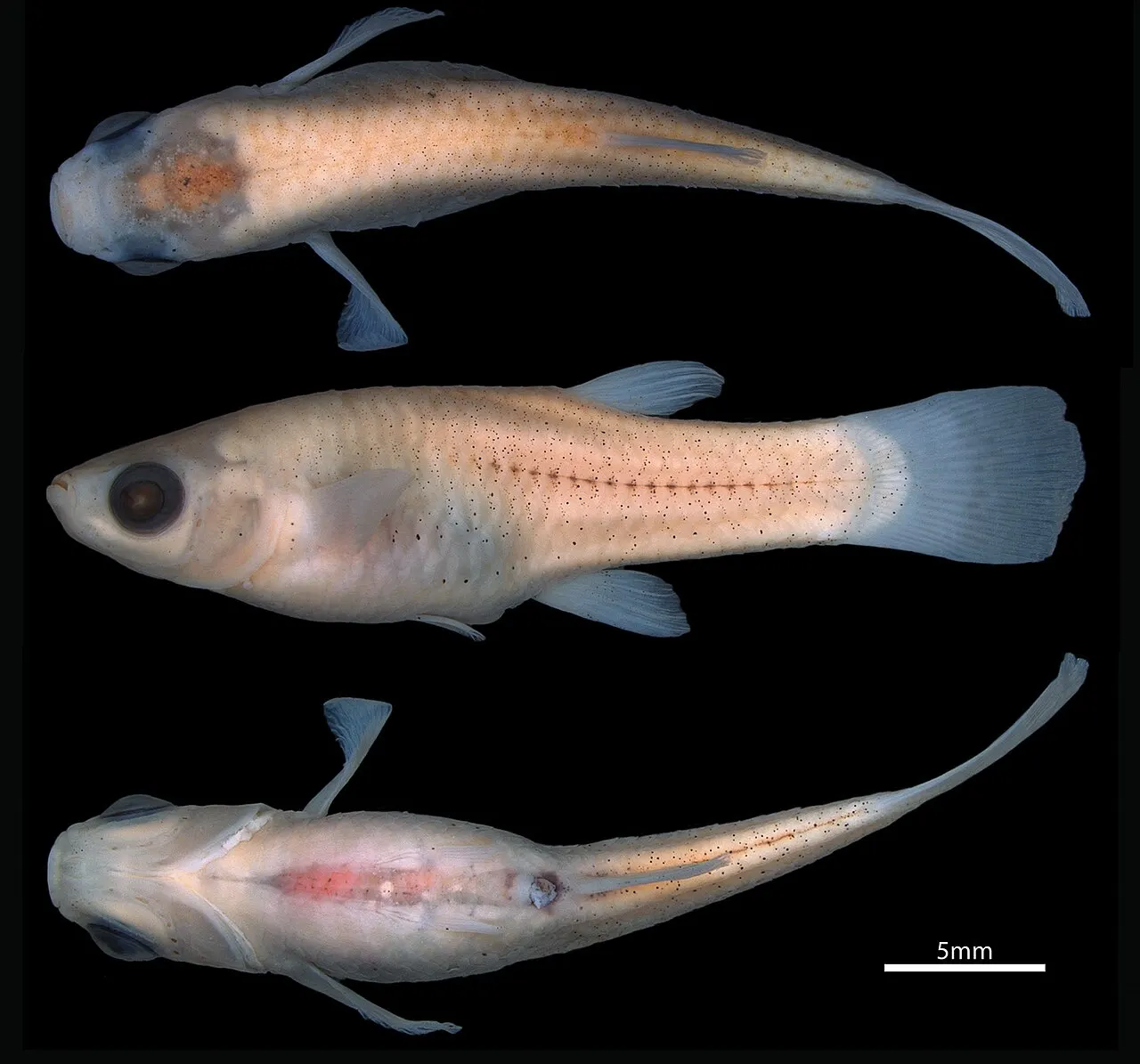
The Rio Concepcion topminnow (Poeciliopsis jackschultzi) is a tiny live-bearing fish known only from spring-fed pools and marshy streams of the Rio Concepcion in Sonora, Mexico. It was formally described in 2019, and the IUCN rated it Endangered in 2020. No survey of its known sites has been made since 2001.
A fish described only recently
Poeciliopsis jackschultzi was named by Kevin Conway, Mariana Mateos and Robert Vrijenhoek in a paper published in ZooKeys in October 2019. It belongs to the Leptorhaphis group of the live-bearing genus Poeciliopsis. The description rests on only seven preserved fish, 17.9 to 26.7 mm long (standard length), collected between 1999 and 2001. They had been kept in an aquarium for a short time and then stored in formalin for several years.
The name honours R. Jack Schultz, a pioneer of research on hybridisation and all-female reproduction in the genus. Many of the features that separate the species from its relatives are in the skeleton, the gill rakers and the colour pattern.
Where it lives
It is known from a handful of sites in the Rio Concepcion drainage (also called the Rio Magdalena), south of the Mexico and United States border. They run from La Cieneguita in the north to the town of Imuris in the south, and include a small spring stream at La Atascosa and a pool near Rancho Las Playas. The fish has only been collected from shallow, still or slow water in marshy, spring-fed pools and nearby channels.
If it occurs continuously between its northernmost and southernmost sites, the describers estimated it could occupy about 30 km of a river roughly 1,000 km long, or about 3 percent. The Red List assessment records an area of occupancy of 12 square kilometres, three locations and an elevation of 800 to 900 m.
Pins are Wikidata “endemic to” fields. Orange dots, when present, are GBIF occurrence tiles — survey bias included.
How it lives
Very little has been written about its behaviour. It shares its pools with the Gila topminnow (Poeciliopsis occidentalis) and with an all-female hybrid form, and at every site it was outnumbered, making up under 17 percent of the Poeciliopsis caught everywhere except La Atascosa in 1986.
Laboratory-reared males did not show the black courtship colouring of some relatives. The most reliable field mark against the Gila topminnow is that jackschultzi lacks a black spot at the front base of the dorsal fin. Females cannot yet be told apart from the all-female hybrids by external features.
Why it is in trouble
The fish lives in a handful of patchy desert wetlands. The Red List lists groundwater pumping for agriculture, housing and roads among the threats, and the 2019 paper adds that demand for water in the region keeps rising. From 1990 to 2012, water from the Alisos aquifer was extracted and exported to the city of Nogales, so recharge depended on rainfall alone. A highway expansion after 1986 nearly wiped out the main habitat at La Atascosa.
Introduced mosquitofish (Gambusia affinis) and green sunfish (Lepomis cyanellus) are present in the river and may add pressure. Treated wastewater has been released into the stream since 2012, and its pollutant loads have been reported above permitted limits.
What is being done
Very little so far. The Red List assessment records no protected area covering the species, no monitoring scheme, no recovery plan and no captive population. It lists site protection, control of invasive species and captive breeding as actions that would help. The describers say the current state of the fish and its habitats is unknown and recommend new surveys using seines and minnow traps.
Sources
Written for this catalog in our own words from the sources below, checked against them on 12 November 2026. Population figures are estimates and carry the year they were made. Status and assessment year: IUCN. 2026. The IUCN Red List of Threatened Species. Version 2026-1. iucnredlist.org.




