Endangered
Pocillopora elegans
Pocillopora elegans
Pocillopora elegans is a branching stony coral that builds reefs across the tropical Pacific, from Southeast Asia to the Americas. The IUCN Red List rated it Endangered in 2024, up from Vulnerable in 2014, because habitat decline, disease and other pressures are projected to cut its population sharply.
How to recognise it
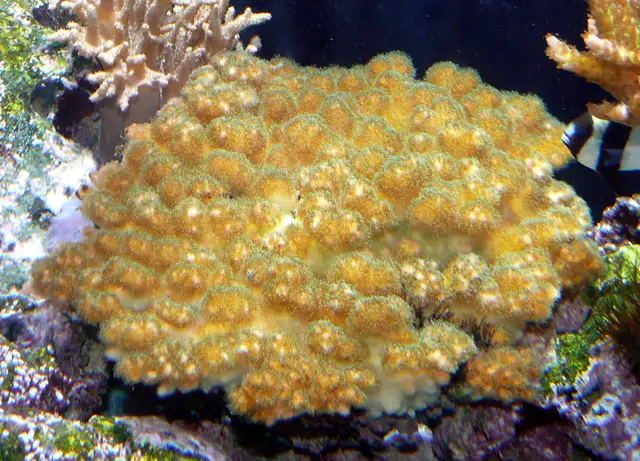
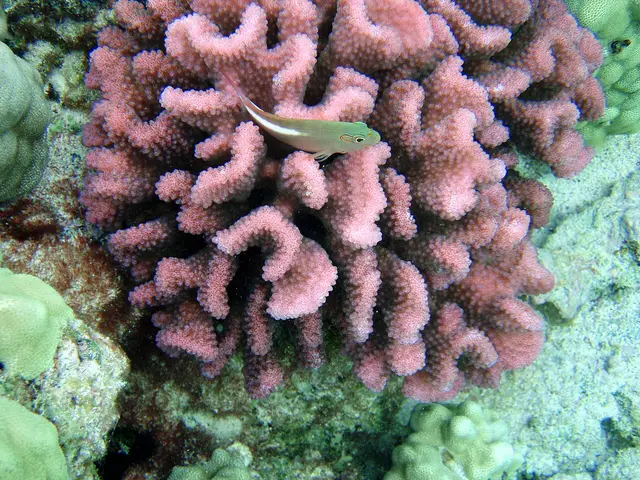
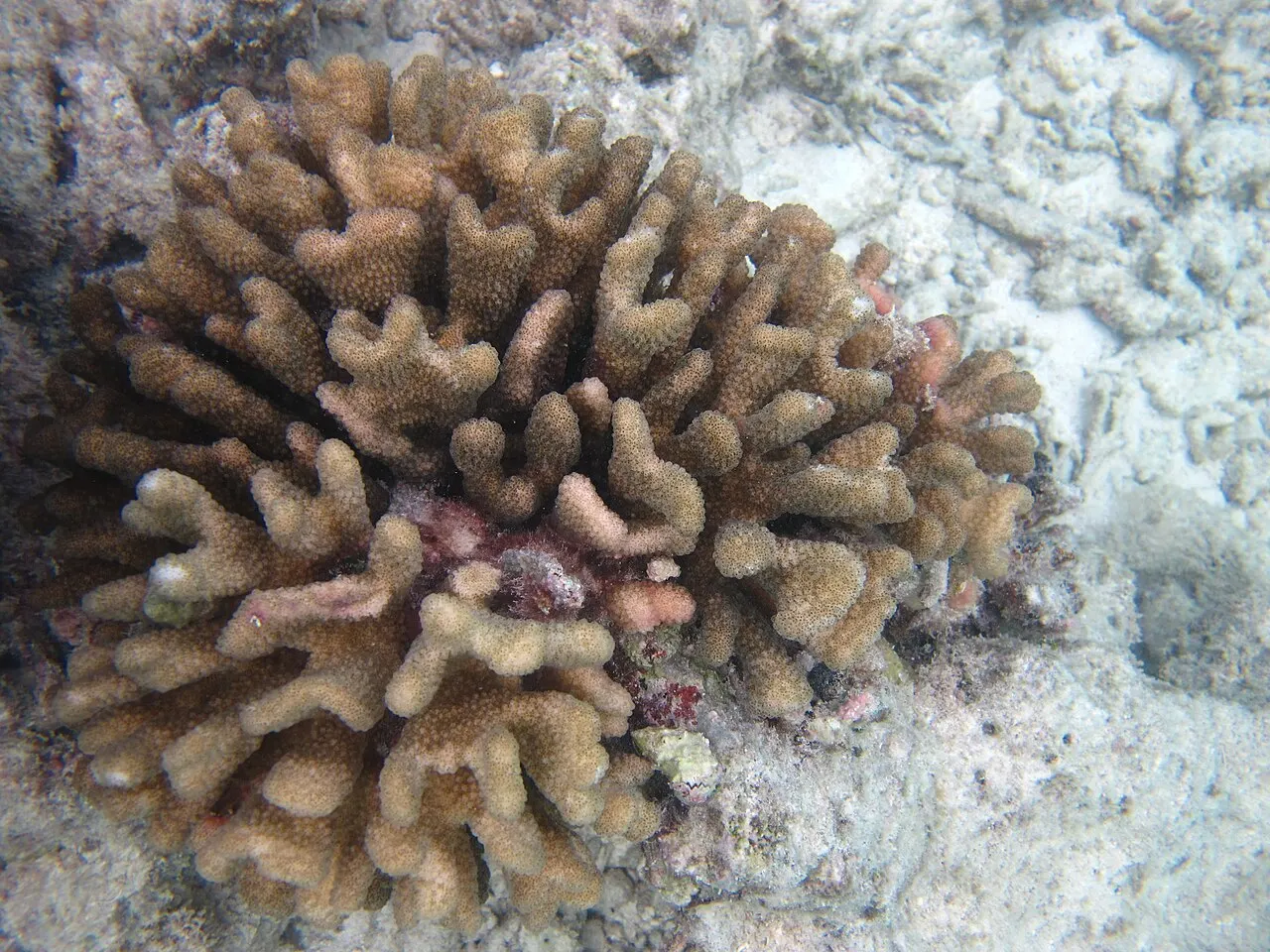
This is a compact, clump-forming coral. Its branches are thick, fairly uniform and mostly upright, with flattened ends. The surface carries smooth, rounded bumps called verrucae, which are the hallmark of the genus, and the individual polyps sit in very small corallites scattered over the skeleton.
Colonies can be cream, pink or greenish-brown. Lookalikes make field identification hard. Pocillopora verrucosa has thinner branches and more protruding corallites, P. capitata has tall cylindrical branches and elongated bumps, and P. eydouxi has larger branches. The Corals of the World database labels P. elegans a poorly known species.
Where it lives
It has a very wide range. The Red List names more than 35 countries and territories, including Indonesia, Malaysia, the Philippines, Papua New Guinea, Fiji, Palau, French Polynesia, Japan, Mexico, Panama, Costa Rica, Colombia and Ecuador. Its range reaches the Galápagos Islands and the far eastern Pacific.
It grows on shallow coral reefs, from about 1 to 38 m deep by the Red List's figures, while another general account gives about 20 m as the usual limit. It is locally common in some parts of the central Indo-Pacific and the far eastern Pacific.
Pins are Wikidata “endemic to” fields. Orange dots, when present, are GBIF occurrence tiles — survey bias included.
How it lives
Like other reef-building corals, it is a colony of tiny polyps that gain energy from algae living inside their tissues, which is why heat waves that trigger bleaching are so damaging. The Red List puts its generation length at about 10 years.
In the eastern Pacific it was reportedly among the most vigorous reef builders before the 1982 to 1983 El Niño, and it disappeared from many former sites afterward. At Uva Island in Panama, cover of the whole Pocillopora genus fell from 44.1 percent in 1980 to 0.3 percent in 1984, and P. elegans was among the most heat-sensitive species in 1983. A 2023 study in PNAS found that Pocillopora cover fell by about 16 percent in each of the 1997 to 1998 and 2015 to 2016 events, far less, as heat-tolerant algal partners became more common. P. elegans has reportedly been recruiting again in Costa Rica, Panama and the Galápagos.
Why it is in trouble
Bleaching and coral disease are the main worries, and the species is reportedly also eaten by crown-of-thorns starfish. The Red List records coastal development, tourism and recreation, shipping, storms, sedimentation, small-scale harvest and temperature extremes among the threats, and notes that the area of reef it can use is still shrinking.
The 2024 assessment projects a population reduction of about 61 percent, driven by habitat decline and by the effects of pathogens, pollutants and introduced species, and lists the population trend as decreasing. A 2014 assessment had rated it Vulnerable.
What is being done
The Red List lists site protection and management, habitat restoration, species recovery work, a genome resource bank and captive breeding or propagation among the conservation actions relevant to the species. The species is listed on CITES Appendix II, which regulates international trade in stony corals.
The 2023 PNAS study warned that the eastern Pacific's resilience may be temporary unless global warming is curtailed.
Sources
Written for this catalog in our own words from the sources below, checked against them on 12 November 2026. Population figures are estimates and carry the year they were made. Status and assessment year: IUCN. 2026. The IUCN Red List of Threatened Species. Version 2026-1. iucnredlist.org.