Endangered
Pleuronaia dolabelloides
Pleuronaia dolabelloides
The slabside pearlymussel (Pleuronaia dolabelloides) is a freshwater mussel found only in the Tennessee River system in the eastern United States. It lives in shallow gravel shoals, and it can live more than 40 years. The IUCN Red List assessed it as Endangered in 2012, and it is also federally listed.
How to recognise it
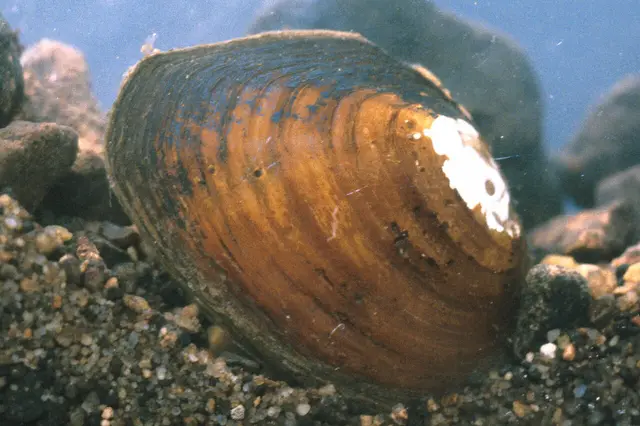
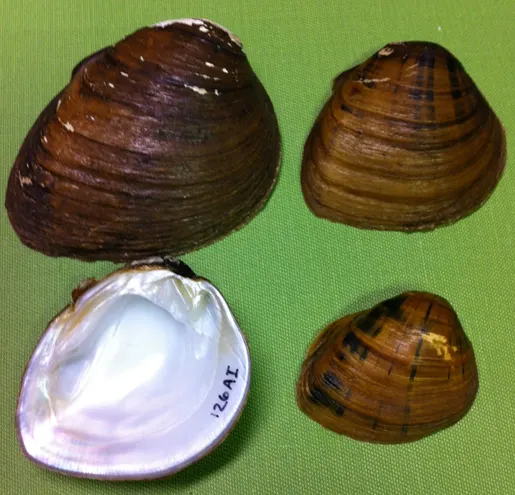
The shell is smooth, heavy and roughly triangular, with moderately inflated valves. Young mussels are greenish-yellow and darken to brown with age. The inside is usually white, sometimes straw-coloured. Adults reach about 3.5 inches (roughly 9 cm) long.
Lea described it in 1840. It was long placed in the genus Lexingtonia and now sits in Pleuronaia, in the river mussel family Unionidae.
Where it lives
It is endemic to the Tennessee River drainage. It is found today in Tennessee, Alabama, Mississippi and Virginia, in riffles and shoals of large creeks and rivers with sand, fine gravel or cobble on the bed and a moderate current. The US Fish and Wildlife Service has designated 13 critical habitat areas, about 971 river miles in all, among them the Clinch, Powell, Paint Rock, Elk, Duck and Buffalo rivers and several Virginia forks of the Holston.
It once occupied about 1,970 river miles of stream, and fewer than 40 percent of that is occupied now. It has disappeared from the Cumberland River system and from Kentucky. The IUCN counts only 2 to 3 locations and an extent of occurrence of 1,000 to 5,000 square kilometres.
Pins are Wikidata “endemic to” fields. Orange dots, when present, are GBIF occurrence tiles — survey bias included.
How it lives
Like other freshwater mussels, its larvae (glochidia) must attach to a host fish to turn into juveniles. Females brood eggs for 2 to 6 weeks and spawning runs from May to August. Likely hosts include several minnows, among them the rosyface, silver, Tennessee and whitetail shiners and the eastern blacknose dace.
The odds for each larva are poor. Survival from the larval stage is thought to be in the order of one in 100,000 to one in a million, and a female may add only about 0.1 to 1.3 juveniles a year. Maturity is probably reached after 4 to 7 years, though that age has not been measured.
Why it is in trouble
Dams are a central problem. More than 2,000 dams of various sizes affect nearly the whole range, and the big reservoirs, built mostly between 1913 and 1976, flooded long stretches of river and have cut the remaining populations off from one another. Gravel and coal mining, silt, pollution, agriculture and development add to the damage. Disease was not seen as a major threat when the species was listed in 2013, but mussel die-offs in the Clinch River beginning in 2016 have since been linked to pathogens.
The IUCN lists the population as decreasing and names mining and quarrying among the threats.
What is being done
The species was listed as endangered under the US Endangered Species Act in September 2013, with critical habitat designated the same day. The agency treats recovery as a long job, giving it a low recovery potential because of its small, isolated populations. A draft recovery plan released for comment in 2024 sets a goal of at least 12 resilient populations and 20 in total, spread across all six ecoregions. It puts the cost at about 68 million dollars, and says the true cost will probably be higher. Methods for captive propagation and reintroduction still have to be developed, and Virginia and Alabama have both listed that as a need.
Sources
Written for this catalog in our own words from the sources below, checked against them on 12 November 2026. Population figures are estimates and carry the year they were made. Status and assessment year: IUCN. 2026. The IUCN Red List of Threatened Species. Version 2026-1. iucnredlist.org.