Endangered
Socorro Towhee
Pipilo socorroensis
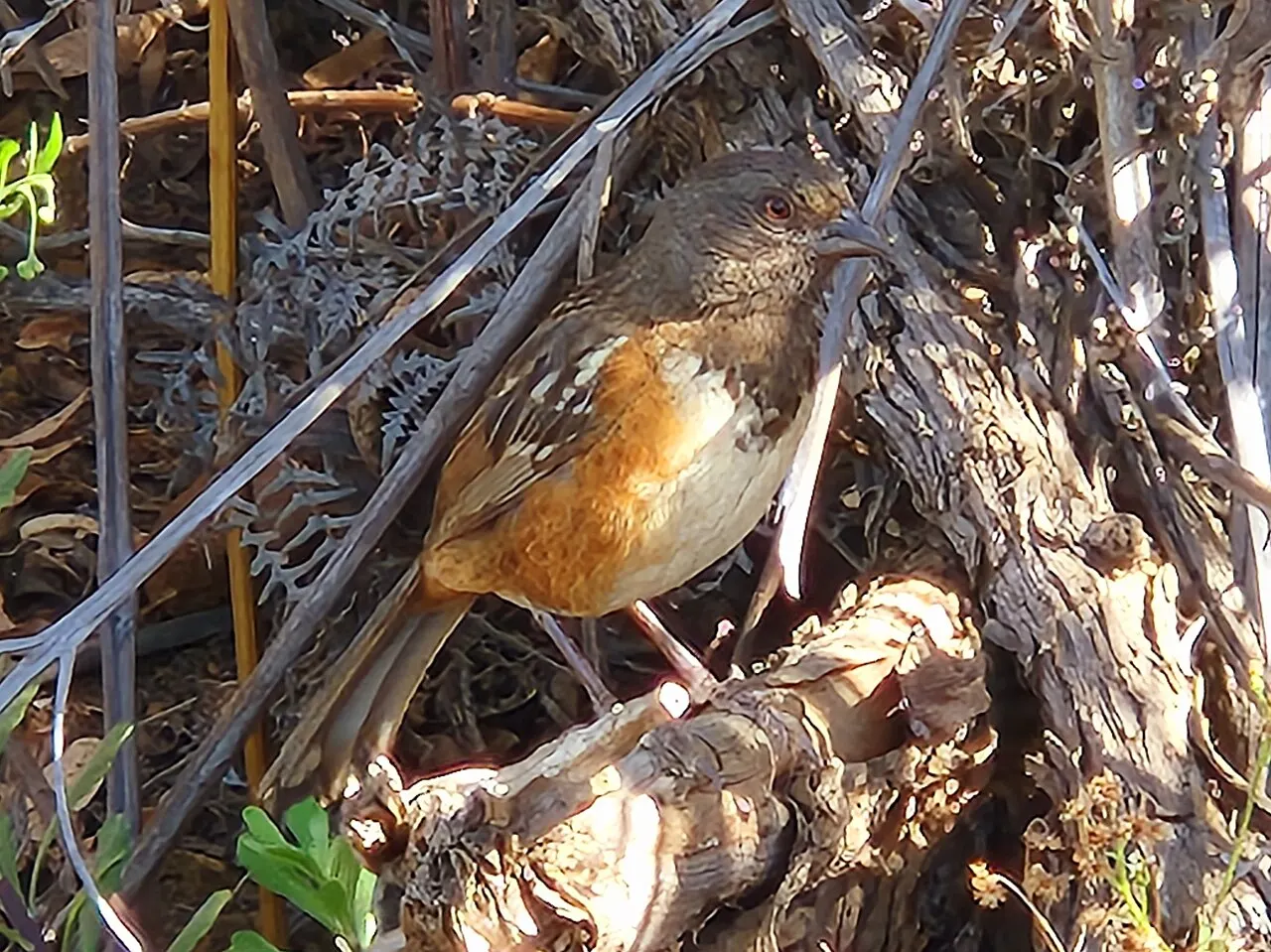
The Socorro towhee (Pipilo socorroensis) is a grey-backed songbird found only on Socorro Island, a volcanic island about 600 km off Mexico's Pacific coast. The IUCN Red List assessed it as Endangered in 2020, with an estimated 2,500 to 9,999 birds. Some authorities treat it as a subspecies of the spotted towhee.
What it is
Towhees are large New World sparrows. The spotted towhee, Pipilo maculatus, is widespread in western North America. The Socorro Island form has distinctive grey upperparts and is reported to be smaller than other spotted towhees.
Whether it is a full species is disputed. The IUCN assesses it as the Socorro towhee, Pipilo socorroensis, while other authorities treat it as the subspecies Pipilo maculatus socorroensis. That choice decides whether it counts as an Endangered species or as an island population of a common bird.
Where it lives
It is endemic to Socorro, the largest of Mexico's four Revillagigedo Islands (about 132 square kilometres, administered by the state of Colima). The IUCN counts a single location and an extent of occurrence of about 170 square kilometres, and estimates the population at 2,500 to 9,999 birds, all in one subpopulation. Its habitat is dry tropical shrubland, which the IUCN lists as suitable both in the breeding season and outside it.
The island's lowlands are mostly dense shrubland. On the wetter northern side, above roughly 650 m, the vegetation turns richer, with small trees and epiphytic orchids.
Pins are Wikidata “endemic to” fields. Orange dots, when present, are GBIF occurrence tiles — survey bias included.
How it lives
Little has been written about the island form itself. Mainland spotted towhees forage on the ground and in low vegetation, noisily rummaging through leaf litter. They eat mostly insects and other small invertebrates in spring and summer, and seeds and berries in autumn and winter. They nest on the ground or low in bushes. How closely the Socorro birds follow that pattern is not documented. The IUCN gives a generation length of about 2.6 years.
Why it is in trouble
The IUCN names two introduced animals as ongoing threats across the whole range: sheep, which were brought to the island in the 1800s and stripped vegetation, and feral cats. Cats arrived with the Mexican Navy station established in 1957. Jehl and Parkes, reporting on expeditions in 1978 and 1981, found the towhee far less common than in the recent past, and attributed the decline of several endemic birds on the island largely to predation by cats.
Sheep were removed, reportedly by 2010. Cats remain on the island. The IUCN records a continuing decline in the area the bird occupies.
What is being done
The IUCN identifies conservation sites across the whole range, but records no recovery plan, no systematic monitoring scheme, no invasive species control in place for this species, and no captive population.
Sources
Written for this catalog in our own words from the sources below, checked against them on 12 November 2026. Population figures are estimates and carry the year they were made. Status and assessment year: IUCN. 2026. The IUCN Red List of Threatened Species. Version 2026-1. iucnredlist.org.




