Endangered
Everett's flying frog
Everett's flying frog
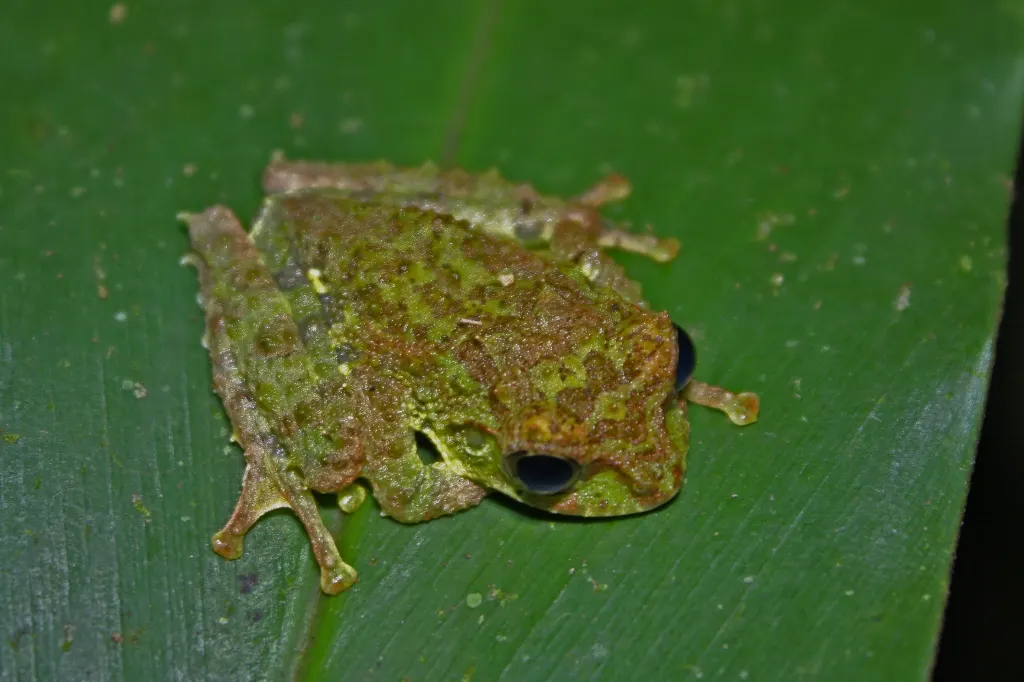
Everett's flying frog (Everett's flying frog), also called Everett's tree frog, is a small, moss-coloured tree frog found only on the Philippine island of Palawan, mostly in streamside forest from the lowlands up into the mountains. The IUCN Red List rated it Endangered in 2018, with a decreasing population and mining among the threats.
How to recognise it
It is a small, slender tree frog, 30 to 49 mm from snout to vent according to a 2022 fauna guide to the Mount Mantalingahan protected area. The snout is short and rounded, the eyes are large, the legs are long and thin, and the toe tips are expanded for gripping. The skin is granular, with tiny pointed spines that are spikier on the shoulders and along the limbs.
Colour varies from plain tan or yellowish brown to pale green, marked with dark brown or reddish patches and bars that help it blend into moss on trunks and branches. That description comes from Jojo De Peralta, a Palawan naturalist who writes the Palawan Wild Frontier blog.
Where it lives
The species was described in 1894 from Palawan, and the Philippine population is known only from there. It is often confused with a look-alike on Borneo. A 2012 study by Stefan Hertwig and colleagues in Zoologica Scripta used DNA evidence to recognise the Palawan frog and the Bornean frog as two separate species, and the Bornean one is now called Philautus macroscelis, the mossy bush frog. Descriptions that place Everett's frog on Mount Kinabalu or in Malaysia, including some older websites, actually refer to that Bornean species.
On Palawan it lives in mossy forest near streams, from lowland to montane forest. The IUCN gives a lowest record of 300 m and counts 3 to 5 locations. According to De Peralta, lowland sightings are now exceedingly rare and it is mostly found from about 700 m upward. The IUCN notes that it occurs in at least one protected area, and the species is included in the 2022 fauna guide for the Mount Mantalingahan protected area.
Pins are Wikidata “endemic to” fields. Orange dots, when present, are GBIF occurrence tiles — survey bias included.
How it lives
It is nocturnal and eats invertebrates. At night it perches on broad leaves, mossy branches and trunks, from a few feet up to about 5 m off the ground. De Peralta reports that males call in the early evening with a series of short, harsh notes.
How it breeds is still unclear. It may lay eggs on vegetation that hatch straight into froglets, or it may use water held in tree hollows or pitcher plants. In the Pulgar Range the frog was more common where the pitcher plant Nepenthes deaniana grew, but pitchers that the team checked held no tadpoles.
Why it is in trouble
The IUCN lists mining and quarrying, and seepage from mining, as the threats, and rates the species Endangered under criterion B1ab(iii) because its range is small and its habitat is shrinking. The IUCN estimates its extent of occurrence at about 4,990 square kilometres and gives the population trend as decreasing.
De Peralta also names oil palm plantations, shifting cultivation, illegal logging and charcoal collection as pressures on the lowland forests, along with pollution from mine tailings and farm runoff. He reports that the frog has vanished from the lower slopes of Mount Gantung, where it was once abundant, and that on a visit in May 2024 it appeared only at around 830 m. Populations seem stable in a few high, undisturbed mossy forests.
What is being done
The IUCN records that the species occurs in at least one protected area, and part of its habitat lies in the Mount Mantalingahan protected area. For the future the IUCN lists site management, habitat protection and national-level policies and regulations as actions needed. No species-specific recovery plan appears in the sources checked.
Sources
Written for this catalog in our own words from the sources below, checked against them on 12 November 2026. Population figures are estimates and carry the year they were made. Status and assessment year: IUCN. 2026. The IUCN Red List of Threatened Species. Version 2026-1. iucnredlist.org.
- IUCN Red List assessment, Everett's flying frog (2018)
- Fauna of Mount Mantalingahan (de Guia and Pantua, 2022)
- Palawan Wild Frontier, Everett's Tree Frog (De Peralta, May 2026)
- Hertwig et al. 2012, Zoologica Scripta 41:29-46 (Crossref record with abstract)
- Amphibian Species of the World treatment via Zenodo (Diesmos et al. checklist)
- Wikipedia, Everett's flying frog
- Wikipedia, Philautus macroscelis

