Endangered
Parides burchellanus
Parides burchellanus
Parides burchellanus is a velvet-black swallowtail butterfly found only in Brazil, where it lives along shaded, forest-lined streams on the Cerrado plateau. The IUCN Red List classes it as Endangered (assessed 2019). Its colonies are small and scattered, and few streams seem to offer what it needs.
How to recognise it
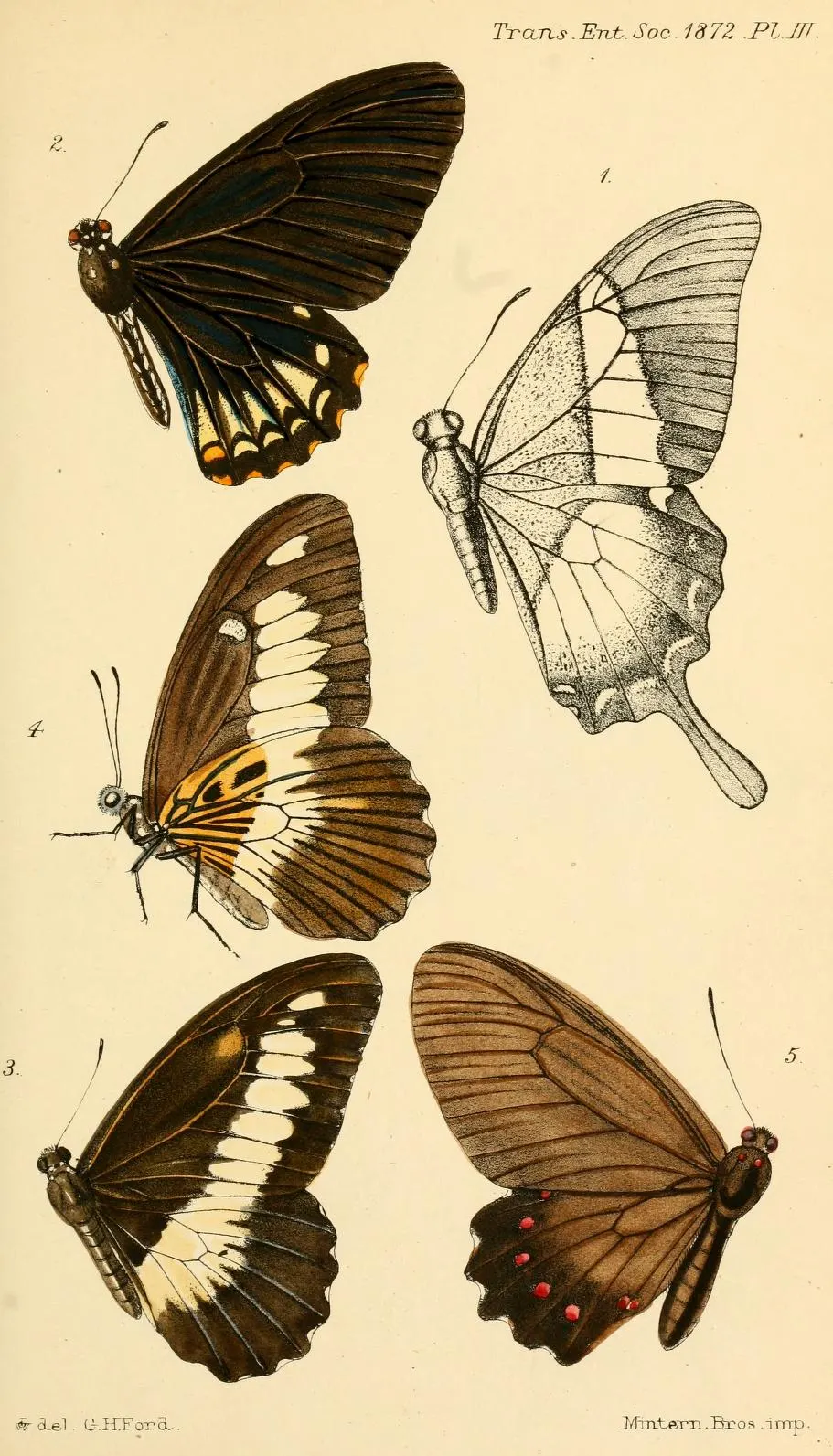
This is a big swallowtail with dark, almost velvety wings. The forewing is plain black apart from a few small white spots near the edge. The hindwing has a scalloped margin and no tails, and its underside carries small red spots set in from the edge. Males have a hair-pouch on the hindwing margin near the abdomen. Otherwise the sexes look much alike.
The species was described in 1872 by John Westwood and named for the English naturalist William John Burchell. It belongs to the Parides aeneas group of swallowtails. Its status as a separate species has been questioned, with an intermediate form with P. aeneas suggested, though GBIF currently treats it as accepted.
Where it lives
It is endemic to central Brazil. The Red List records it from Goiás, Minas Gerais and the Federal District, with only four separate locations and a recorded elevation of roughly 770 to 1,010 metres.
The habitat is gallery forest, the strips of trees that follow rivers through open Cerrado country. Adults tend to turn up along narrow streams where the canopy closes over the water. A 2012 mark-recapture study in Minas Gerais searched 63 sites that looked suitable and found resident populations at only seven.
Pins are Wikidata “endemic to” fields. Orange dots, when present, are GBIF occurrence tiles — survey bias included.
How it lives
The caterpillars feed on two pipevines, Aristolochia chamissonis and A. melastoma. Both larvae and adults are tied closely to the riverside forest, and a 2012 study in the Annals of the Entomological Society of America proposed that this double habitat dependence helps explain the butterfly's rarity.
That study followed one riparian forest site for 13 months. The colony usually held 10 to 30 butterflies, peaking near 100, and males outnumbered females in every month. Males stayed in the study area for an average of about 23 days and females about 16, with the longest-staying individuals recorded at 73 days for a male and 64 days for a female. Males moved up to 950 metres and females up to 650 metres. The age structure shifted toward older butterflies before numbers dropped in the dry season.
Why it is in trouble
The Red List lists habitat alteration and housing and urban development as threats, with the main stress being conversion and degradation of the riverside forest. Whether the population is rising or falling is recorded as unknown.
Because each colony is so small and so tied to a particular stretch of stream, losing one patch of gallery forest could erase a colony outright.
What is being done
The species is listed in Appendix I of CITES (a listing reported in force in late 2019). It is also reportedly on the IUCN's list of 100 of the world's most threatened species, one of two butterflies on it. The Red List names habitat protection and restoration as the actions needed, and records whether any known colony sits inside a protected area as unknown. The 2012 study recommended protecting the habitat of every known colony.
Sources
Written for this catalog in our own words from the sources below, checked against them on 12 November 2026. Population figures are estimates and carry the year they were made. Status and assessment year: IUCN. 2026. The IUCN Red List of Threatened Species. Version 2026-1. iucnredlist.org.




