Endangered
Dibbler
Parantechinus apicalis
The dibbler (Parantechinus apicalis) is a small, speckled, flesh-eating marsupial from the south-west of Western Australia. Written off as extinct in the 1800s, it turned up again in 1967. The IUCN assessed it as Endangered in 2026, estimating about 650 animals, with the population still decreasing.
How to recognise it
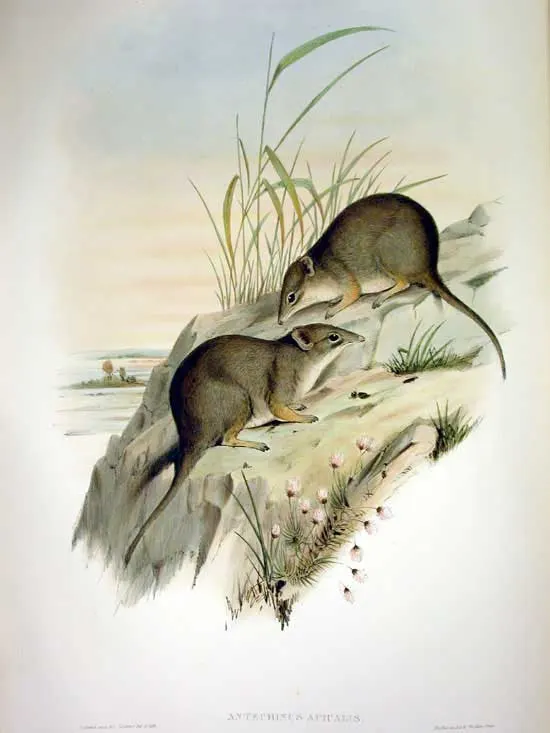
A dibbler is a grey-brown marsupial flecked with white hairs, with a pale ring round each eye and a short, tapering tail. Adults measure roughly 10 to 16 cm in body length and weigh about 40 to 125 g, making it one of Australia's smallest marsupials.
It hunts alone, mostly around dusk and at night. Small vertebrates, insects and other invertebrates make up most of its diet. It is agile enough to climb bushes and lick nectar from flowers.
Where it lives
Dibblers once ranged across near-coastal south-west Western Australia. By 1884 they were declared extinct, then were rediscovered at Cheyne Beach on the south coast in 1967. Today they live in Fitzgerald River National Park on the mainland and on small islands, including Boullanger and Whitlock Islands off Jurien Bay. Translocated populations exist on Escape Island, Gunton Island and at Peniup Nature Reserve, and animals have been released on Dirk Hartog Island.
They favour thick leaf litter and sandy soils, typically unburnt coastal mallee heath.
Pins are Wikidata “endemic to” fields. Orange dots, when present, are GBIF occurrence tiles — survey bias included.
Why it is in trouble
The 2026 assessment gives about 650 individuals in 7 subpopulations across 6 locations, the largest holding about 100. Its range is severely fragmented, and drought and temperature extremes are also listed as threats.
A 2022 study in Scientific Reports reported fewer than 1,000 in the wild, counting translocated groups, with the Jurien Bay island populations at roughly 10 to 30 adults each. It named foxes and feral cats, unsuitable fire regimes, dieback disease and competition with house mice as pressures. It found low genetic diversity, and a 100-year model gave the three island populations survival odds of 6 to 48 percent, depending on the island.
What is being done
Perth Zoo and the state conservation department ran a breeding program from 1997. It ended in 2023 after 1,173 dibblers were bred for release, the last 18 going to Dirk Hartog Island. The first zoo-bred animals reached that island in 2019, and 203 had been released there by 2023. Dirk Hartog was made safe by removing cats, sheep and goats in 2018. Of five translocations tried from 1998, three succeeded: Escape Island in 1998, Peniup in 2001 and Gunton Island in 2015. Roughly 91 to 100 percent of the population is inside protected areas.
Sources
Written for this catalog in our own words from the sources below, checked against them on 12 November 2026. Population figures are estimates and carry the year they were made. Status and assessment year: IUCN. 2026. The IUCN Red List of Threatened Species. Version 2026-1. iucnredlist.org.




