Endangered
Masoala Web-foot Frog
Paradoxophyla tiarano
Paradoxophyla tiarano is a small, flat-bodied frog known only from the rainforest of northeastern Madagascar, where it lives in still pools. It was described in 2006 and was assessed as Endangered by the IUCN Red List in 2025. Its name is Malagasy for "one that loves water".
How to recognise it
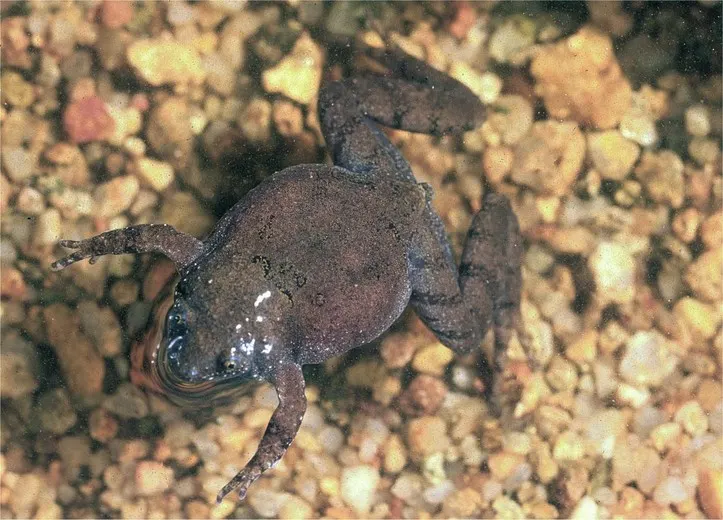
This is a narrow-mouthed frog (family Microhylidae) with a flattened body, a long, sharply pointed snout and small round eyes. The back is light brown to tan with small irregular markings, the legs carry darker cross bands, and the belly is whitish with a darker net-like pattern. The throat is darker than the rest.
The two females measured were much bigger than the single male: the male used to describe the species was 17.5 mm from snout to vent, while the females were 28 to 31 mm. Its only relative in the genus, P. palmata, has extensive foot webbing, but this species has only traces of it and no webbing at all on the hands.
Where it lives
The first frogs were collected in December 1999 at a campsite known locally as Menamalona, on the Masoala Peninsula, at 780 m above sea level. The species was described in 2006 by Franco Andreone and colleagues in Acta Herpetologica, partly on the basis of DNA and chromosome differences from P. palmata.
The IUCN counts two locations in Madagascar, at 780 to 1,009 m, with a range of only about 48 square km and an area actually occupied of around 16 square km (2025 assessment). The frog lives in lowland rainforest and in small seasonal pools and marshes.
Pins are Wikidata “endemic to” fields. Orange dots, when present, are GBIF occurrence tiles — survey bias included.
How it lives
The type specimens were caught in a small pool beside a forest stream, in December. The describers also found 70 tadpoles there and assigned them to this species because they match the typical suspension-feeding tadpole of this frog family and resemble those of P. palmata. They have a rounded body, a flat snout, a wide mouth and eyes set wide apart. At a late stage they were about 11 mm in body length and 16 mm in tail length.
Calls had not been recorded when the species was described. Its relative breeds explosively in rainforest pools, and the describers predicted this species does the same. Both frogs had so far been found in water in or very near fairly undisturbed forest, which suggests they depend on mature, humid forest, especially outside the breeding season.
Why it is in trouble
With so small a range, any change to the forest is a serious risk. The IUCN lists shifting agriculture, more frequent and more intense fires, drought, storms and flooding, temperature extremes, and unintentional harm from small-scale harvesting. Forest loss in Madagascar is fast, and the IUCN records continuing decline in the frog's habitat.
The describers pointed to the large national park at Masoala as a favourable factor for the species, but the IUCN record does not say whether the frog's two locations lie inside it.
What is being done
The IUCN says the species occurs in at least one protected area and lists site protection, site management and awareness work as conservation actions. It also calls for research on population size, distribution and trends, on life history and ecology, and on threats. No population count exists.
Sources
Written for this catalog in our own words from the sources below, checked against them on 12 November 2026. Population figures are estimates and carry the year they were made. Status and assessment year: IUCN. 2026. The IUCN Red List of Threatened Species. Version 2026-1. iucnredlist.org.




