Endangered
Panay Cloudrunner
Crateromys heaneyi
The Panay cloudrunner (Crateromys heaneyi) is a large, bushy-tailed cloud rat found only on Panay in the Philippines, where it lives in lowland rainforest. The IUCN Red List lists it as Endangered (assessed 2017), mainly because forest clearance has left it a small, fragmented range.
How to recognise it
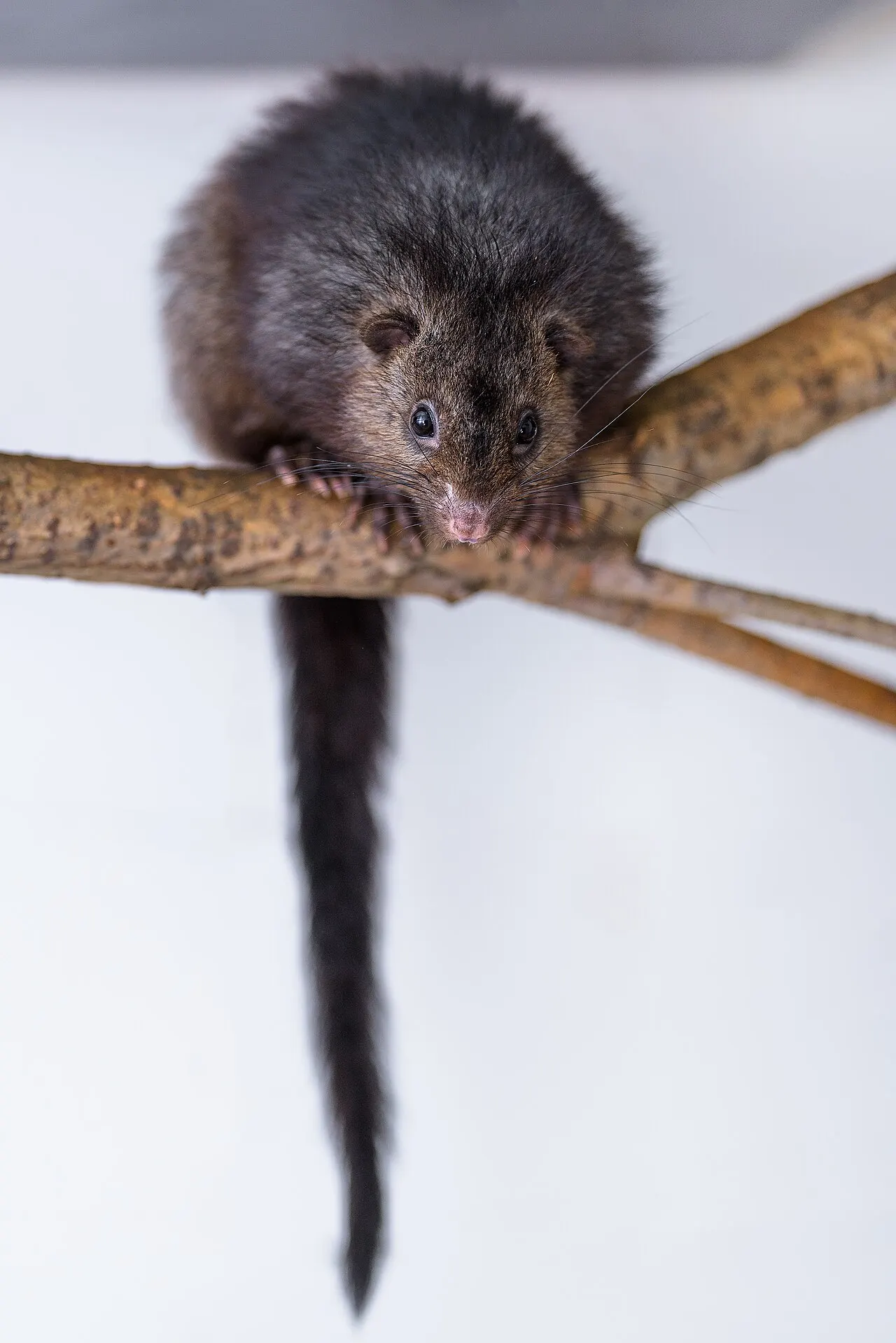
It's the second-largest of the cloud rats, a squirrel-like rodent with thick, soft, grizzled grey-brown fur. Museum measurements put the head and body at roughly 28 cm, with a tail of 30 to 34 cm, and weights run from about 930 to 1,040 g.
Where it lives
Nowhere but Panay. Western science first met it in 1987, and Pedro Gonzales and Robert Kennedy described it in 1996 from specimens collected on the south-western side of Mount Baloy in Antique Province. Panay had been largely overlooked by biologists because so little of its forest was left.
The animal is recorded from lowland primary and secondary evergreen rainforest, probably up to about 400 m. Today it survives in remnant forest in a mountain range on the island's western side.
Pins are Wikidata “endemic to” fields. Orange dots, when present, are GBIF occurrence tiles — survey bias included.
How it lives
It's nocturnal and tree-dwelling. By day it rests in holes in large tree trunks, and nests have also turned up inside tree ferns, in ground holes between roots, and as dome-shaped bundles of twigs and leaves in trees. It climbs well but moves slowly unless chased.
It eats leaves, fruit, seeds, roots and flowers. Wild animals reportedly take bananas, guavas, young corn, papaya, mangoes and figs. It may live alone, as a pair or in a family group, and captive animals have been recorded making a grunt, a soft hiss during feeding and whirring growls when males square off. Breeding is reportedly year-round, with litters of one or two.
Why it is in trouble
Logging and the spread of farming into lowland forest are the main threats. The IUCN records a decreasing population, a severely fragmented range and continuing habitat loss. Shifting agriculture, small-holder farming and housing are all listed, along with some hunting, though hunting seems to have limited effect compared with forest loss. The IUCN puts the area it ranges over at about 4,336 square kilometres, and that area is shrinking.
What is being done
Conservation sites have been identified across its whole range, and the species is in captive breeding. A programme at Mar-it Conservation Park held 45 animals in 2005, and a few zoos abroad, including London Zoo, have kept it. The IUCN lists site protection, habitat restoration and site management as the actions called for.
Sources
Written for this catalog in our own words from the sources below, checked against them on 12 November 2026. Population figures are estimates and carry the year they were made. Status and assessment year: IUCN. 2026. The IUCN Red List of Threatened Species. Version 2026-1. iucnredlist.org.