Critically Endangered
Paedophryne kathismaphlox
Paedophryne kathismaphlox
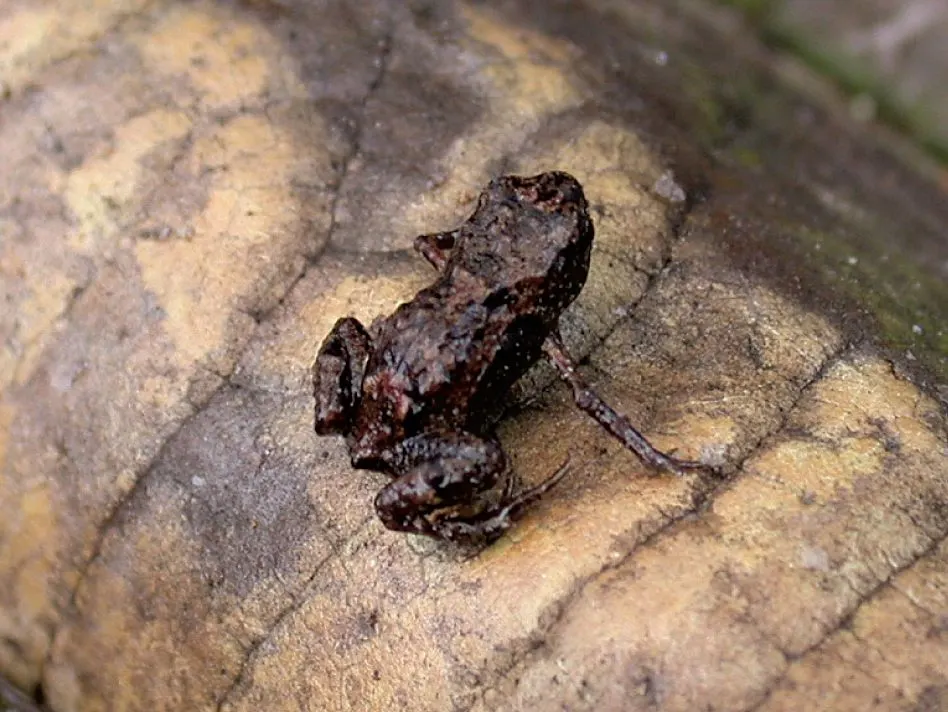
Paedophryne kathismaphlox is a minute frog from the mountains of Papua New Guinea, only about 10 to 11 mm long as an adult. The IUCN Red List rated it Critically Endangered in 2020, with a decreasing population. It is known from very few records and has a burnt-orange patch below the anus.
How to recognise it
Adults are tiny. In the original description, the one male measured 10.1 mm from snout to vent and females 10.4 to 10.9 mm. The back is dark brown with small darker blotches, and the belly is dark brown with scattered light straw-coloured flecks.
What sets it apart from its relatives is a burnt-orange patch below the anus, seen in life, which contrasts with the dark body. In preserved specimens the patch fades to a dirty grey-white.
The frog belongs to the microhylid family and to the genus Paedophryne, whose name comes from Greek words meaning child and frog. Fred Kraus created the genus and described this species in a 2010 paper in ZooKeys. The genus is reported to contain some of the smallest frogs, and vertebrates, on Earth.
Where it lives
The type specimen, an adult female, was collected by local villagers on the north-east slope of Mount Simpson in Milne Bay Province, at about 2,170 m, in February 2003. The IUCN lists Papua New Guinea as its only country, moist montane forest as the habitat, and a single location with an extent of occurrence of about 10 square kilometres. GBIF holds only four occurrence records.
The call of this species was still unknown in a 2012 comparison of Paedophryne frogs by Rittmeyer and colleagues.
Pins are Wikidata “endemic to” fields. Orange dots, when present, are GBIF occurrence tiles — survey bias included.
Why it is in trouble
The Red List classes it Critically Endangered under criterion B1ab(iii), which is used for a very small range known from few places, with continuing decline in habitat quality. The assessment lists more frequent and intense fires and a named species among the threats, and gives the effects as ecosystem degradation and increased mortality. The population trend is decreasing.
What is being done
The assessment records that the frog does not occur in any protected area, and it calls for research on population size, distribution and trends. Its list of suggested conservation actions includes national and international measures, policies and regulations, awareness, captive breeding and a genome resource bank. Those are recommendations, and no source found describes a captive programme in place.
Sources
Written for this catalog in our own words from the sources below, checked against them on 12 November 2026. Population figures are estimates and carry the year they were made. Status and assessment year: IUCN. 2026. The IUCN Red List of Threatened Species. Version 2026-1. iucnredlist.org.
- IUCN Red List assessment, Paedophryne kathismaphlox (2020)
- Kraus 2010, New genus of diminutive microhylid frogs from Papua New Guinea, ZooKeys 48 (Plazi treatment XML)
- Paedophryne, Wikipedia
- Rittmeyer et al. 2012, Ecological guild evolution and the discovery of the smallest vertebrate, PLoS ONE (Europe PMC full text)
- GBIF occurrence search, Paedophryne kathismaphlox




