Critically Endangered
Orange-footed pimpleback mussel
Plethobasus cooperianus
The orange-footed pimpleback (Plethobasus cooperianus) is a freshwater mussel of big rivers in the eastern United States, once found across the Ohio, Cumberland and Tennessee drainages. The IUCN rated it Critically Endangered in its 1996 assessment. Today only a few scattered river reaches still hold any, and it's very rarely found.
How to recognise it
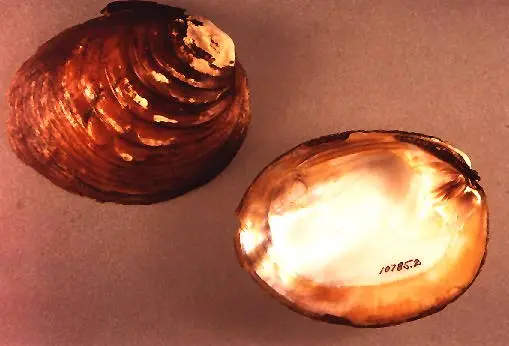
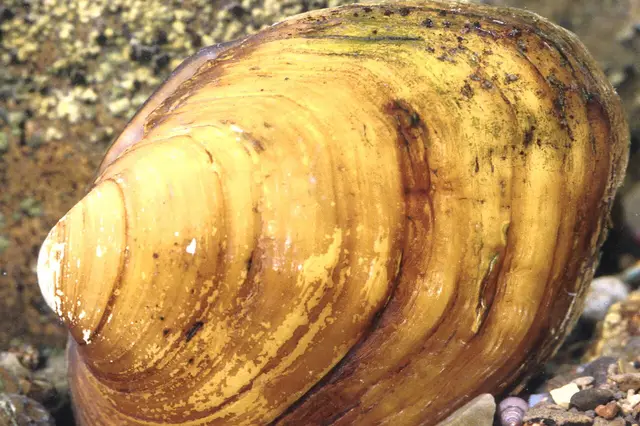
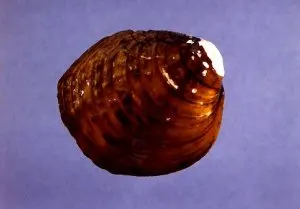
It's a rounded river mussel in the family Unionidae. Shells reportedly reach about 9.5 cm long, with bumps on the rear part of the shell. The soft foot is orange in living animals, which gives the species its common name. It was first described by Isaac Lea in 1834.
Where it lives
This mussel lives in silt-free sand or gravel in clean, fast-flowing stretches of large rivers, usually in deeper water than most of its relatives. It burrows into the bottom and can stay buried for long periods, so it's hard to find. It has reportedly been recorded in water up to about 9 metres (29 feet) deep, which makes surveys slow and costly.
Historically it ranged through the Ohio, Cumberland and Tennessee River systems. A 2022 U.S. Fish and Wildlife Service review considers it gone from the lower Ohio River in southern Illinois upstream of the Tennessee confluence, and from the Tennessee River in Alabama. What's left is a 34-mile reach of the Ohio below the mouth of the Tennessee, about 45 miles of the Tennessee River below Pickwick Landing Dam, and a 22-mile reach below Kentucky Dam. A 35-mile reach of the Tennessee below Chickamauga Lock and Dam was last documented with a single animal in 2004, and the Cumberland River gave one individual in a 2011 to 2012 survey of 34 sites.
Pins are Wikidata “endemic to” fields. Orange dots, when present, are GBIF occurrence tiles — survey bias included.
How it lives
Little is known about its biology. It's thought to be a typical long-lived mussel, and like other freshwater mussels it presumably has larvae that develop on a fish host. The fish host hasn't been identified, which complicates any breeding effort.
Counting it is very hard. In a 2008 survey at Tennessee River Mile 160.7, only one orange-footed pimpleback turned up among 11,090 native mussels of 17 species. The size of each population can't currently be estimated.
Why it is in trouble
Dredging, dams and development along the banks have broken up and degraded its habitat. Silt washing in from changed land use clouds the water, smothers the river bed and can clog or abrade a mussel's gills. The remaining groups are isolated from each other, and dams block the fish that carry larvae, so nothing can recolonise lost stretches. The IUCN assessment dates from 1996 and carries no threat or habitat detail.
Zebra mussels, introduced to the Tennessee River system in the early 1990s, are considered a major threat and could shrink the places where a recovery population might be set up. Climate change, disease and pollution that standard water-quality limits may not fully cover add to the worry. The review found that collecting for shells or science isn't a current problem.
What is being done
The species has been protected under the U.S. Endangered Species Act since June 14, 1976, and the 1984 recovery plan is still the guiding document. None of its delisting criteria have been met. A non-essential experimental population was designated in 2007 for the lower French Broad and lower Holston rivers in Tennessee.
Between 2013 and 2022, 55 animals were placed in a grid in the Tennessee River to serve as breeding stock, close enough together for natural fertilisation. In 2016 a Kentucky fisheries biologist turned 5,000 larvae into juveniles in the lab, but the young couldn't be reared. In 2022, six gravid females were found among 32 animals checked and moved to a holding station on Lake Cumberland for propagation work.
Sources
Written for this catalog in our own words from the sources below, checked against them on 12 November 2026. Population figures are estimates and carry the year they were made. Status and assessment year: IUCN. 2026. The IUCN Red List of Threatened Species. Version 2026-1. iucnredlist.org.