Critically Endangered
Opisthoteuthis chathamensis
Opisthoteuthis chathamensis
Opisthoteuthis chathamensis, the roughy umbrella octopus, is a small finned octopus of the deep seabed around New Zealand. The IUCN assessed it as Critically Endangered in 2014 because of a decline linked to unintentional capture in large-scale fishing. Very little else is known about it.
How to recognise it
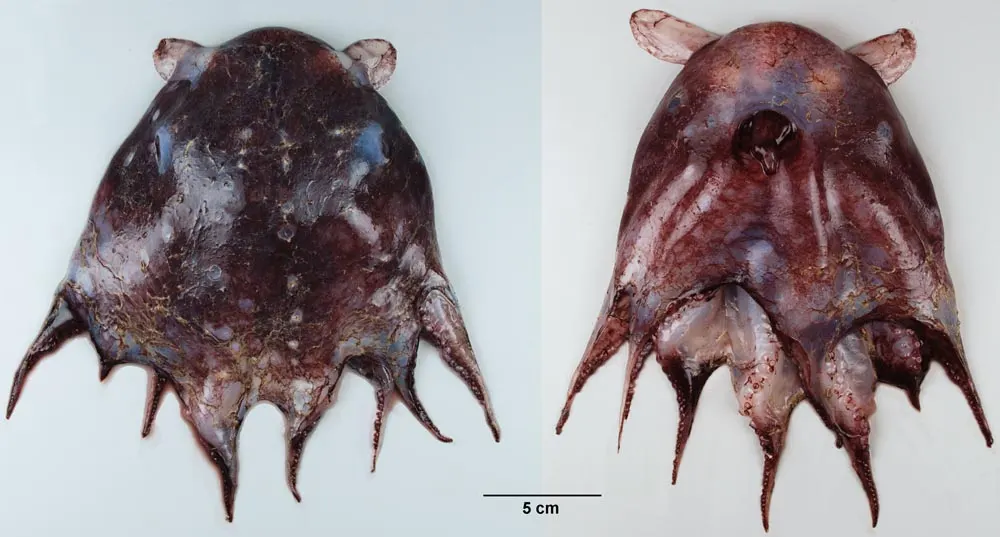
This is a cirrate or 'umbrella' octopus, a group with fins and arms joined by a broad web. It was described by Steve O'Shea in 1999. The largest recorded total length is 18 cm, with a mantle about 5.4 cm long.
The arms are roughly equal in length. Males carry about 41 to 45 suckers on each arm and females about 45 to 55. The inner surface of the web is maroon and the suckers are pale cream.
Where it lives
It lives on soft sediment on the seabed at depths of 900 to 1,438 m. The IUCN records it from New Zealand only. Its name comes from the Chatham Islands, where the type specimen was collected from 1,180 m, and it is known from soft sediments of the Chatham Rise.
Habitats listed in the assessment include the deep continental slope, seamounts and deep-sea vents and seeps. Some encyclopedia accounts also give a recent record from Macquarie Island, but the IUCN does not list it.
Pins are Wikidata “endemic to” fields. Orange dots, when present, are GBIF occurrence tiles — survey bias included.
How it lives
Almost nothing has been published on the biology of this species. Cephalopods in general have separate sexes, and adults usually die soon after spawning or brooding. Embryos of other octopuses in the genus take roughly 1.4 to 2.6 years to develop, which points to a slow life cycle and slow recovery from losses. The IUCN gives a generation length of about 5 years.
Why it is in trouble
The one threat the IUCN records is large-scale unintentional harvest, meaning the octopus is caught by fishing gear aimed at other species. It was reportedly a common bycatch species in 1999.
The IUCN trend is decreasing. One summary reports a decline of about 70% in recent years and adds that the species has not been recorded since 1999. Other accounts say it still occasionally turns up in bycatch, so the exact scale of the fall is uncertain.
What is being done
The assessment lists site and area management as the only conservation action, and no specific recovery measures are recorded. Neither CITES nor the Convention on Migratory Species has evaluated the species.
Sources
Written for this catalog in our own words from the sources below, checked against them on 12 November 2026. Population figures are estimates and carry the year they were made. Status and assessment year: IUCN. 2026. The IUCN Red List of Threatened Species. Version 2026-1. iucnredlist.org.




