Critically Endangered
Nematogenys inermis
Nematogenys inermis
The mountain catfish (Nematogenys inermis) is a scaleless, whiskered river fish endemic to central Chile and the only living member of its family. Once found across much of central Chile, it now survives in scattered spots. The IUCN rated it Critically Endangered in its 2023 assessment.
How to recognise it
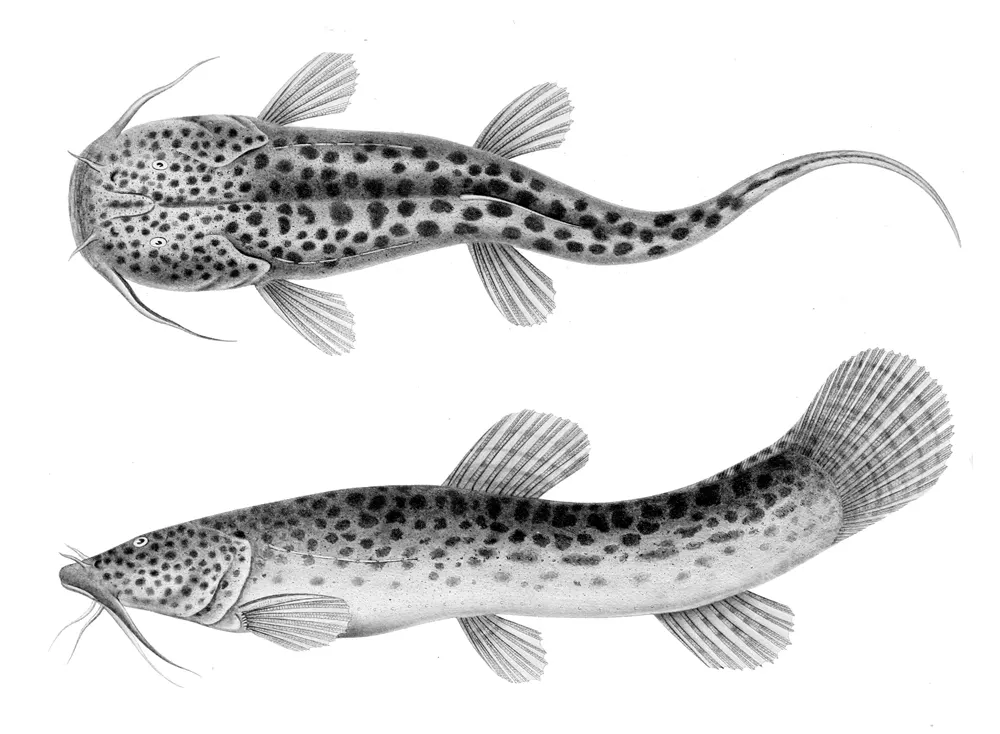
This is an elongated catfish with naked skin and no scales. It has three pairs of barbels (whiskers): on the chin, on the upper jaw and by the nostrils. There is no adipose fin, the small fleshy fin many catfishes carry behind the dorsal fin, and the gill cover lacks spines.
The head is flattened, the mouth wide and lined with many small teeth, and the eyes are small. The body is yellowish to light brown with irregular spots, most visible on the fins, and the belly is paler. Maximum length is given as 40.7 cm in one reference, while a hobbyist factsheet says 24 cm, so the true upper size is unclear.
Where it lives
The species lives only in Chile, in permanent rivers and streams. A hobbyist factsheet says it was once widespread through central Chile and is now limited to isolated localities around Concepcion, Rancagua and Angol. The same factsheet says it is considered extinct in almost all Chilean rivers, apart from some relatively undisturbed coastal catchments.
The 2023 assessment puts the extent of occurrence at about 40,297 square kilometres and the area actually occupied at about 17,812 square kilometres. Both are recorded as still shrinking.
Pins are Wikidata “endemic to” fields. Orange dots, when present, are GBIF occurrence tiles — survey bias included.
How it lives
It feeds at night, mostly on bottom-living prey. In a stomach-content study cited by the factsheet, true bugs (Hemiptera) were the most frequent item, followed by amphipods (small crustaceans) and midges (Chironomidae). Worms and other insects are also reported.
Breeding appears to happen once a season, in late spring or early summer. The assessment gives a generation length of 4 years. Little else about its life history has been published, and captive fish are reported to refuse food and die within months, so the species has not been kept successfully.
Why it is in trouble
The assessment records a past population reduction of about 90 percent and a further ongoing reduction of around 50 percent, both based on loss of occupied area and habitat quality. The threats it lists centre on the rivers: soil erosion and sedimentation, nutrient loads, small-holder and agro-industry plantations and farming, pesticides and herbicides, rubbish, drought, dams, and water taken for domestic, commercial and agricultural use.
The hobbyist factsheet adds dredging, channelling, fragmented habitat, loss of streamside forest and predation by introduced fish.
What is being done
The assessment lists the conservation actions needed, including site and habitat protection and management, habitat restoration, control of problem species, education and awareness, and a genome resource bank. It also records that there is no recovery plan and no systematic monitoring scheme in place.
Sources
Written for this catalog in our own words from the sources below, checked against them on 12 November 2026. Population figures are estimates and carry the year they were made. Status and assessment year: IUCN. 2026. The IUCN Red List of Threatened Species. Version 2026-1. iucnredlist.org.




