Endangered
Rough gecko
Naultinus rudis
The rough gecko (Naultinus rudis) is a day-active, tree-dwelling gecko found only in the north-east of New Zealand's South Island, including the Kaikoura ranges. The IUCN Red List assessed it as Endangered in 2019. It gives birth to live young and is rarely seen.
How to recognise it
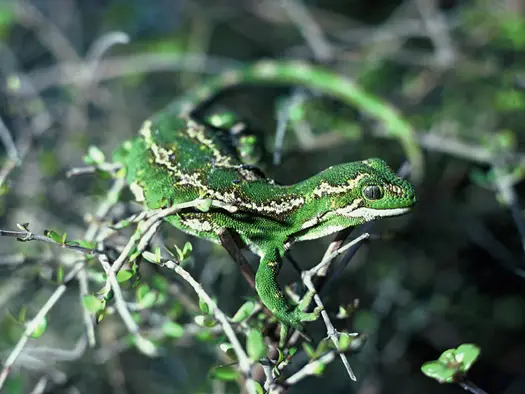
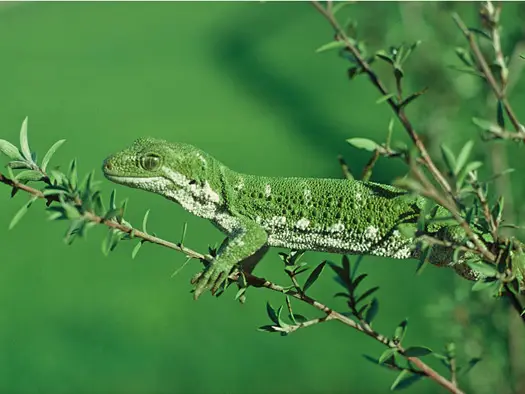
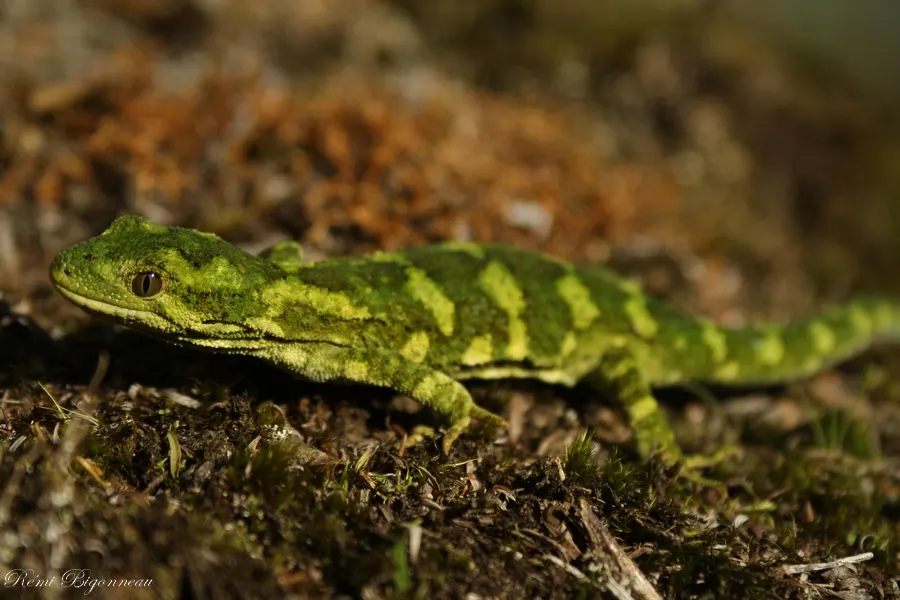
It is a mid-sized gecko, up to 79 mm from snout to vent, with a tail longer than the body. Adults can weigh up to about 15.5 g. The upper body ranges from green to grey and is covered in raised, enlarged scales that give it a bumpy look and its name, though the scales feel soft. Markings can be stripes, blotches or diamonds.
Zoo keepers describe males as olive green with white spots and females as softly spotted green. The inside of the mouth is grey-blue and the tongue pinkish-grey.
Where it lives
The species is found in the north-east of the South Island, from east of the Wairau River south to northern Canterbury, with the Waiau Uwha River possibly marking its southern limit. It lives in forest, scrub and swamp, and seems to favour scrubby or regenerating ground. The IUCN estimates its extent of occurrence at about 3,579 square kilometres, with only about 68 square kilometres actually occupied.
Pins are Wikidata “endemic to” fields. Orange dots, when present, are GBIF occurrence tiles — survey bias included.
How it lives
This gecko climbs, grips branches with a prehensile tail, and spends much of the day basking. It eats mostly flying insects such as moths, flies and beetles, plus small spiders, nectar, small fruits and scale insect honeydew. If threatened it gapes and barks.
Rough geckos are solitary. Males fight in the breeding season and often carry scars. Females bear one or two live young a year, in roughly late February to April, and the young mature at 1.5 to 2 years. Captive geckos have reached about 50 years old, and wild individuals have lived at least 15.
Why it is in trouble
The IUCN describes a decreasing, severely fragmented population with a shrinking occupied area. Listed threats include introduced mammal predators, collecting for the pet and display trade, and earthquakes and tsunamis. The New Zealand Herpetological Society adds habitat clearance and development, and competition and predation from Vespula wasps. Zoo keepers say the geckos are an easy meal for rodents.
Very little was known until recently. Before a 2019 survey run by Fauna Finders with Auckland Zoo support and led by Dr Marieke Lettink, only about 40 rough geckos had ever been recorded in the wild, most of them decades ago. The survey more than doubled the number of recorded sightings.
What is being done
After that survey, scientists lowered the gecko's national status in New Zealand from Nationally Endangered to Nationally Vulnerable, while the IUCN keeps it at Endangered. The IUCN notes the species occurs in at least one protected area, and it is covered by international trade controls (CITES Appendix II). The survey team searched sites using old records and public reports, then talked to landowners about protection once geckos were found. Auckland Zoo keeps the species and reported its first rough gecko birth in eight years in May 2021.
Sources
Written for this catalog in our own words from the sources below, checked against them on 12 November 2026. Population figures are estimates and carry the year they were made. Status and assessment year: IUCN. 2026. The IUCN Red List of Threatened Species. Version 2026-1. iucnredlist.org.