Critically Endangered
Natterer's Longwing
Heliconius nattereri
Natterer's longwing is a rare butterfly found only in a strip of Brazil's Atlantic Forest between Espírito Santo and Bahia. Adults flit high in the canopy of mountain forest. The IUCN Red List lists it as Critically Endangered, though that assessment dates from 1996.
How to recognise it
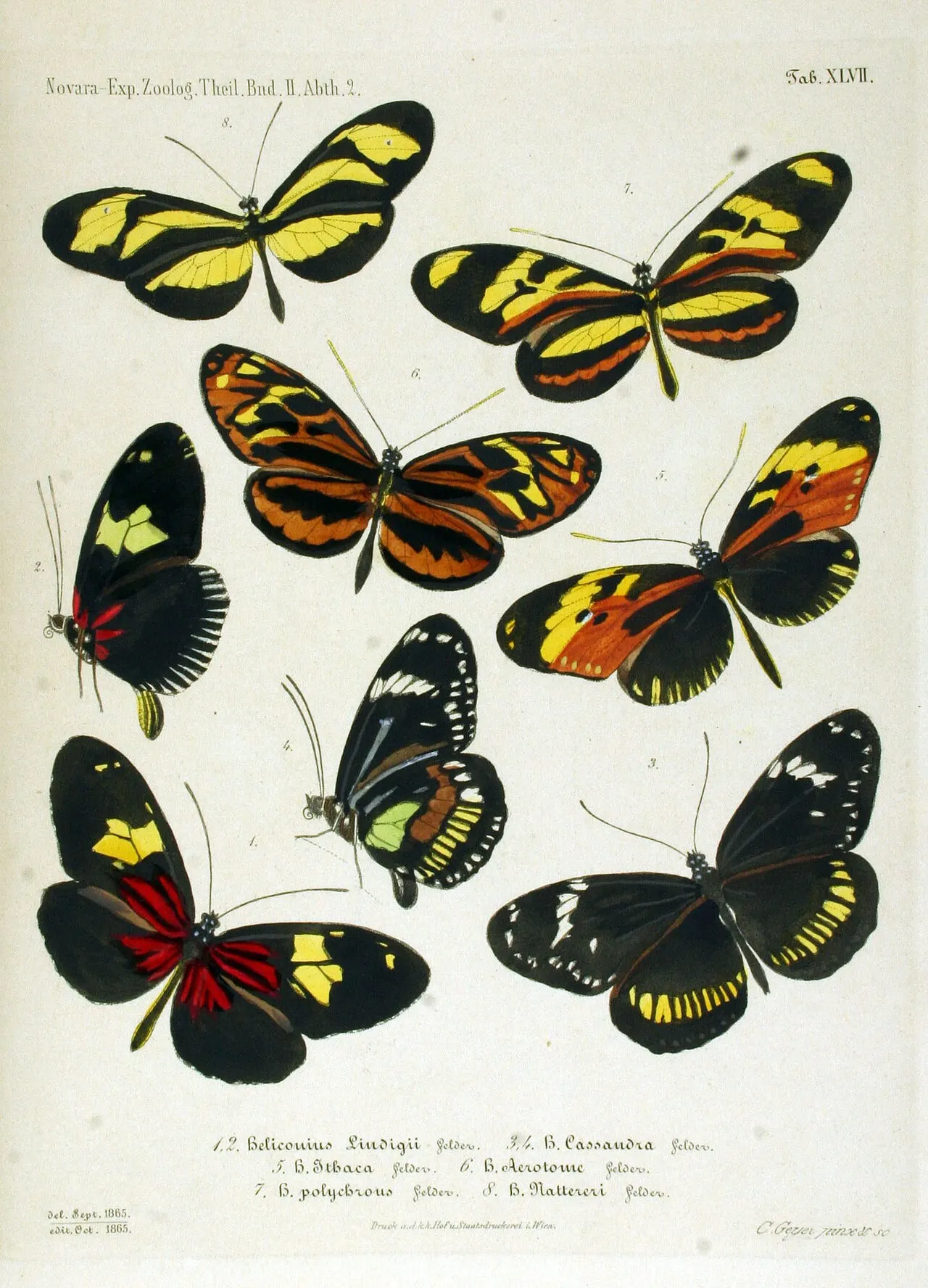
Heliconius nattereri belongs to the longwings, a group of Neotropical butterflies with long, narrow wings. It was described in 1865 by the entomologists C. and R. Felder. Females are black with orange and yellow markings, while males are black and yellow. The two sexes also seem to use the forest differently: males are reported to fly faster and gather in the canopy, females to fly slower in the middle layers.
Where it lives
The butterfly is endemic to Brazil. A 2020 genomic study in BMC Biology put its range in parts of Espírito Santo and Bahia, usually above about 500 metres, in four forest areas each ringed by cleared land. A 2017 paper in Biota Neotropica put the range at under 1,000 kilometres end to end.
That paper confirmed the northernmost population near Amargosa, Bahia. The other confirmed populations are at Serra Bonita Reserve near Camacan, Bahia, where it was seen in 2016, and at Santa Teresa, Espírito Santo, inside the Augusto Ruschi Biological Reserve.
Pins are Wikidata “endemic to” fields. Orange dots, when present, are GBIF occurrence tiles — survey bias included.
How it lives
It favours dense mountain forest, mostly above about 600 metres. Adults fly high and are hard to find, and densities are usually low. At Amargosa, researchers saw males and females over six days in 2016. A five-day search in 2017 turned up one male, collected while feeding on flowers about 10 metres up, and three others flying past.
The host plant there, the passion vine Passiflora contracta, was confirmed in 2013, and the male collected in 2017 was feeding on Gurania, a cucumber relative. A narrow choice of host plants and slow development from caterpillar to adult add to its vulnerability, according to the 2020 study.
Why it is in trouble
Before the naturalist Keith Brown rediscovered it in the 1960s, only about 20 pinned museum specimens were known. Deforestation has left the species in small patches, and illegal logging was reported in the Amargosa mountains.
Its genes show the strain. The 2020 study found nucleotide diversity of about 36 percent of that in the common Heliconius melpomene, and patterns that suggest a recent population bottleneck. Modelled effective population size is around 620,000 today, though the Santa Teresa population has sat near 40,000 for some 30,000 years.
What is being done
Two of the three confirmed sites lie in protected areas. The Amargosa population has no formal protection, although a 2011 municipal decree created a reserve there. A 2017 paper by Cardoso, Brito and Lion calls for urgent protection of these mountain forests and long-term mark-recapture studies at Amargosa.
Sources
Written for this catalog in our own words from the sources below, checked against them on 12 November 2026. Population figures are estimates and carry the year they were made. Status and assessment year: IUCN. 2026. The IUCN Red List of Threatened Species. Version 2026-1. iucnredlist.org.




