Endangered
White-throated wren-babbler
Napothera pasquieri
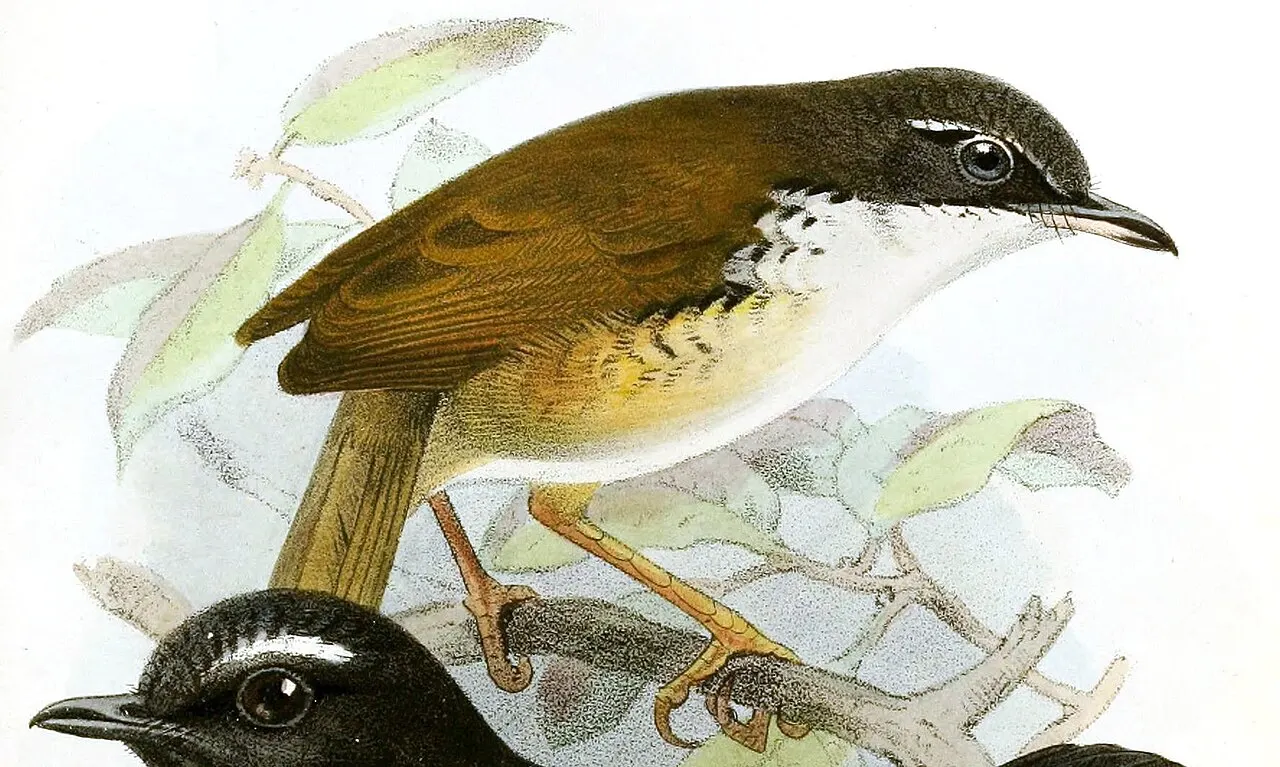
The white-throated wren-babbler (Napothera pasquieri) is a small forest bird found in the mountains of northwestern Vietnam, with possible presence in neighbouring Yunnan, China. The IUCN Red List rated it Endangered in 2024. It has a very long bill and a bright white throat.
How to recognise it
It's a small bird, 11 to 12 cm long, streaky brown and almost tailless. The bill is long and slightly curved downward, and the white throat stands out against the dark rufous-brown head and streaked back.
It was first described in 1930 by Jean Delacour and Pierre Jabouille as Rimator pasquieri, and later moved to the genus Napothera. The species name honours Pierre Pasquier, a French colonial administrator who served as Governor-General of Indochina.
Where it lives
The type locality is Fan Si Pan in northern Vietnam, and the bird is known from the surrounding Fansipan mountains. The IUCN assessment gives an altitude range of 1,220 to 2,500 m. It lives in moist montane forest and, less importantly, in high-altitude shrubland.
China's Yunnan Province is listed as a place where it possibly still occurs. Vietnam is the only country with confirmed presence.
Pins are Wikidata “endemic to” fields. Orange dots, when present, are GBIF occurrence tiles — survey bias included.
How many are left
The 2024 assessment estimated 500 to 5,000 birds in total, spread over 3 to 20 locations, and judged the population to be decreasing. One generation is put at about 2.7 years.
Why it is in trouble
Farming is the main pressure. The assessment names small-holder farming and agro-industry as the biggest threats, with new roads a smaller one. All three convert or degrade the montane forest the bird depends on.
The assessment also calls for keeping cardamom planting out of the forest understorey inside protected areas, which indicates that understorey cardamom is a known source of habitat degradation within its range.
What is being done
It occurs in at least one protected area, and the IUCN notes that conservation sites have been identified across its whole range. What's still needed is more of the range brought under protection and better enforcement inside existing reserves. No recovery plan, monitoring scheme or captive programme was in place at the time of assessment.
Sources
Written for this catalog in our own words from the sources below, checked against them on 12 November 2026. Population figures are estimates and carry the year they were made. Status and assessment year: IUCN. 2026. The IUCN Red List of Threatened Species. Version 2026-1. iucnredlist.org.




