Endangered
Marbled streamlined frog
Marbled streamlined frog
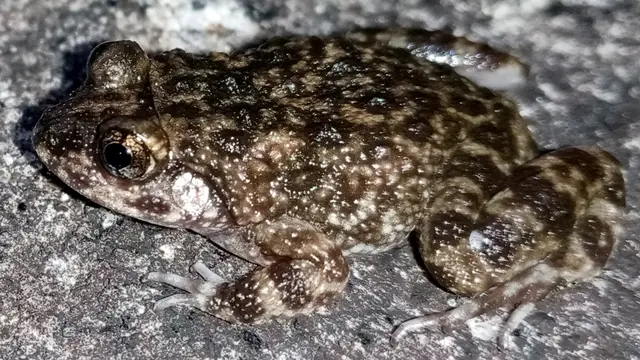
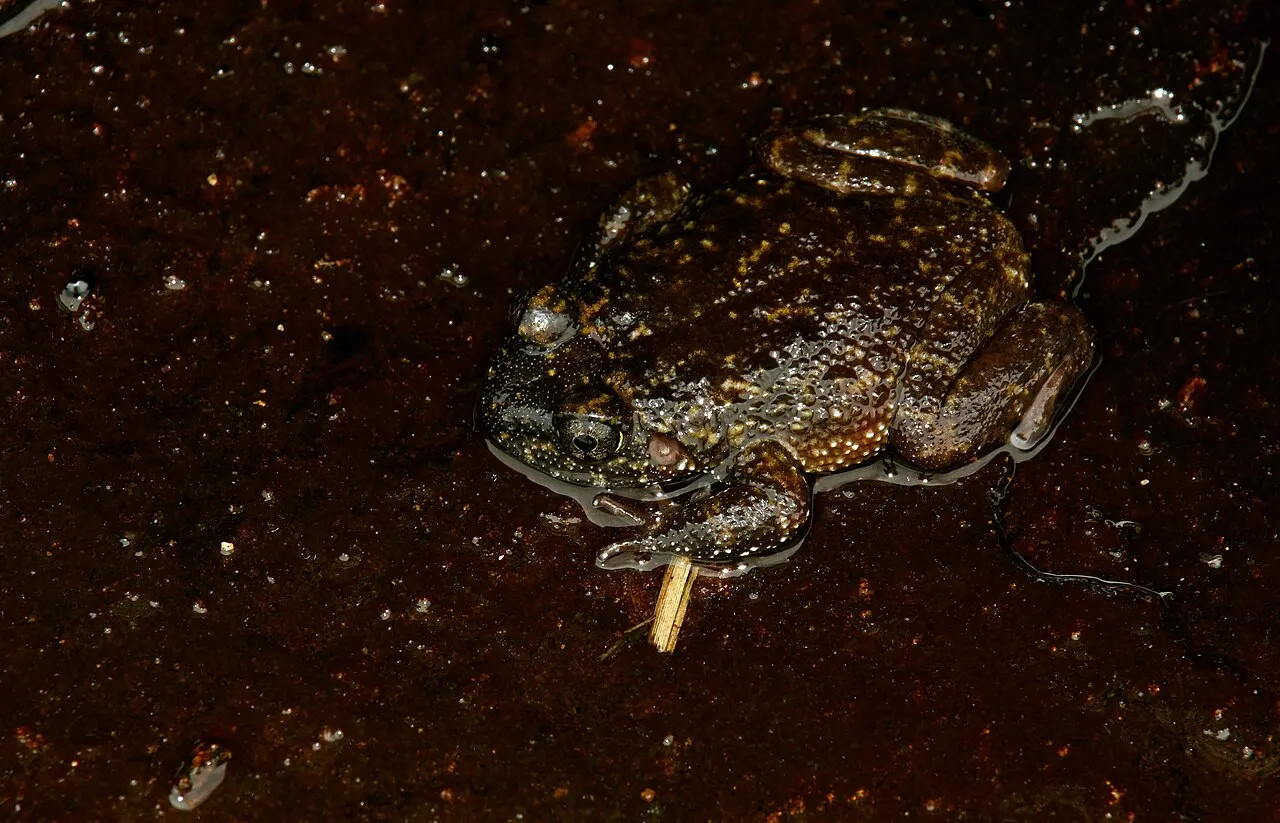
Marbled streamlined frog, known as Kirtisinghe's rock frog or the marbled streamlined frog, is a small, stout-bodied frog found only in the Knuckles Mountain Range of central Sri Lanka. It lives on wet rock beside fast mountain streams. The IUCN Red List assessed it as Endangered in 2020, down from Critically Endangered in 2008.
How to recognise it
This is a small frog, reported at about 2.5 cm long by one source and about 4.5 cm by another, with a stout body, a broad short head and a rounded snout. The back is brown with darker streaks, the belly is pale grey, and the legs carry dark brown cross-bands. The eardrum is about half the size of the eye.
Kirtisinghe described the species in 1946. It was long filed with the true frogs (Ranidae), but DNA work moved it to the family Dicroglossidae. Its tadpoles are semi-terrestrial, sitting on wet rock in the splash zone rather than in open water.
Where it lives
It is endemic to the Knuckles range, found at roughly 200 to 1,300 m above sea level. The frogs live in and beside fast-flowing forest streams, tucked under boulders, in rock crevices and on wet rock faces. Tadpoles sit on rock in the splash zone beside the torrent.
How big its range really is has been debated. Older estimates put its extent of occurrence at about 82 square km. A 2020 study in the Russian Journal of Herpetology, led by Kanishka Ukuwela, combined field surveys, DNA tests and habitat modelling and predicted about 831 square km, with the eastern slopes of the range looking most suitable. The researchers asked for the frog to be confirmed in those predicted areas before any status change. The IUCN assessment lists 1 to 5 locations.
Pins are Wikidata “endemic to” fields. Orange dots, when present, are GBIF occurrence tiles — survey bias included.
How it lives
Breeding is squeezed into the short wet season, roughly November to February. According to a 2018 Sunday Times report, the frogs come out onto the rock at night to feed, mostly in the early evening. Numbers fall through the dry season, which lasts about eight months.
Why it is in trouble
The IUCN gives the population trend as decreasing and says the habitat is still shrinking. Its threat list includes housing, small-holder farming, tourism and recreation, fire, herbicides and pesticides, drought, and the unintentional effects of small-scale harvesting. Researchers also point to encroachment by cardamom and tea plantations.
Warming is a further worry, because the frogs rely on a thin film of water over the rock. In 2018 a Sri Lankan newspaper reported that walkers on a nature trail crush tadpoles on exposed rock during the wet season, and that a local forest officer had agreed in principle to move the stretch of trail crossing frog habitat. Surveys have found some frogs near highways and tea estates, which hints at a degree of tolerance for disturbed ground.
What is being done
The species occurs in at least one protected area, and the IUCN lists habitat protection, site protection and site management among the conservation actions. The 2020 modelling paper recommends fuller surveys, including the rest of the sanctuary, ongoing monitoring of both frogs and habitat, and keeping plantations from encroaching. Public signs about the frog were being planned in 2018.
Sources
Written for this catalog in our own words from the sources below, checked against them on 12 November 2026. Population figures are estimates and carry the year they were made. Status and assessment year: IUCN. 2026. The IUCN Red List of Threatened Species. Version 2026-1. iucnredlist.org.