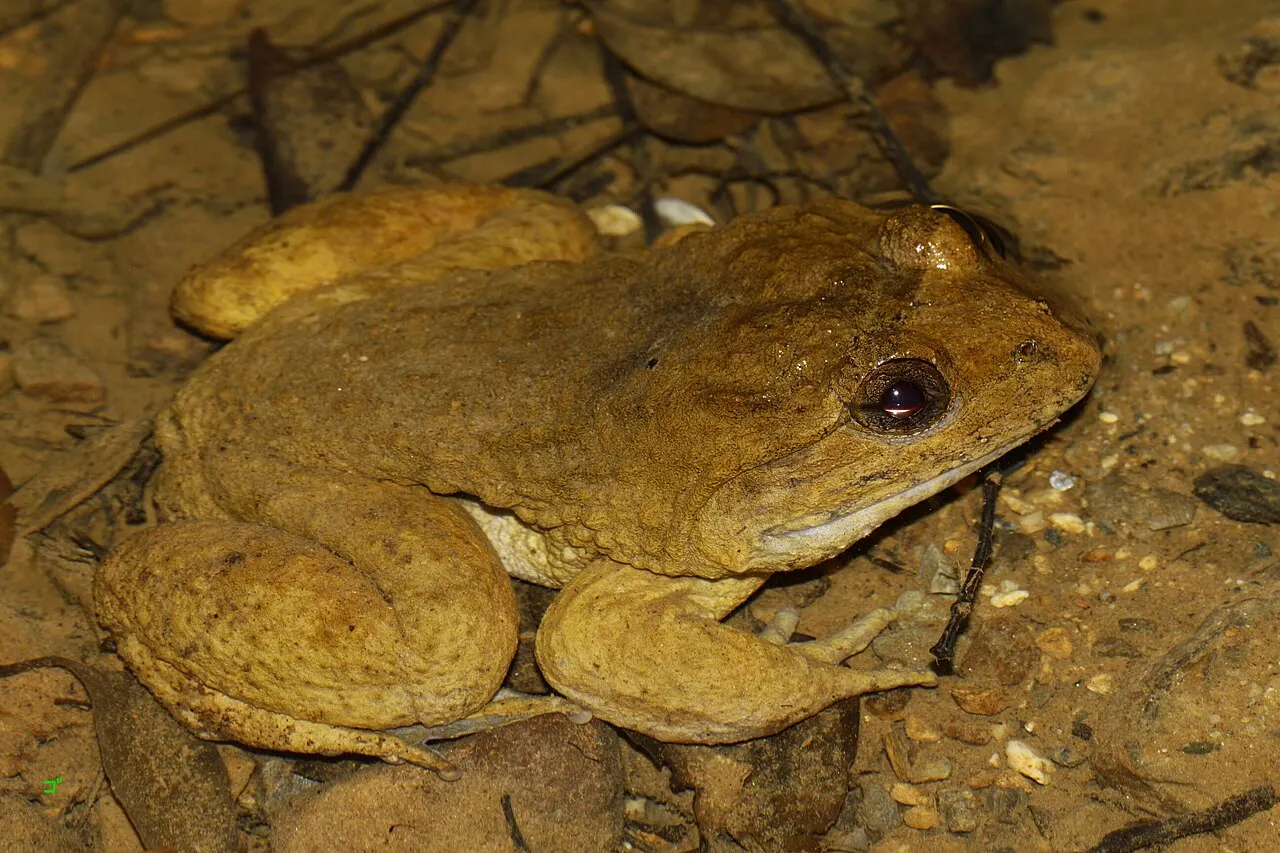
Endangered
Namiye's frog
Limnonectes namiyei
Namiye's frog (Limnonectes namiyei), also called the Okinawa wart frog, lives only on Okinawa Island in Japan, along forest streams. It was assessed as Endangered in 2021 because its range is small, about 247 square kilometres, in a single location, though the Red List now describes its population trend as stable.
Names and discovery
Leonhard Stejneger described this frog in 1901 as Rana namiyei. The name honours Motoyoshi Namiye, a Japanese naturalist and herpetologist. In English it is called Namiye's frog, Namie's frog or the Okinawa wart frog, and the Japanese name is Namie gaeru. It belongs to the family Dicroglossidae.
Where it lives
The frog is found only in Japan, in the Nansei Islands, and only on Okinawa Island. The Red List counts a single location and an extent of about 247 square kilometres. The habitats listed are permanent rivers and creeks (including waterfalls) and subtropical dry forest, and the species is reported to favour upstream stretches within primary broad-leaved evergreen forest. Nearly all of the roughly 200 records on the global biodiversity database GBIF come from Okinawa.
Pins are Wikidata “endemic to” fields. Orange dots, when present, are GBIF occurrence tiles — survey bias included.
Why it is in trouble
It used to be a common frog and has declined sharply. The IUCN has rated it Rare in 1994, Vulnerable in 1996, Endangered in 2004 and Endangered again in 2021. Forest clearing and the building of roads and dams cost it habitat, and roads and dams remain recorded threats, rated low impact in 2021. Small-scale wood harvest is also listed as a low-impact threat.
Introduced mongooses preyed on the frog, and the 2021 assessment classes that threat as past and unlikely to return. Mongoose removal in the northern part of Okinawa Island began under the prefecture in 2000 and the national environment ministry in 2001. Japan's environment ministry reported that the first ten-year plan sharply reduced mongoose numbers and range, though the animals had not been eliminated by 2014. A second plan set complete removal from a defined northern area by the 2022 fiscal year.
What is being done
The Red List records site protection and management, sub-national legislation and control of invasive species as actions in place, though it says the frog does not occur in a protected area. The 2021 assessment gave the trend as stable. The frog sits in the Endangered category because it occupies one small area where habitat is still declining.
Sources
Written for this catalog in our own words from the sources below, checked against them on 12 November 2026. Population figures are estimates and carry the year they were made. Status and assessment year: IUCN. 2026. The IUCN Red List of Threatened Species. Version 2026-1. iucnredlist.org.

