Endangered
Sulawesi wart frog
Sulawesi wart frog
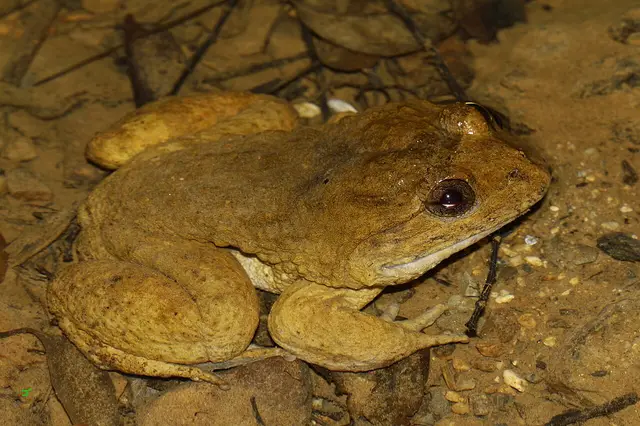
The Sulawesi wart frog is a stream frog of the mountains of southwest Sulawesi, Indonesia. The IUCN Red List rated it Endangered in 2019. It is a fanged frog, one of a poorly studied group on the island, and it is reportedly common where forest remains.
Where it lives
This frog is endemic to Sulawesi, the large island in central Indonesia. It is usually described from the Moncong Lompobatang massif in the south-west, in montane forest at 1,000 m and above. The IUCN counts two locations, sets the lower elevation limit at 1,000 m and estimates the extent of occurrence at only 858 square kilometres.
Museum records suggest it may reach further. Specimens catalogued under this name in GBIF include some from near Cikoro on Gunung Lompobatang (about 1,300 m) and Bontomaranu (about 1,170 m), and others from Bantimurung National Park in Maros at 495 to 573 m, well below the 1,000 m floor. A 2023 paper in PLOS ONE (Frederick and colleagues) reported the frog living alongside other fanged frogs at Bontomaranu and Bontosiri, so the range may be wider than the Red List account states.
Pins are Wikidata “endemic to” fields. Orange dots, when present, are GBIF occurrence tiles — survey bias included.
How it lives
The Red List lists two habitats for the species, moist montane forest and permanent streams, including waterfalls. It lives in and around the streams themselves.
It belongs to the Dicroglossidae and to Limnonectes, the fanged frogs. The Sulawesi fanged frogs are a poorly studied group, with at least 15 species recognised in the 2023 paper but only five formally described. They vary widely in how they breed. In that paper's genetic comparison, this species differed from its relative Limnonectes arathooni by at least 3.85 percent in a mitochondrial gene fragment, so the two are clearly separate.
Why it is in trouble
The 2019 assessment records a decreasing population and continuing loss of habitat area. It lists small-holder farming, shifting agriculture, and housing and urban growth as ongoing threats, along with harvest of the frog as human food. Each is rated as low impact. The assessment says the habitat is not severely fragmented, and gives no population count.
The species was first described as Rana microtympanum by Van Kampen in 1907 and is now placed in the genus Limnonectes.
What is being done
The Red List says the frog occurs in at least one protected area. It lists site management and habitat protection as conservation actions, and calls for research on population size, distribution and trends, threats and harvest levels. No captive breeding programme is listed.
Sources
Written for this catalog in our own words from the sources below, checked against them on 12 November 2026. Population figures are estimates and carry the year they were made. Status and assessment year: IUCN. 2026. The IUCN Red List of Threatened Species. Version 2026-1. iucnredlist.org.