Endangered
Myathropa usta
Myathropa usta
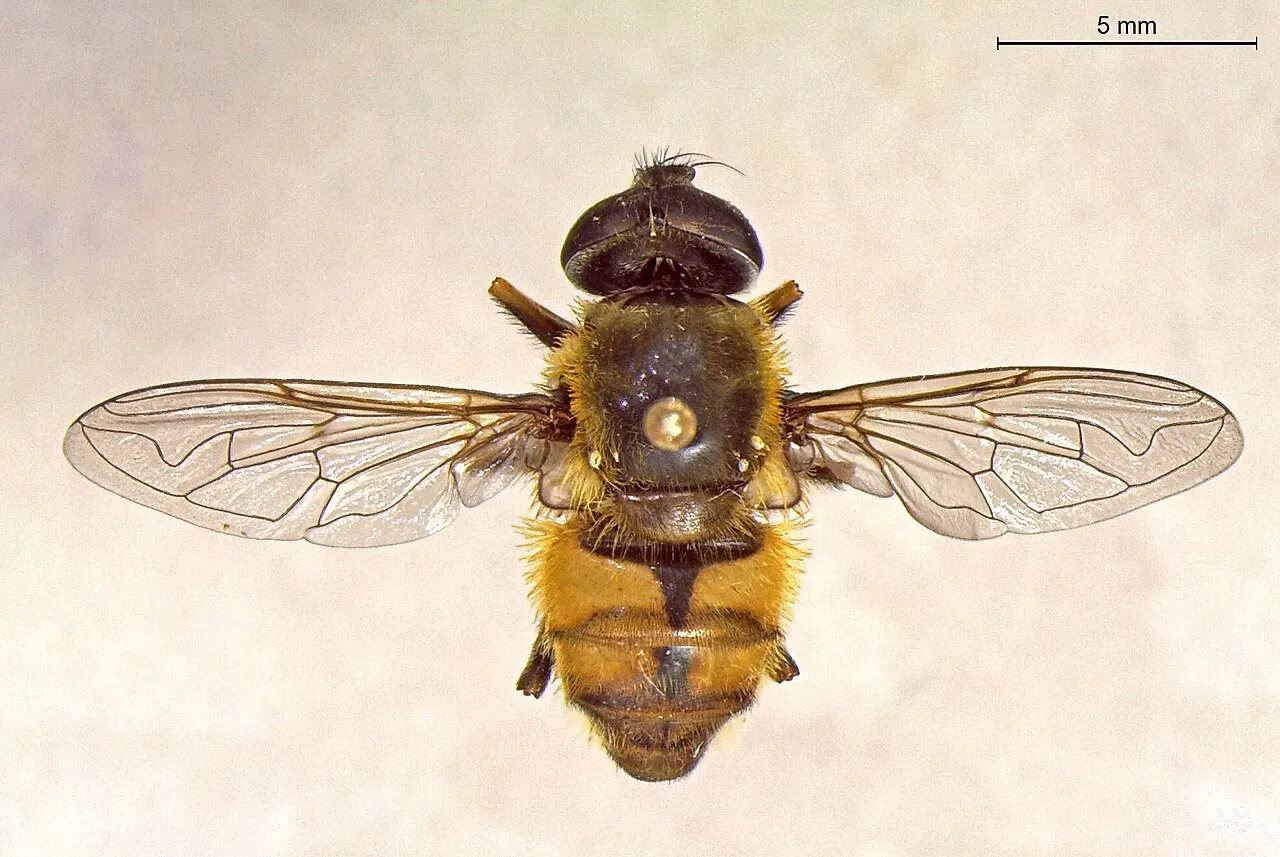
Myathropa usta is a large hoverfly found only on the island of Madeira, Portugal, in the Atlantic. Wollaston described it in 1858, and it is one of four hoverflies unique to the Madeira archipelago. The IUCN Red List assessed it as Endangered in 2021 because of its tiny range.
How to recognise it
In the 2022 identification key to Madeira's hoverflies, M. usta falls in a group of larger species that measure about 10 to 16 mm, some with a metallic bronze sheen. It is separated from the similar hoverfly Eristalis tenax by its eyes, which have no bands of fine hairs, and by its open wing cell R1.
The key illustrates a male and a female, each from above and in profile. Wollaston first named the species Eristalis ustus, and it was later moved to the genus Myathropa.
Where it lives
The IUCN lists only Madeira. The four endemic hoverflies of the archipelago occur mostly in native laurel forest (laurisilva) and high-altitude heathland on Madeira Island, and the IUCN describes this one as restricted to humid laurel forest and Erica forest in the centre and north of the island.
The IUCN counts five locations, with an area of occupancy of about 24 square km and an extent of occurrence of about 128 square km. That is a very small footprint, even for an island species. The global biodiversity database GBIF holds only 16 occurrence records.
Pins are Wikidata “endemic to” fields. Orange dots, when present, are GBIF occurrence tiles — survey bias included.
Life history
Adults have been recorded from March to September, though the IUCN thinks they are probably present all year. The larvae have not been described. They are expected to resemble those of the related Myathropa florea, which live in standing water, rot-holes and water-filled hollows among tree roots.
The species seems to be found in small numbers: about forty specimens are recorded as collected between 1935 and 2002.
Why it is in trouble
The 2021 assessment records an ongoing decline in the area of suitable habitat, though the trend in numbers is listed as unknown. Fire is treated as the main threat, since it defines the species' few locations. Invasive plants such as the Australian tree Pittosporum undulatum affect the laurel forest, and tourism and outdoor recreation may also put pressure on the habitat. Climate change may affect it in future.
The wider picture is hard to read, because the 2022 key notes that information on the distribution, ecology and conservation of Madeira's hoverflies is still lacking. It also points to land-use change, invasive species and climate change as threats to oceanic island wildlife, and expects trade and tourism to bring in more introduced species.
What is being done
Its conservation is tied to that of the laurel forest, which is protected and part of the Natural Park of Madeira. Area protection is the only conservation measure listed for it. The IUCN says research and monitoring of its biology and population trend are needed.
Sources
Written for this catalog in our own words from the sources below, checked against them on 12 November 2026. Population figures are estimates and carry the year they were made. Status and assessment year: IUCN. 2026. The IUCN Red List of Threatened Species. Version 2026-1. iucnredlist.org.




