Endangered
Mountain viper
Montivipera albizona
The central Turkish mountain viper (Montivipera albizona) is a venomous snake of rocky mountain slopes in central Turkey. The IUCN Red List rated it Endangered in 2009, citing a small range and a declining number of mature animals. It was only described as a species in 1990, and its exact status is still debated.
How to recognise it
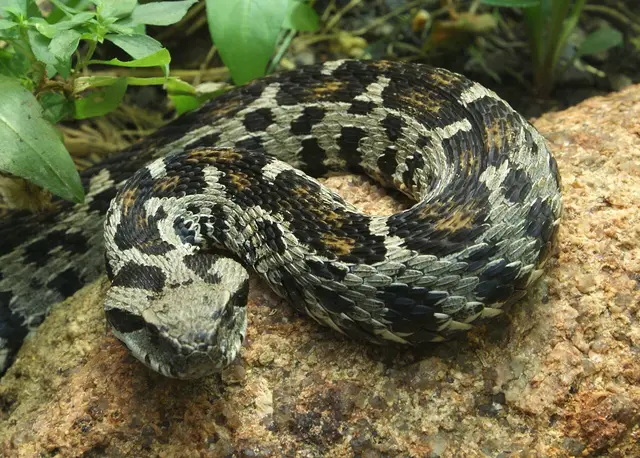
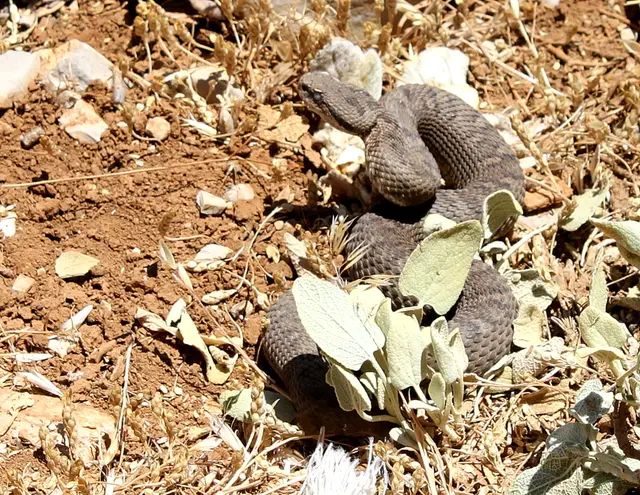
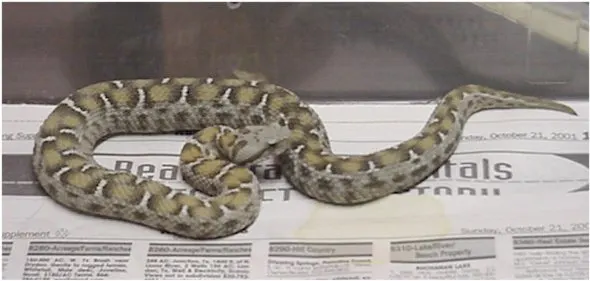
It is a stout viper with a broad head that stands out from the neck. The longest recorded male was a little under 78 cm, and most animals are smaller. The body is grey with about 30 narrow bands edged in white and black, separated by brick-red-brown zones.
Two large dark slanting spots mark the top of the head, and a dark stripe runs from the eye toward the corner of the mouth. The belly is grey with fine dark speckling. Like other vipers it is venomous, and it is listed as ovoviviparous, so females bear live young.
Where it lives
The snake is found only in Turkey, in the mountains of the central part of the country. The type locality is in the Kulmac Daglari range, close to the so-called Anatolian Diagonal. The exact spot is withheld for conservation reasons.
A 2020 study in Herpetological Conservation and Biology added 51 new localities for four mountain viper taxa of central-eastern Anatolia, this one included. It reported range extensions of more than 100 km for each taxon and an extent of occurrence roughly four to eight times larger than earlier literature and Red List maps showed.
Habitat is dry and rocky: temperate shrubland, grassland and bare rocky ground. The IUCN assessment gives an elevation band of 1,500 to 1,800 m.
Pins are Wikidata “endemic to” fields. Orange dots, when present, are GBIF occurrence tiles — survey bias included.
A species in dispute
Nilson, Andrén and Flärdh described it in 1990 as Vipera albizona. A group of specialists led by Schätti argued that it belongs with the Ottoman viper (Montivipera xanthina), while Mulder in 1994 supported it as a separate species on the basis of colour pattern. The 2020 study lists it as a subspecies of the Bolkar viper, Montivipera bulgardaghica albizona, and the Reptile Database calls its status uncertain. The Red List still treats it as its own species.
Why it is in trouble
The 2009 assessment, under criterion B1ab(v), which is based on a small range, rates the population as decreasing. It names two threats: animals being taken deliberately, and persecution. The assessment gives no figures for how many animals are lost.
The Reptile Database notes it among the 30 most endangered viper species, a list compiled by Maritz and colleagues in 2016.
What is being done
The IUCN assessment lists national and regional-level measures, trade and harvest management, site protection and awareness work as conservation actions. It is reportedly a strictly protected species under Appendix II of the Berne Convention. The new range records suggest the snake may be more widespread than thought, but that does not by itself show the population is stable.
Sources
Written for this catalog in our own words from the sources below, checked against them on 12 November 2026. Population figures are estimates and carry the year they were made. Status and assessment year: IUCN. 2026. The IUCN Red List of Threatened Species. Version 2026-1. iucnredlist.org.