Endangered
Lebanon viper
Montivipera bornmuelleri
The Lebanon viper (Montivipera bornmuelleri) is a small mountain viper found only on the high ridges of Lebanon and neighbouring Syria, often among rocks and cedar forest. The IUCN Red List rated it Endangered in 2006 because its range is small, broken into pieces and losing habitat to overgrazing.
How to recognise it
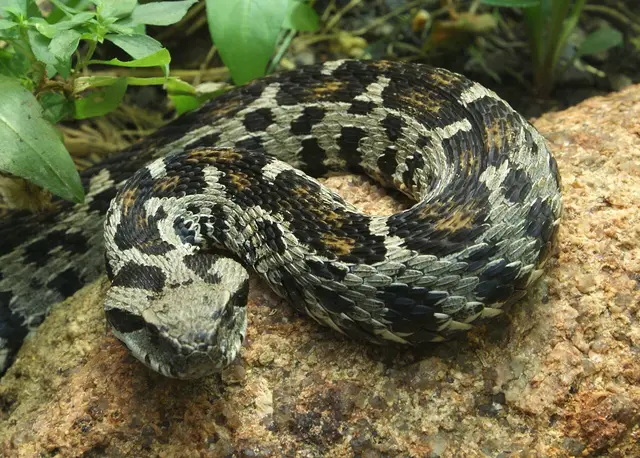
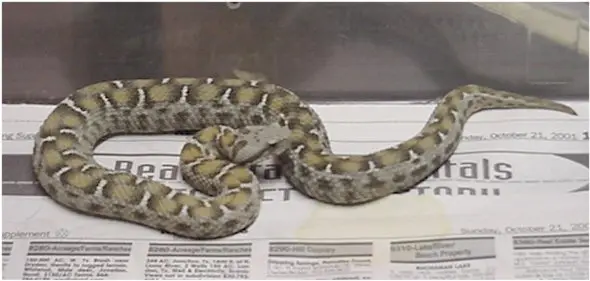
It carries a broken pattern of dark blotches along the back, and the centres of the blotches can be lighter. The tail ends in a yellow tip. Colour patterns vary enough between animals that a Lebanese field study called the populations polymorphic.
It is a small snake. Twelve animals caught in that 2012 study measured 20 to 55 cm from snout to vent, much smaller than the other vipers of Lebanon. It says the species barely exceeds 60 cm, though one reference reports a maximum total length of about 75 cm.
Where it lives
It is known from the Mount Lebanon and Anti-Lebanon ranges, Mount Hermon and Jabal al Arab in Syria. A species summary prepared for the Red List gives an elevation of about 1,000 to 2,200 m, while the Lebanese field study found it only between 1,900 and 2,200 m and says it occurs only above 1,800 m.
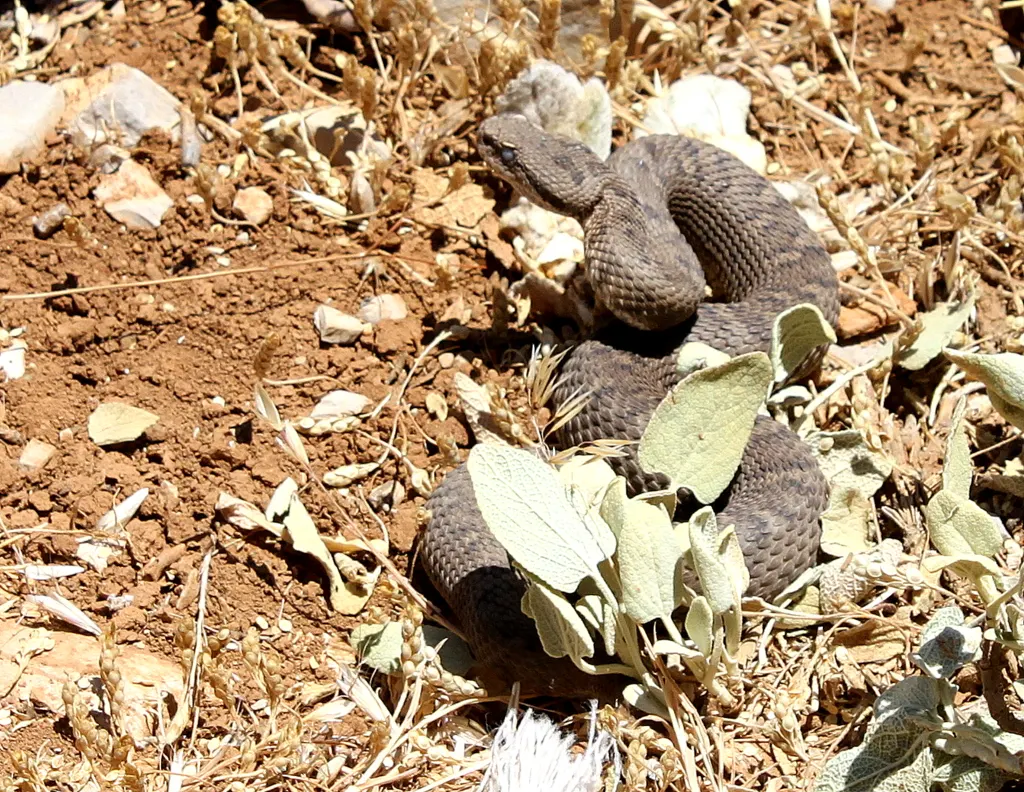
Its habitat is cedar forest, alpine grassland, and rocky ground with cushion-type plants. At Oyoun Al Simane on Mount Sannine the slopes are rocky, with small spiny Berberis shrubs, and are grazed by sheep and goats. It shares such places with several lizards and, on Jabal al Makmel near the Cedars, with other snakes.
Pins are Wikidata “endemic to” fields. Orange dots, when present, are GBIF occurrence tiles — survey bias included.
How it lives
In the cold mountain climate the snake hibernates for 7 to 8 months and is active for 4 to 5. Animals appear in early May, but they only creep out to bask close to their burrows, among rocks and plants that block the wind, when daytime air is around 14 to 18 degrees C. Small mammals and lizards make up the diet, and the burrows of the snow vole are common in its habitat.
Mating most likely happens in May and June. Females give live birth between mid-August and early September after about two to two and a half months. One female in the 2012 study gave birth to five young and another to one. The species summary gives litters of 2 to 18. The study also analysed the venom by mass spectrometry and found enzyme families typical of vipers, including metalloproteinases and phospholipases, but did not test its effects on people.
Why it is in trouble
The 2006 assessment found an extent of occurrence under 5,000 square km, split into fragments, with continuing loss in the extent and quality of mountain habitat through overgrazing. In Lebanon, sheep and goats overgraze the ground and off-road vehicles damage it. On Mount Hermon, military building and possible skiing development are further worries. The Red List also lists tourism and recreation, and commercial and industrial development, among the pressures.
The trend is recorded as decreasing. No population count exists, although the species summary says it can be common in suitable habitat.
What is being done
The viper occurs inside protected areas, including Arz Al-Shouf and Horj Ehden in Lebanon and the Hermon Reserve. The Red List lists site management as the conservation action in place, and no programme aimed at this species is known.
Sources
Written for this catalog in our own words from the sources below, checked against them on 12 November 2026. Population figures are estimates and carry the year they were made. Status and assessment year: IUCN. 2026. The IUCN Red List of Threatened Species. Version 2026-1. iucnredlist.org.
- IUCN Red List assessment, Montivipera bornmuelleri (2006), read via the Red List API
- IUCN Mediterranean species summary sheet, Montivipera bornmuelleri (2006)
- Hraoui-Bloquet et al. 2012, Lebanese Science Journal 13(1)
- Wikipedia, Lebanon viper
- Society for the Protection of Nature in Lebanon, species page