Endangered
Takitimu gecko
Mokopirirakau cryptozoicus
The Takitimu gecko (Mokopirirakau cryptozoicus) is a rock-dwelling, live-bearing gecko found only in the lower South Island of New Zealand. The IUCN Red List rated it Endangered in 2019 and lists its population as declining. Its species name means hidden living, and it is rarely seen.
How to recognise it
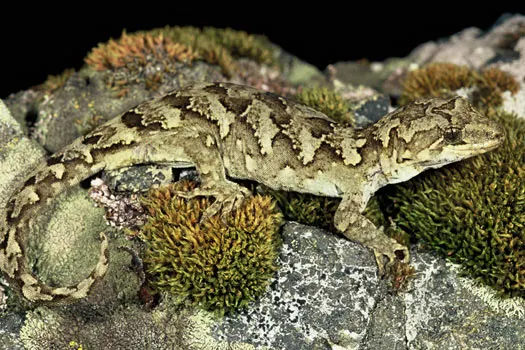
This is a medium-sized gecko, reaching about 87 mm from snout to vent and up to 18 g. The back is slate grey, dark brown or cream-grey, usually with pale herringbone patterns and larger blotches or stripes. Some animals carry orange, red or purple-grey spots.
A dark V-shaped mark sits between the eyes, and a pale stripe runs from the nostril through the eye to the ear. The belly is mottled pale grey or yellow-pink, and the inside of the mouth is bright orange. The intact tail is shorter than the body.
Where it lives
It occurs only in Southland and western Otago, in the south of the South Island. Known sites include the Tākitimu Mountains (the type locality, where the species was described in 2004), the Rees Valley, the northern Richardson Mountains and the Waitutu Forest. A population was found more recently on Resolution Island.
Its home is crevices in bluffs, rock outcrops and scree, in alpine and subalpine country. It also turns up in mature beech and podocarp forest. The Red List gives an elevation range of 200 to 1,150 m, while the New Zealand Herpetological Society's reptile page gives a ceiling of 1,450 m. The Red List puts its extent of occurrence at about 1,800 square km.
Pins are Wikidata “endemic to” fields. Orange dots, when present, are GBIF occurrence tiles — survey bias included.
How it lives
The Takitimu gecko is mostly nocturnal, though it may bask half-hidden near its retreat. It eats moths, spiders, weta and other alpine invertebrates, and seasonally takes nectar and small fruits from subalpine plants.
Females give birth to live young, one or two at a time, about every two years. Young animals probably mature at 1.5 to 2 years, perhaps up to 4 in alpine populations. Captive geckos of this kind have often lived more than 25 years, but how long wild ones survive is largely unknown. The Red List estimates a generation at 15 years.
Why it is in trouble
The Red List counts the population as severely fragmented and declining, and names invasive species among the threats. The New Zealand Herpetological Society points to introduced mammalian predators, which have hit the country's lizards hard, and adds that climate change is stressing alpine habitat.
No total count exists. One estimate, reportedly fewer than 10,000 animals scattered in pockets, is rough and undated.
What is being done
Almost all of the population, 91 to 100 percent by the Red List's estimate, lies inside protected areas. The species is on CITES Appendix III, listed by New Zealand.
No management program targets this gecko alone. Some of its habitat receives wide-scale pest control aimed at other conservation goals.
Sources
Written for this catalog in our own words from the sources below, checked against them on 12 November 2026. Population figures are estimates and carry the year they were made. Status and assessment year: IUCN. 2026. The IUCN Red List of Threatened Species. Version 2026-1. iucnredlist.org.




