Endangered
Néhoué River Mossy Gecko
Mniarogekko jalu
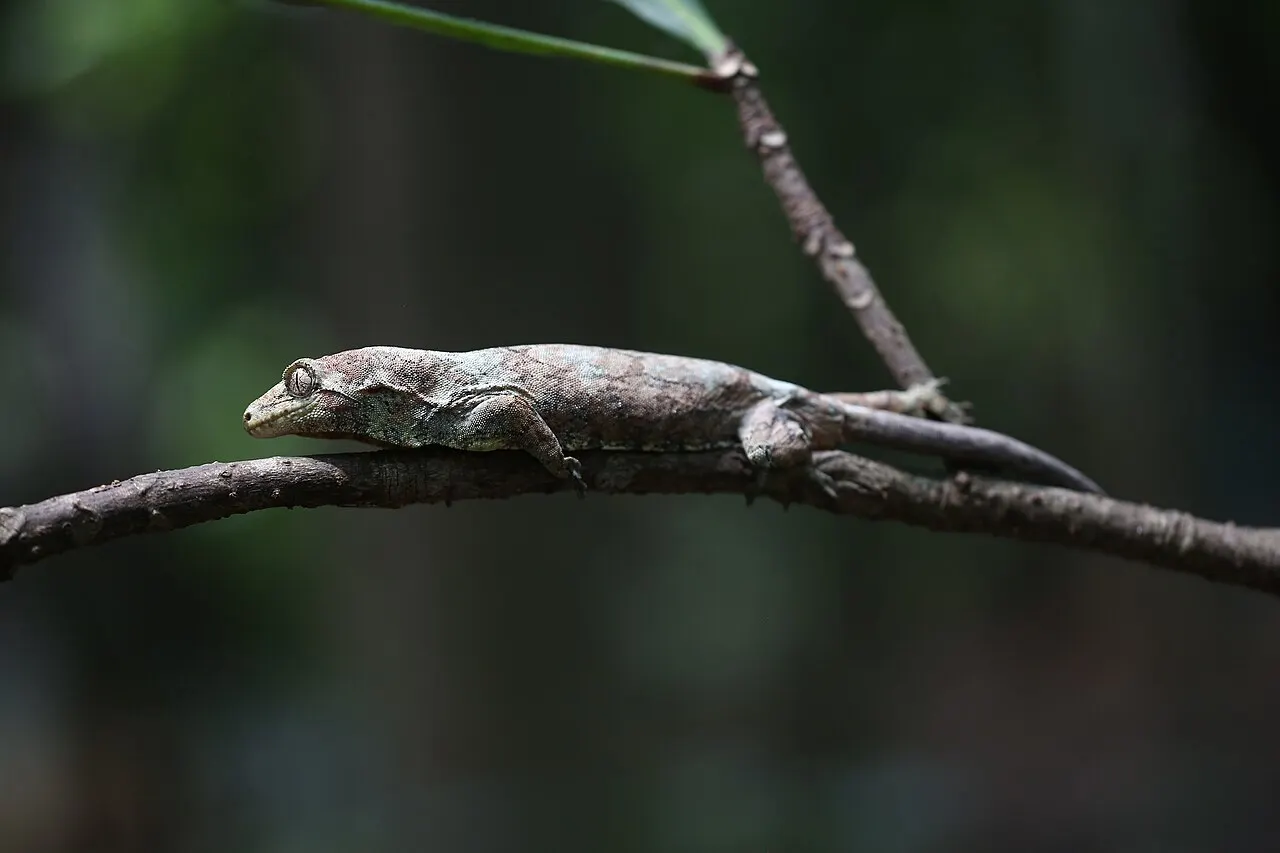
The Néhoué River mossy gecko (Mniarogekko jalu) is a large, tree-dwelling gecko found only in the far north of New Caledonia. The IUCN Red List rated it Endangered in 2021. It grows to about 140 mm from snout to vent, and its species name means "spirit" in the Nyêlâyu language.
How to recognise it
This is a big gecko, up to about 140 mm from snout to vent, not counting the tail. The belly is a uniform pale yellowish green.
Its sister species, Mniarogekko chahoua, usually has a white or cream belly with green only in places. Males of M. jalu also carry fewer pores in front of the vent (54 to 91, usually in three rows) than M. chahoua, which has about 120. The species was formally described in 2012, in a revision of New Caledonia's giant geckos.
Where it lives
The species is known only from the northern end of New Caledonia: a few sites in the far north of the main island, Grande Terre (the Néhoué River, the Tiébaghi massif and the Ougne forest), and the Belep Islands, including Art Islet. The type specimen came from Art Islet at about 230 m elevation, roughly 2 km east of Waala.
The IUCN assessment counts four locations, an occupied area of about 24 square kilometres and a range of about 1,341 square kilometres. It lives in moist lowland forest from sea level to around 500 m.
Pins are Wikidata “endemic to” fields. Orange dots, when present, are GBIF occurrence tiles — survey bias included.
How it lives
It has been found only in old-growth closed forest with large trees, from tall valley forest on river soils to low forest on rocky plateaus. It seems to live entirely in the trees. At night it forages in twigs and outer foliage, and by day it shelters in holes and crevices in trunks and branches, favouring the tangled roots of banyan trees.
Eggs have been found in a tree crevice and among ferns growing on branches. Researchers watched geckos in fruiting trees at night and assumed they were eating the berries, as its relative M. chahoua is known to do. When threatened, it coils into a ball and drops to the forest floor.
New Caledonia's giant geckos are linked in local tradition with the spirit world, both feared and respected. That is the origin of the name jalu.
Why it is in trouble
The IUCN lists five ongoing pressures, each scored as high impact: more frequent and intense fires, mining and quarrying, introduced cats, the invasive little fire ant (Wasmannia auropunctata), and intentional use or collection of the animal. It records a continuing decline in habitat area and in the area the species occupies. The population trend is unknown.
Old-growth forest in its range is now reduced to scattered remnants after repeated burning and clearing. The original description reported the gecko missing from a mountain gully where mining dust had coated the vegetation, and absent from a forest valley swamped with fire ants, although it was common in the next valley. No total population estimate exists. Surveys in 2001 and 2002 found it relatively numerous at each known site.
What is being done
The IUCN lists site protection, site management and control of invasive species as conservation actions. The 2021 assessment records the species as absent from protected areas. The original description mentions one site with reserve status, a small recreation reserve at the Néhoué River that has heavy human use.
Sources
Written for this catalog in our own words from the sources below, checked against them on 12 November 2026. Population figures are estimates and carry the year they were made. Status and assessment year: IUCN. 2026. The IUCN Red List of Threatened Species. Version 2026-1. iucnredlist.org.




