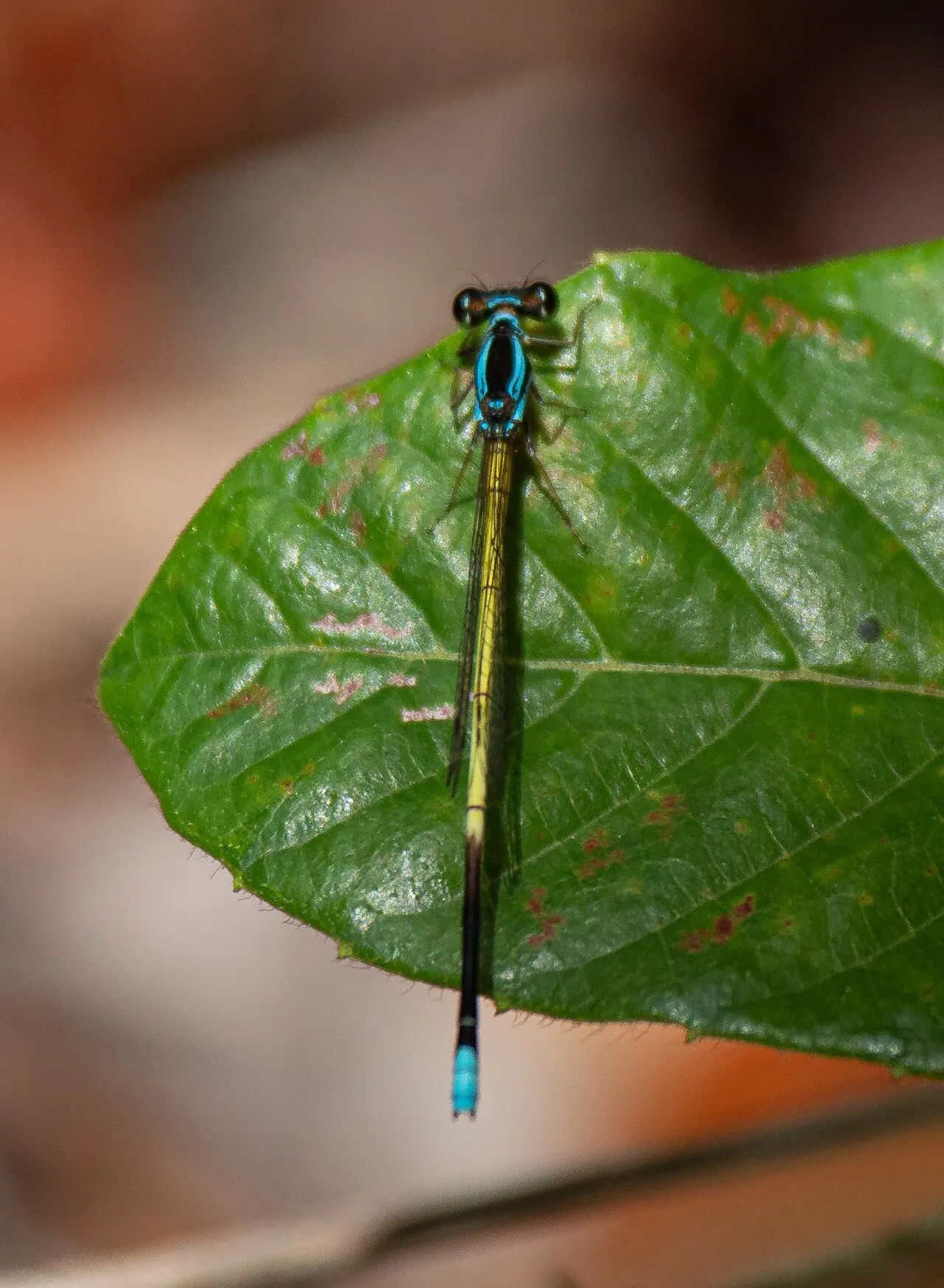
Critically Endangered
Minagrion ribeiroi
Minagrion ribeiroi
Minagrion ribeiroi is a damselfly of the family Coenagrionidae from the Atlantic Forest region of southeastern Brazil. It was first collected in 1960 at a lagoon in Rio de Janeiro State. The IUCN Red List rated it Critically Endangered in 2009, and field observers encounter it only rarely.
How to recognise it
Females measure 33 to 35 mm in total length, with a forewing of 18 to 19 mm. Their wings are clear with a brown pterostigma, the small colored cell near the wing tip, and the head is black above with a pale bar at the back and a yellow face.
Separating it from its relatives takes a close look at the male's anal appendages. In this species the cercus is shorter than the tenth abdominal segment and has one strong tooth at its tip, and its broad lower part takes up at least three quarters of its length. In other Minagrion species that part is half the length or less.
Where it lives
The species was described in 1962 by N. D. Santos as Telagrion ribeiroi, and moved to the genus Minagrion in 1965. The type specimens were collected on 14 September 1960 at Lagoa das Taxas, Recreio dos Bandeirantes, in Rio de Janeiro. Most of the museum material examined in a 2020 revision of the genus came from that area and nearby Restinga de Itapeba, collected between 1960 and 1969.
Records exist only for Rio de Janeiro and São Paulo States, in Atlantic Forest country. The IUCN puts its extent of occurrence at about 40 square kilometres, at elevations from sea level to 45 m, and counts it as one location. It lists permanent freshwater marshes and pools under 8 hectares, and lowland moist tropical forest, as its habitat. The only São Paulo specimen in that revision, a female, came from Salesópolis at 1,074 m.
Pins are Wikidata “endemic to” fields. Orange dots, when present, are GBIF occurrence tiles — survey bias included.
How it lives
Little has been published about how this species lives. The IUCN habitat list centers on small freshwater marshes and pools and on lowland moist forest.
The 2020 revision notes that although the species is numerous in the collection of Brazil's National Museum, it is among the rarer Minagrion species in collections and is rarely encountered in the field.
Why it is in trouble
The IUCN lists three ongoing threats, all scored low impact: recreational activities, housing and urban areas, and a pressure of unrecorded type. The assessment's stress categories point to ecosystem conversion and degradation. The population trend is unknown, and no population size is given.
The 2020 revision lists the original male holotype and female allotype as lost, and says the allotype was probably destroyed in the 2018 fire at the National Museum in Rio.
What is being done
The assessment recommends site and area protection and site and area management, and lists no conservation actions as already in place. Recent records, including observations at a reserve in the Guapiaçu watershed in 2018, show the species is still being seen.
Sources
Written for this catalog in our own words from the sources below, checked against them on 12 November 2026. Population figures are estimates and carry the year they were made. Status and assessment year: IUCN. 2026. The IUCN Red List of Threatened Species. Version 2026-1. iucnredlist.org.




