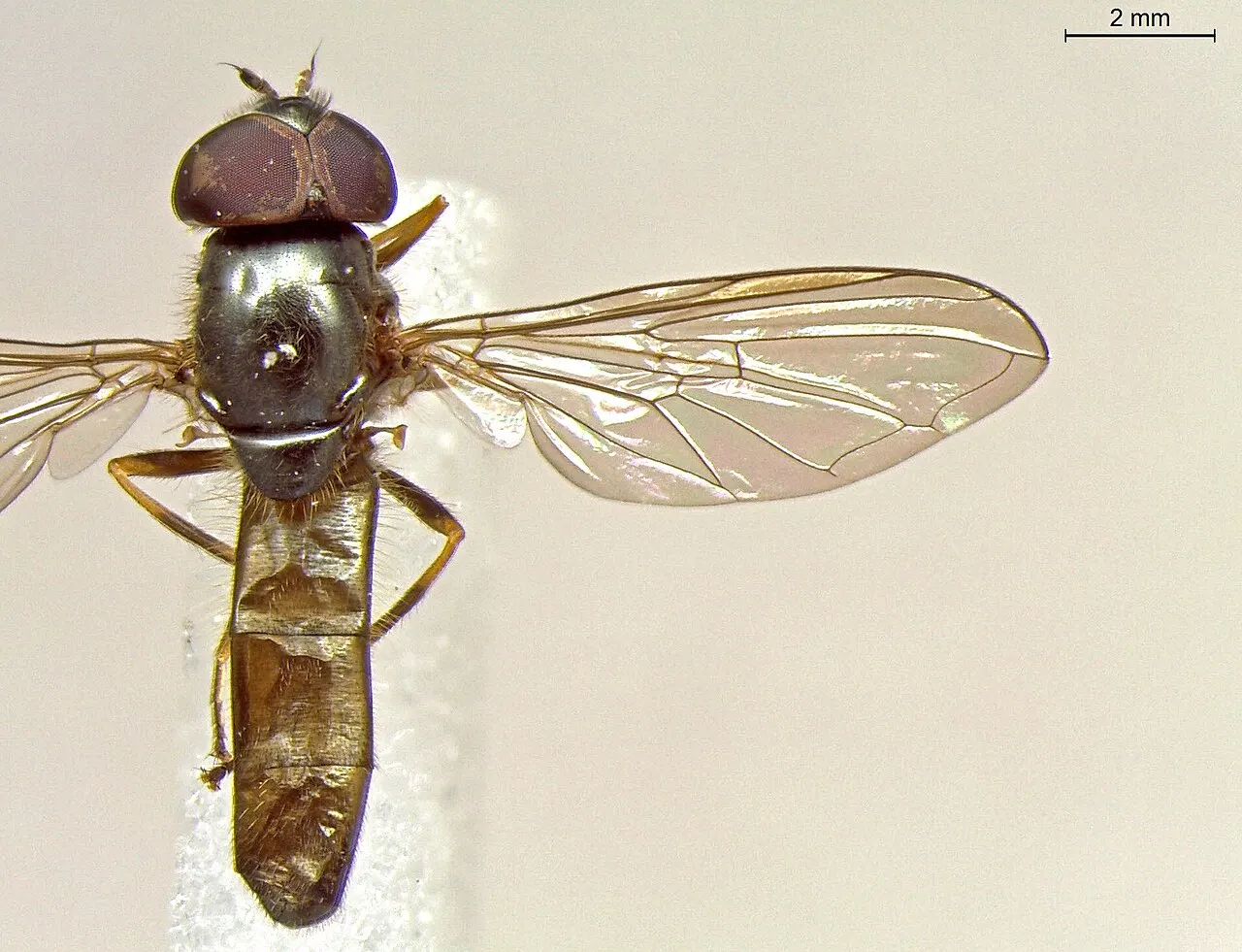
Endangered
Melanostoma wollastoni
Melanostoma wollastoni
Melanostoma wollastoni is a small hoverfly found only on Madeira, the Portuguese island in the Atlantic. The IUCN Red List assessed it as Endangered in 2021. It was described as new to science in 2004, and its tiny range is shrinking as habitat is lost to tourism and recreation areas.
How to recognise it
This is a hoverfly in the family Syrphidae. Adults measure about 7 to 10 mm, which is larger than its relative Melanostoma mellinum on the island (5 to 8 mm). Males have a wholly black abdomen. Females show at most a little reduced orange marking, whereas M. mellinum has clear orange patches, triangular in females and rectangular in males.
Where it lives
It is endemic to Madeira. A 2022 identification key for the Madeira archipelago's hoverflies counts 26 species, four of them found nowhere else, and this is one of the four. The key records it only on Madeira island itself, not on Porto Santo or the Desertas. The species mostly occurs in native laurel forest and in high-altitude heathland.
The IUCN gives an elevation band of about 850 to 1,060 m. Its extent of occurrence is about 412 square kilometres, and the area it actually occupies about 56 square kilometres, split among 3 to 5 locations. GBIF holds only 18 occurrence records, including several from the Ribeiro Frio natural park.
Pins are Wikidata “endemic to” fields. Orange dots, when present, are GBIF occurrence tiles — survey bias included.
Why it is in trouble
The IUCN records a continuing decline in the area the fly occupies. Tourism and recreation areas are the threat named, and they convert and degrade habitat. Whether the population itself is falling is listed as unknown, as is how fragmented it is. The Endangered criteria used (B1ab(iii)+2ab(iii)) concern a small range, few locations and shrinking habitat, not counted losses.
The IUCN lists subtropical dry forest and plantations among its habitats, which sits oddly with the laurel forest and heathland given above.
What is being done
The fly occurs in at least one protected area, and habitat protection is the action listed. The 2022 Madeira key says information on the distribution, ecology and conservation of the island group's hoverflies is still lacking.
Sources
Written for this catalog in our own words from the sources below, checked against them on 12 November 2026. Population figures are estimates and carry the year they were made. Status and assessment year: IUCN. 2026. The IUCN Red List of Threatened Species. Version 2026-1. iucnredlist.org.




