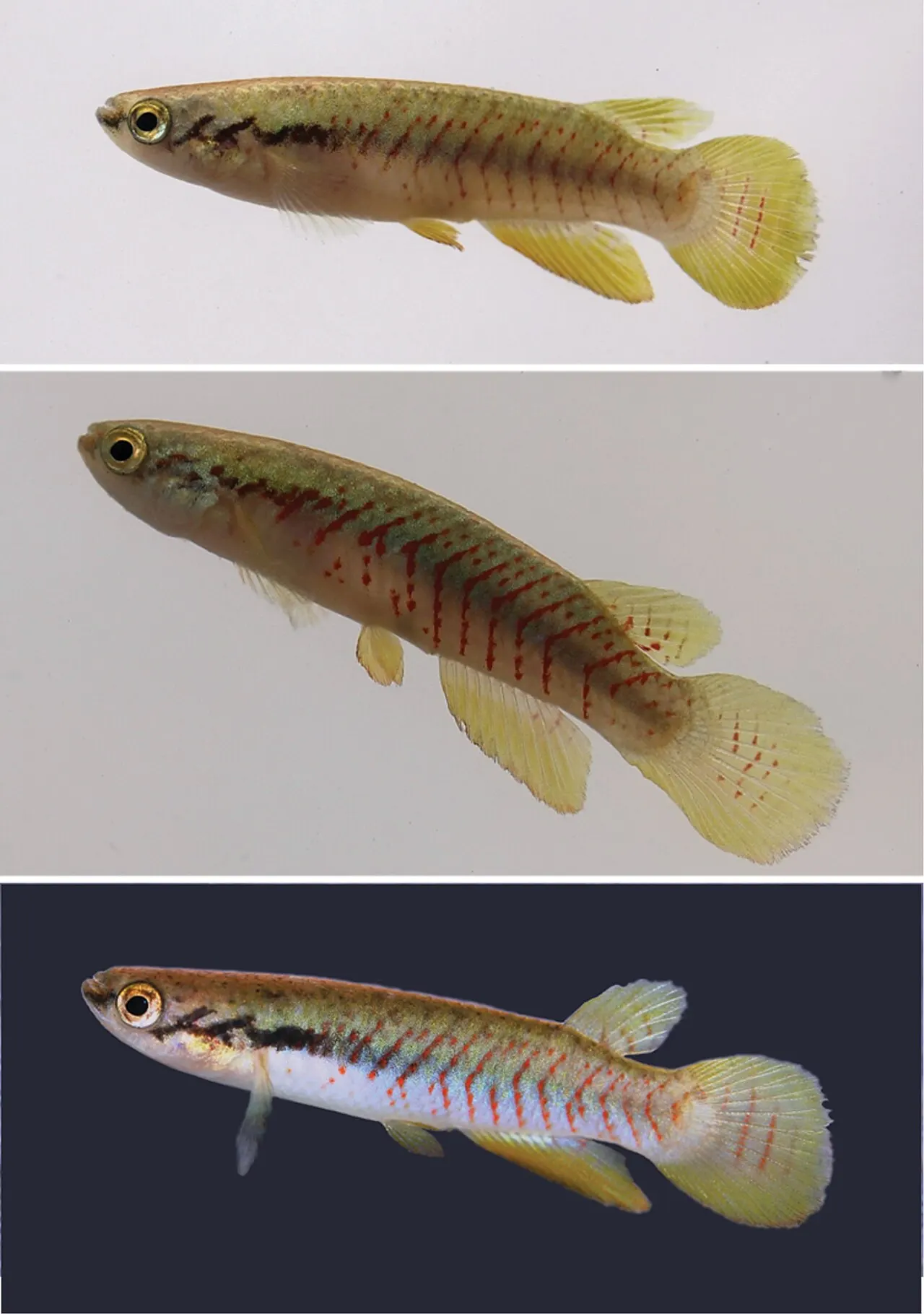
Endangered
Melanorivulus ivinhemensis
Melanorivulus ivinhemensis
Melanorivulus ivinhemensis is a tiny killifish from small streams and wetlands beside the lower Rio Ivinhema in Mato Grosso do Sul, Brazil. The IUCN Red List rated it Endangered in 2021. Adults are about 30 mm long at most, and the males show a yellow tail with thin red bars.
How to recognise it
It's a slender, nearly cylindrical little fish with a slightly pointed snout and short jaws. The largest female measured 30.4 mm and the largest male 30.1 mm. Females are usually slightly larger than males.
Males are distinguished from relatives in the Melanorivulus pictus group by a yellow tail fin with thin red bars across only the middle of the fin. Only the closely related M. rutilicaudus shares that pattern, and the two differ in fin ray counts.
Where it lives
The species is known only from the lower course of the Rio Ivinhema, in the upper Rio Paraná basin, in Mato Grosso do Sul. It was described in 2018 by Matheus Volcan, Francisco Severo-Neto and Luis Lanés from collections made in September and December 2016, and the type locality is a first-order stream in the municipality of Nova Andradina.
Fish were found in four areas spread over about 25 km on both sides of the river, in small first-order streams and wetlands in open sun at 267 to 315 m above sea level. The Red List gives a similar elevation range of 252 to 317 m and lists habitats including permanent and seasonal streams, marshes and springs.
Pins are Wikidata “endemic to” fields. Orange dots, when present, are GBIF occurrence tiles — survey bias included.
How it lives
The fish was recorded in shallow water, mostly under 20 cm deep over clay, though one wetland was about 70 cm deep with a muddy bottom and turbid water. Eight other fish species lived alongside it, including small tetras and a cichlid (Cichlasoma dimerus). Little else is known about its diet or breeding.
Why it is in trouble
The Red List assessment counts one or two locations and gives an extent of occurrence that may be as small as about 230 square kilometres. It records continuing decline in habitat area, and lists nutrient loads, sedimentation and soil erosion, pesticides, sewage, farming and ranching, water abstraction and housing as threats. The population trend is recorded as stable.
Field work for the 2018 description found the fish in areas with no major impacts, although under intense agricultural activity, and saw no evidence of extinction risk then. The Red List assessment, which weighs the small range and the pressures on its streams, rated it Endangered in 2021.
What is being done
The Red List notes that the species occurs in at least one protected area, and it records no conservation actions as underway. The 2018 description noted a large density of potential habitat along the 25 km stretch where the fish was found.
Sources
Written for this catalog in our own words from the sources below, checked against them on 12 November 2026. Population figures are estimates and carry the year they were made. Status and assessment year: IUCN. 2026. The IUCN Red List of Threatened Species. Version 2026-1. iucnredlist.org.




