Endangered
Tricarinate hill turtle
Melanochelys tricarinata
The tricarinate hill turtle (Melanochelys tricarinata) is a small, wholly land-living turtle with three ridges on its shell, found along the Himalayan foothills of India, Nepal and Bangladesh. The IUCN Red List assessed it as Endangered in 2020, and it is rare and poorly known.
How to recognise it
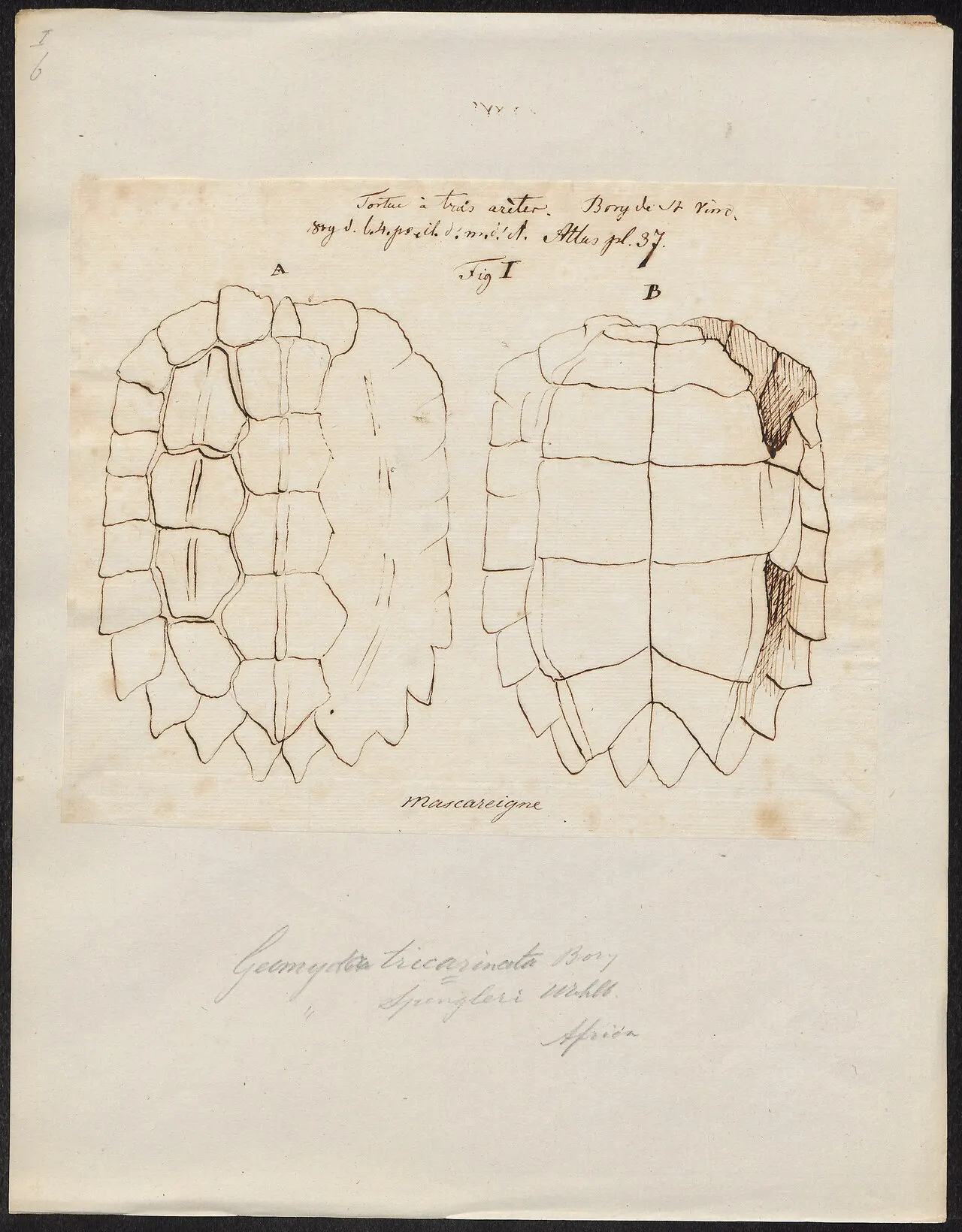
The shell is long and domed, with three ridges running along it. The central ridge is far more pronounced than the two on the sides, which sit where the flat top of the shell drops to the steep flanks. Shell colour runs from dark olive through grey-black to reddish brown, and the ridges are pale yellow. The underside is yellow or orange, and the head and neck are grey-black. Some animals have a yellow or red line running from the nose through the eye.
It is small. The largest recorded straight shell length is 174 mm. In a study in India's Doon Valley, adult males averaged about 154 mm and females about 138 mm. Edward Blyth described the species in 1856.
Where it lives
It lives in a narrow band along the foothills of the Himalayas, from Uttar Pradesh in the west through northern India and southern Nepal to Arunachal Pradesh, plus northern Bangladesh. A few records lie far from the hills, including Chaibasa in southern Bihar and a forest reserve in Cox's Bazar district, Bangladesh. In Nepal, records come from Chitwan and the Terai plains.
It uses moist deciduous forest, especially sal, as well as evergreen forest and riverside grassland. The IUCN lists moist lowland forest, savanna, grassland and river habitats, up to about 300 m.
Pins are Wikidata “endemic to” fields. Orange dots, when present, are GBIF occurrence tiles — survey bias included.
How it lives
Very little is known about its life in the wild. Captive animals are most active around dusk and spend the day hidden in leaf litter or under fallen trunks. The Doon Valley study, run from 2002 to 2008, caught 120 turtles and found that 94.4 percent of captures happened in the rainy months. The turtles eat both fruit and animal matter, and adults of both sexes stopped growing after about ten years.
Captive females have laid one to three large eggs at a time, although one older handbook reported three to six. Eggs measure 38 to 47 mm long, incubation took 60 to 72 days in captivity, and hatchlings are 33 to 40 mm. Adult females have a flexible, fibrous join between the belly shell and the carapace, which probably helps large eggs pass.
Why it is in trouble
The IUCN lists dams, shifting agriculture and direct harvesting as threats, and gives the population trend as decreasing. Clearing of forest along the Ganga and Brahmaputra plains may explain why its range is so patchy. Chakma people in southeastern Bangladesh are reported to eat it, and subsistence use has been recorded in Assam, Bihar and Dudhwa National Park in India.
A study published in 1996 found 22 souvenir masks made from its shells (18.3 percent of those examined) in Kathmandu. Fires set in grassland reserves as a management tool are also suspected to harm it.
What is being done
It is on CITES Appendix I and Schedule I of India's Wildlife (Protection) Act of 1972, and Bangladesh lists it on Schedule III of its 1974 act. It has been recorded in protected areas including Manas Tiger Reserve, Corbett National Park and Chitwan National Park, though it appears rare even in Indian reserves. In Nepal it has religious standing, and some are kept in Hindu temples as an incarnation of Vishnu.
Sources
Written for this catalog in our own words from the sources below, checked against them on 12 November 2026. Population figures are estimates and carry the year they were made. Status and assessment year: IUCN. 2026. The IUCN Red List of Threatened Species. Version 2026-1. iucnredlist.org.



