Endangered
Mauritius Fody
Foudia rubra
The Mauritius fody (Foudia rubra) is a small red-headed weaver found only on the island of Mauritius. By about 2001 only around 100 pairs were left in the wild. The IUCN Red List rated it Endangered in 2025, estimating a small but stable 160 to 220 mature birds.
How to recognise it
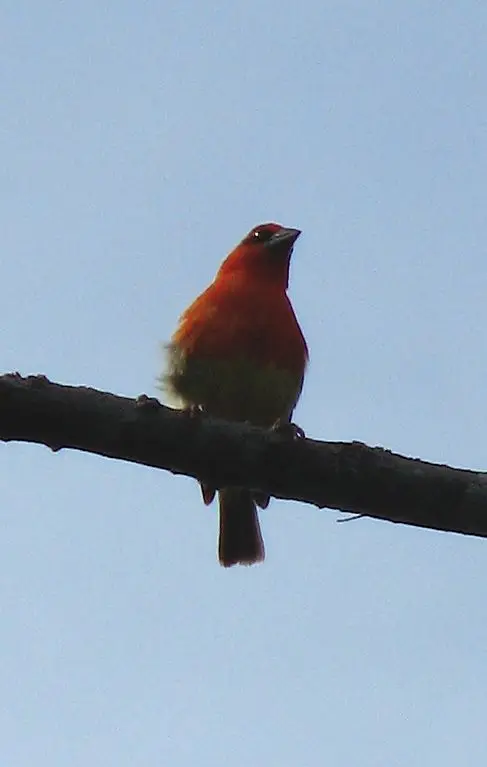
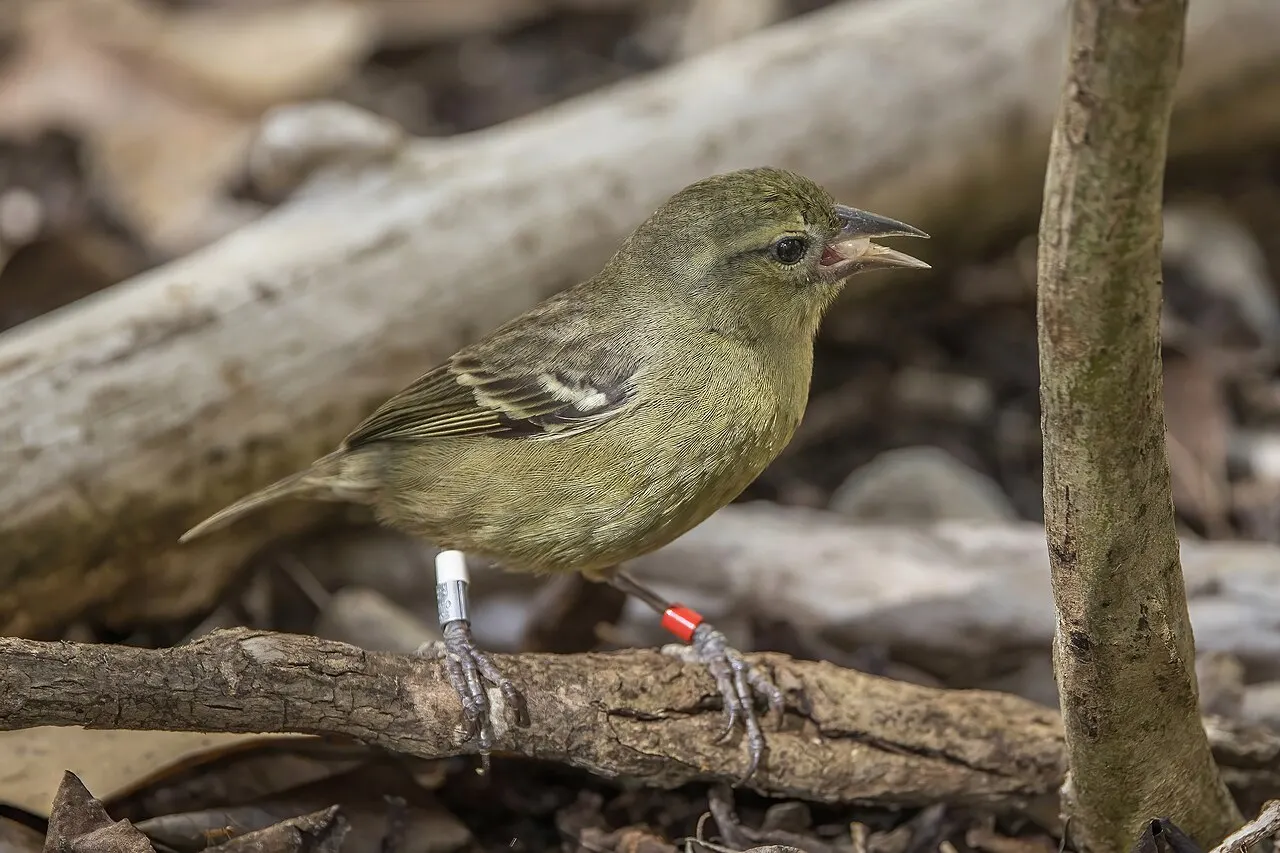
The fody is about 14 cm long. Breeding males are olive brown with a red head, breast and rump patch, and black between the eye and the bill. Females, non-breeding males and young birds are plainer, olive brown with white wing bars and a brown bill.
Where it lives
The species exists nowhere but Mauritius, from sea level to about 800 m. Historically it lived in the uplands of the south-west, and it now survives in a few pockets there, including Bassin Blanc and the Macchabee Forest Road area. Birds also live on Ile aux Aigrettes, a small islet off the coast.
Its habitats include shrubland, lowland forest and plantations. Stands of introduced Japanese cedar have replaced much native vegetation but reportedly offer some shelter from predators.
Pins are Wikidata “endemic to” fields. Orange dots, when present, are GBIF occurrence tiles — survey bias included.
How it lives
Fodies eat insects such as grasshoppers, beetle larvae and caterpillars, along with spiders. Some birds take berries, and they also feed on nectar using a brush-tipped tongue.
Males and females both weave the nest from grass, moss and small twigs.
Why it is in trouble
Land clearing for plantations reportedly began in the 1970s. A 1999 to 2001 survey found the wild population had fallen from roughly 250 pairs in 1975 to just over 100.
Today the main problem is nest raiding by introduced animals. Black rats and crab-eating macaques take eggs and chicks, and common mynas have been seen preying on nests. Larvae of a tropical nest fly reportedly feed on the blood of chicks and can leave them dehydrated and anaemic. The IUCN also lists competition and hybridisation among the pressures, and the introduced Madagascar fody may compete with it.
What is being done
The Mauritian Wildlife Foundation and its partners run an intensive recovery effort. Rats and macaques are reportedly controlled, and nests are treated against nest flies. At some nests, eggs are reportedly taken for hatching in captivity while the wild pair lays and raises a replacement clutch.
The most successful step has been moving birds to Ile aux Aigrettes, a 26 ha island. Between November 2003 and March 2006, 93 captive-reared fodies, raised from birds of 14 mainland territories, were released there. Managers supplied extra food and dusted accessible nests with the insecticide carbaryl. By the end of the 2006 to 2007 breeding season the island held 38 pairs, and by December 2008 it held 142 birds, including 47 breeding pairs. Nests treated with carbaryl succeeded more often (33 percent) than untreated ones (15 percent).
The IUCN moved the species from Critically Endangered to Endangered in 2009. Its current assessment notes that it occurs in a protected area, that a monitoring scheme is running and that a formal recovery plan is not in place.
Sources
Written for this catalog in our own words from the sources below, checked against them on 12 November 2026. Population figures are estimates and carry the year they were made. Status and assessment year: IUCN. 2026. The IUCN Red List of Threatened Species. Version 2026-1. iucnredlist.org.