Critically Endangered
Mascarene Petrel
Pseudobulweria aterrima
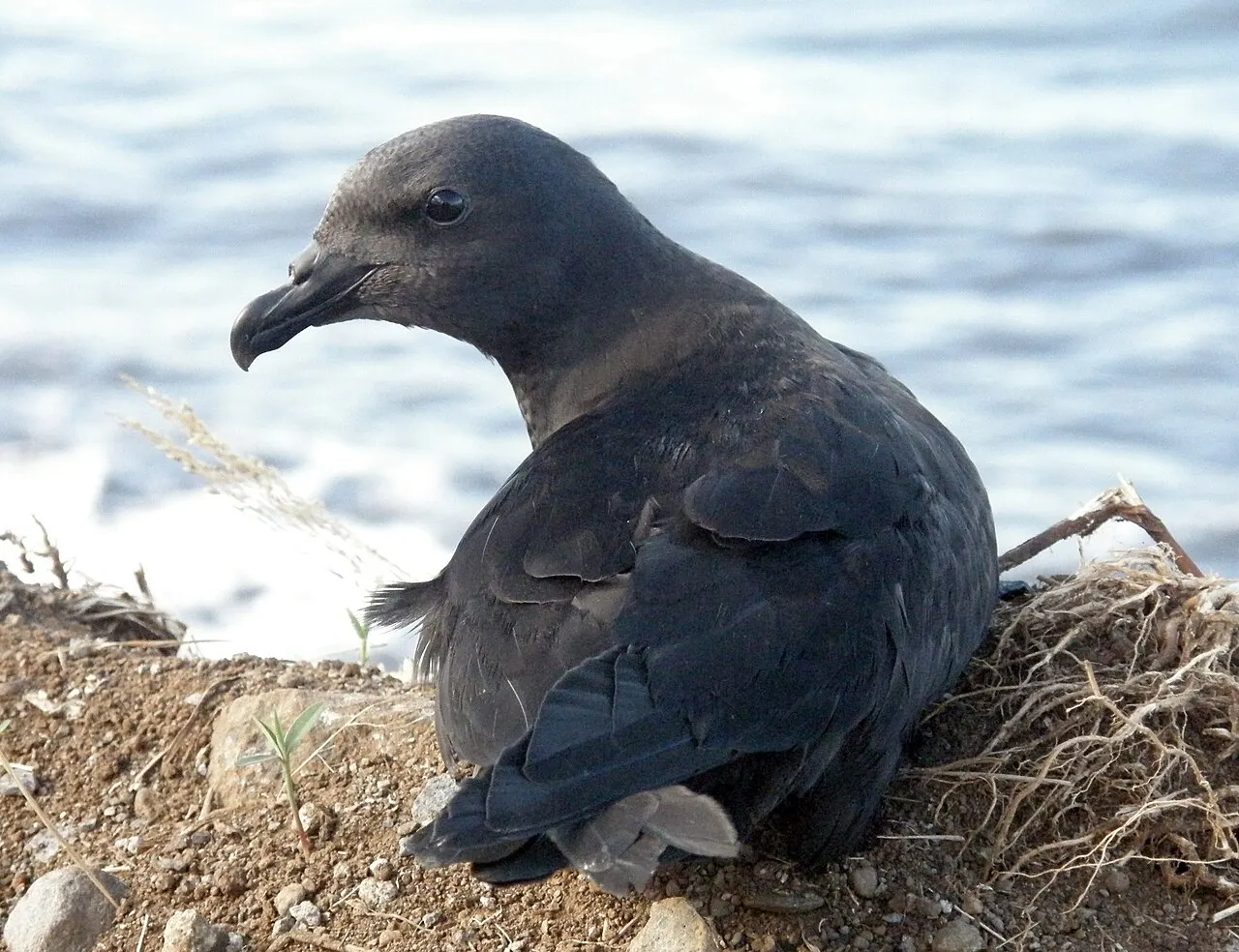
The Mascarene petrel (Pseudobulweria aterrima) is a dark, medium-sized seabird that nests on Reunion Island in the Indian Ocean. Rated Critically Endangered on the IUCN Red List in 2018, it was long known from a handful of birds and specimens, and its first nesting colony was only found in 2016.
How to recognise it
It's a medium-sized, all-dark gadfly petrel about 36 cm long, chocolate brown with a slightly paler chin and throat, a black bill, pink legs and black feet. It looks like Bulwer's petrel and Jouanin's petrel, but is smaller, with a heavier bill and a shorter tail than those species. At sea it is easy to confuse with other dark petrels.
Where it lives
The IUCN records it as present on Reunion and as extinct on Mauritius, where a dead bird has also been found. Four specimens were collected on Reunion in the 19th century, and a subfossil bone has turned up on Rodrigues, so it once ranged more widely in the Mascarene Islands. Two birds were found dead in the 1970s, and a few have been seen at sea south of Reunion since 1964.
Today it is known to breed only on Reunion. The IUCN gives its extent of occurrence as about 77,000 square kilometres and the area it actually occupies as roughly 9 square kilometres, across four locations.
Pins are Wikidata “endemic to” fields. Orange dots, when present, are GBIF occurrence tiles — survey bias included.
How it lives
The first breeding site was found in November 2016 in Saint-Joseph, in the south of Reunion, by researchers who abseiled down cliffs and used infrared binoculars to track landing birds. A study published in the Journal of Field Ornithology in 2022 described two colonies on steep, forested cliffs at about 650 and 1,250 metres. The team ran sound recorders at 68 sites from 2015 to 2017 and picked up calls at 17 of them.
Pairs dig burrows in humus, usually under tree roots or rocks. Calling peaks in December and January, and in late 2015 the busiest hour was roughly 2 to 3 am. The petrel is reportedly mostly monogamous. Two eggs and a chick were seen at one colony in November 2016.
Why it is in trouble
The 2018 assessment estimates only 100 to 200 birds and a declining trend. Introduced black rats and feral cats are named as threats, along with the small Indian mongoose and light pollution. At one colony, all three occupied burrows were empty by December 2016, probably because of rats, and cameras recorded tenrecs entering occupied burrows. Cats were detected near the colonies but not at the nests.
Young birds leaving the nest are also drawn to artificial lights, which can bring them down on land. A 2020 genetic study reported high genetic diversity despite a severe population bottleneck.
What is being done
A rescue campaign has collected birds grounded by lights since 1996, and public awareness efforts led to 58 birds being found between 1996 and 2021. The LIFE+ Petrels project (2014 to 2020) set out to stop the decline of Reunion's endemic petrels.
Removing all cats and rats from the island was judged not currently possible, so the plan focuses on predator control and predator-proof fencing. The IUCN lists legal protection and monitoring of breeding sites, light-reduction work and an artificial breeding colony among the actions needed.
Sources
Written for this catalog in our own words from the sources below, checked against them on 12 November 2026. Population figures are estimates and carry the year they were made. Status and assessment year: IUCN. 2026. The IUCN Red List of Threatened Species. Version 2026-1. iucnredlist.org.




