Critically Endangered
Masafuera Rayadito
Aphrastura masafuerae
The Masafuera rayadito (Aphrastura masafuerae) is a small brown ovenbird found only on Alejandro Selkirk Island, part of Chile's Juan Fernandez archipelago in the Pacific. The IUCN Red List rated it Critically Endangered in 2023, listing it at a single location with a population in the low hundreds.
How to recognise it
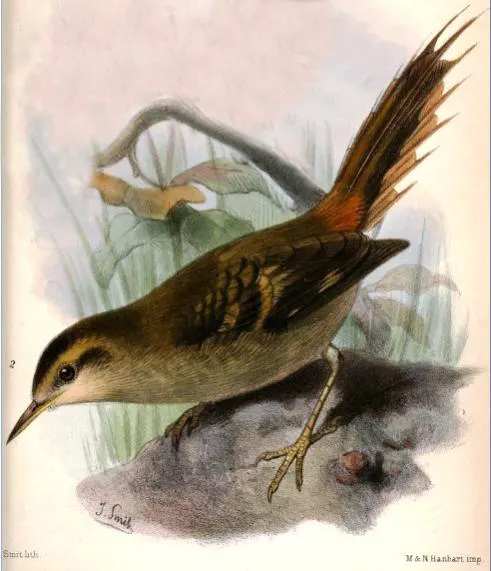
It's a bird of about 14 to 16 cm (sources differ slightly), with a dull brown back, a rufous-brown rump and a mostly rufous tail. The head has a pale buff eyebrow stripe and a whitish forehead with fine rusty streaks. The tail feather tips lack barbs, which gives them a spiny look. Males and females look alike.
It shares its genus with the thorn-tailed rayadito of the South American mainland, and the two are thought to have split during the Pleistocene. The call is a low, churring trill, but as of 2023 no recordings were on the main public sound archives. The birds are easier to hear than to see.
Where it lives
Alejandro Selkirk is a remote island roughly 165 km west of the other two main Juan Fernandez islands and about 670 km off the Chilean coast. Getting there from Robinson Crusoe Island takes at least 12 hours by boat, depending on weather. The rayadito lives nowhere else. The IUCN assessment lists one location of about 36 square km, with shrubland, temperate forest and streams as habitat, between about 600 and 1,320 m.
It favours dense undergrowth in humid montane scrub and woodland with tree ferns (Dicksonia externa), often along streams and among canelo trees (Drimys confertifolia). It is mostly resident, though some birds move downslope in the austral winter.
Pins are Wikidata “endemic to” fields. Orange dots, when present, are GBIF occurrence tiles — survey bias included.
How it lives
The diet is poorly known but probably mostly small arthropods. Birds forage almost always in pairs, usually in the understory, picking at ferns, sometimes hanging upside down, and searching moss and lichen on canelo trunks.
Nests are built from plant fibre in natural cavities, including holes in cliffs, and the birds also use nest boxes. The island is geologically young, and good nest sites are scarce. Both parents feed the chicks, and breeding is known to include December and January.
Why it is in trouble
A tiny range is the basic problem. Rats, which arrived on ships, eat eggs and chicks and also eat seeds and sprouts the forest needs to regrow, and feral cats take juveniles and adults. Goat trampling, fire and timber cutting have also damaged native vegetation. In the 1980s the bird was feared possibly extinct after livestock grazing spread into native forest, but it survived.
Population counts disagree. About 500 birds were reported in surveys in the 1980s, and only about 140 had been documented by 2002. A study based on surveys in 2006 and 2007 extrapolated about 500 birds (a wide range of 148 to 932). Island Conservation counted 1,227 in 2015, far above the others. The 2023 IUCN assessment gives 90 to 330 and a stable trend. No one has an exact count.
What is being done
The Chilean conservation group Oikonos began putting up nest boxes in 2006. The first 81 wooden boxes failed because of damp, animal damage and an unsuitable design. A second set of 81 PVC boxes in 2013 went unused, apparently because the material was too cold. Bamboo boxes worked, and a vertical cavity design brought six nests in 2017. In 2019, 15 nests were recorded, 10 of them active and 7 successful.
Island Conservation has used audio recorders to follow the birds. The local community built a biosecurity barrier to keep cats from nesting areas, and cargo from the mainland is checked for seeds and pests. A rodent eradication was postponed because of the COVID-19 pandemic.
Sources
Written for this catalog in our own words from the sources below, checked against them on 12 November 2026. Population figures are estimates and carry the year they were made. Status and assessment year: IUCN. 2026. The IUCN Red List of Threatened Species. Version 2026-1. iucnredlist.org.




