Endangered
Marañón poison frog
Excidobates mysteriosus
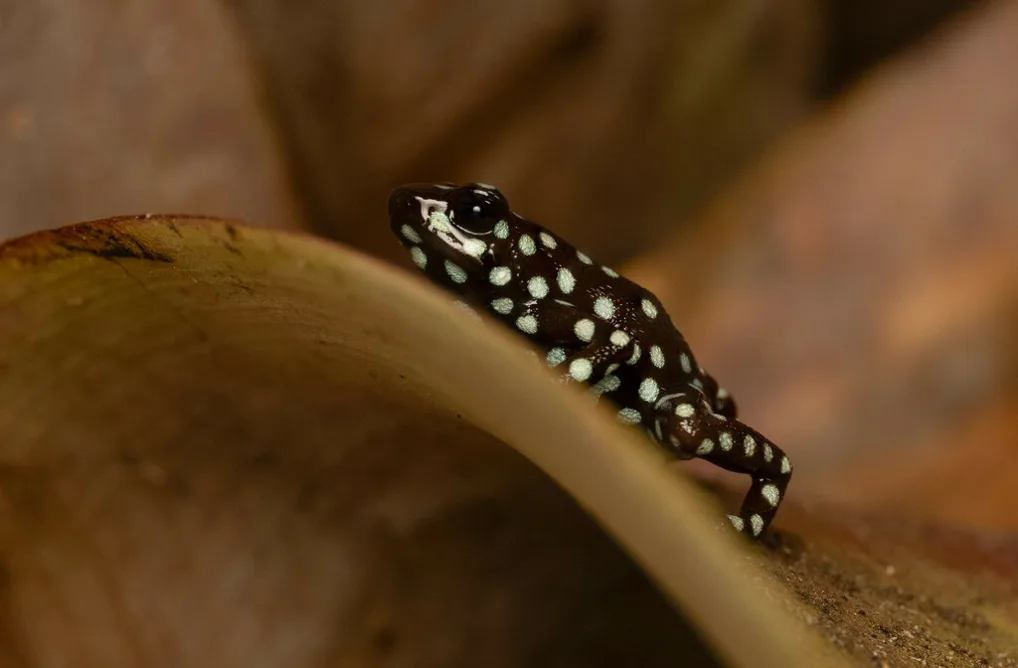
The Marañón poison frog (Excidobates mysteriosus) is a tiny black frog with white spots, known only from northern Peru, in and around the Cordillera del Cóndor. The IUCN Red List rated it Endangered in 2018 and records a decreasing population, with its forest home shrinking.
How to recognise it
A small frog, about 27 to 29 mm from snout to vent. The back is black with white polka dots, and the pattern differs between individuals. There is always a dot under the chin. Tadpoles are black.
Where it lives
The species is endemic to Peru. It was first recorded in the Cordillera del Cóndor, in the upper Marañón River drainage of Cajamarca Department. The IUCN estimates its extent of occurrence at about 717 square kilometres, counts between 1 and 5 locations, and gives an elevation range of about 600 to 1,305 metres.
A later study reported a second population at Pedro Ruiz in Amazonas region, roughly 90 km southeast of the first site, and a habitat model of only about 414 square kilometres, according to a 2025 news summary. Nearly half of the main distribution corridor has under 50% forest cover.
The frog lives in premontane forest, particularly where cacti and ground bromeliads are plentiful, and it turns up near the bottoms and tops of cliffs.
Pins are Wikidata “endemic to” fields. Orange dots, when present, are GBIF occurrence tiles — survey bias included.
How it lives
It is mostly active by day and hunts small prey among the vegetation, mainly ants and small flies. It breeds in rainwater held in bromeliads. The female lays eggs near the water, and after hatching the male carries the tadpoles on his back to pools in other parts of the bromeliad.
Bromeliads also shelter adults and young. The ones it uses are reported to grow on very old trees, few of which remain, so clearing forest cuts the plants the frog depends on.
Why it is in trouble
Its range is tiny and the forest around it is being cleared. The IUCN assessment lists housing, small-holder farming and small-holder grazing as ongoing threats, and records a continuing decline in the area of its habitat. Forests around Santa Rosa, where it was first found, have been almost entirely cleared for coffee, according to the same news summary.
Collection for the international pet trade is listed as a further, low-impact threat. Numbers are reported to have fallen sharply in the 1990s when the frog was in demand for terrariums. All poison dart frogs of the family Dendrobatidae have been listed in CITES Appendix II since 1987, which regulates international trade.
What is being done
The assessment records the species as held in captive collections and lists enforcement action at national and international levels, along with awareness work and site management. Whether its remaining forest is formally protected is recorded as unknown. Researchers have suggested expanding protected areas along the corridor between Santa Rosa and Pedro Ruiz.
Sources
Written for this catalog in our own words from the sources below, checked against them on 12 November 2026. Population figures are estimates and carry the year they were made. Status and assessment year: IUCN. 2026. The IUCN Red List of Threatened Species. Version 2026-1. iucnredlist.org.