Endangered
Black-eared miner
Manorina melanotis
The black-eared miner is a grey honeyeater with a black face mask and a yellow bill, found only in old mallee woodland in south-eastern Australia. The IUCN Red List assessed it as Endangered in 2022, estimating 400 to 2,000 mature birds. Its biggest problem is a close relative that interbreeds with it.
How to recognise it
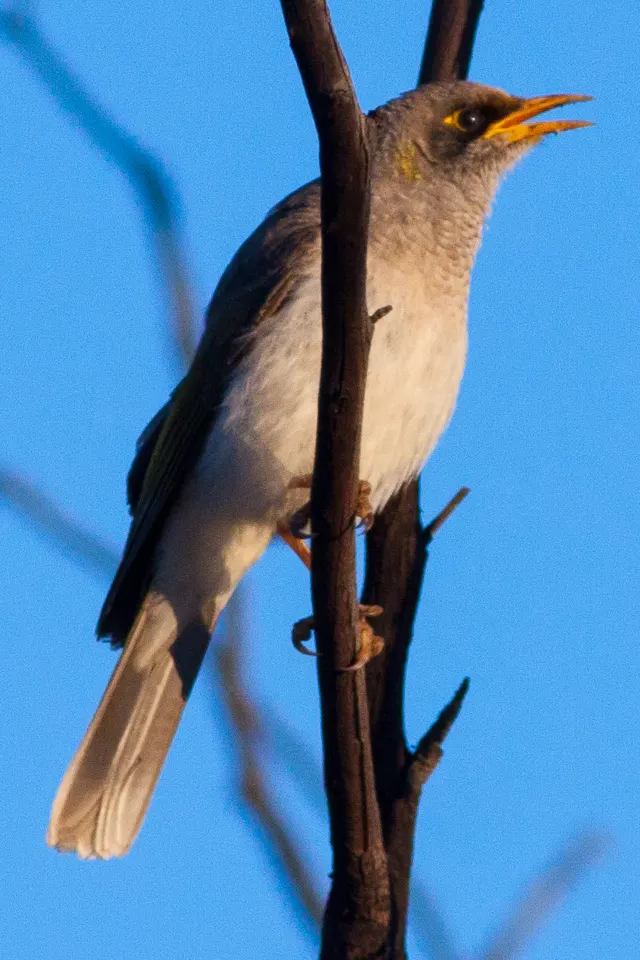
It's a medium-sized honeyeater, 23 to 26 cm long, with mid to dark grey upperparts, a white belly and a black mask running from the bill back over the ear. The bill and the bare skin behind the eye are yellow. The sexes look alike, and young birds are browner.
The yellow-throated miner is the main lookalike. It has a pale rump and a white-tipped tail, while the black-eared miner's rump matches its back and its tail has no pale tip. Hybrids show a mixture, which makes identification in the field hard. A field key published by the Australian government rates the feathering on the lower jaw against the throat, and the contrast between back and rump.
Where it lives
The species is endemic to Australia, in the mallee country of north-western Victoria and south-eastern South Australia. The Red List says more than 95 percent of the birds are in the Riverland Biosphere Reserve in South Australia, with much smaller numbers in Murray-Sunset National Park and Annuello Flora and Fauna Reserve in Victoria. Conservation projects also work at Gluepot Reserve, Taylorville and Calperum stations and Hattah-Kulkyne National Park.
Mallee is eucalyptus woodland of multi-stemmed trees seldom taller than 10 m. Black-eared miners are most abundant in mallee that hasn't burned or been heavily grazed for about 45 years, though they use younger regrowth at lower densities. Estimates of the area a viable population needs run from 13,000 hectares (Red List) to 30,000 hectares (a New South Wales government profile). The Red List counts about five locations and an extent of occurrence of about 14,000 square kilometres.
Pins are Wikidata “endemic to” fields. Orange dots, when present, are GBIF occurrence tiles — survey bias included.
How it lives
Black-eared miners are cooperative breeders. A breeding pair can be helped by up to 13 helpers, mostly males. Colonies form during the breeding season, nesting in groups of about 8 to 40 birds, then spread through the bush at other times. The cup nest of grass and sticks sits in the fork of a mallee eucalypt or in a clump of mistletoe. Breeding is opportunistic, most often recorded from September to December, and can run for over a year when rain is good.
They glean and probe insects and other invertebrates, including grasshoppers, beetles and caterpillars, from loose bark on mallee trunks, and they also eat lerp, nectar, pollen, seeds and fruit. They are shyer than other miners and usually fly off when approached.
Why it is in trouble
Clearing mallee for farming fragmented the habitat. Stock watering points also opened it up, and that let the yellow-throated miner, a bird of more open country, spread into the black-eared miner's range. The two interbreed, and the hybrids are fertile. The Red List calls this hybridisation the greatest current threat. Other threats listed include drought, more frequent and intense fire, heat extremes and grazing pressure. In 2014 a fire burned the whole of Bronzewing Flora and Fauna Reserve, where 45 captive birds had been released and were presumed to have died.
The Red List estimates 400 to 2,000 mature individuals, with a best estimate of 1,000, and a declining trend. There are three subpopulations, and the largest holds about 960 individuals. Counts of colonies probably overstate the total, because birds move toward observers, colonies are clumped, and adults number only about twice the colonies.
Is it a separate species
Its status has been argued over for a century. The 1999 Directory of Australian Birds by Schodde and Mason treated it as a subspecies or variant of the yellow-throated miner. A 2001 study of museum and live birds in Biological Conservation found the two were separable on appearance before the habitat was heavily modified after 1950, and argued for full species status. The IUCN treats it as a full species.
What is being done
The Red List says the whole population lies inside protected areas, a recovery plan is in place and a recovery team has been formed. Five colonies, 60 adults and 30 young, were moved from Riverland to Murray-Sunset National Park in 2000 and 2001. They bred after release, but by 2014 only two colonies were found near the release sites. A colony moved to Scotia Sanctuary in New South Wales was overwhelmed by yellow-throated miners and hybrids in 2010.
In July 2022 the regional board for the Murraylands and Riverland in South Australia announced a 13-month project with about AUD 125,000 in federal funding. It includes genetic tests on black-eared miners, hybrids and yellow-throated miners, removal of yellow-throated miners from key black-eared miner habitat, and removal of old stock watering points. The Red List recommends continued translocations, habitat protection, fire management and limits on grazing.
Sources
Written for this catalog in our own words from the sources below, checked against them on 12 November 2026. Population figures are estimates and carry the year they were made. Status and assessment year: IUCN. 2026. The IUCN Red List of Threatened Species. Version 2026-1. iucnredlist.org.
- IUCN Red List assessment 22704441/213606093
- Black-eared miner (encyclopedia article)
- NSW threatened species profile, black-eared miner
- Murraylands and Riverland Landscape Board, Help at hand for black-eared miner (4 July 2022)
- Clarke, Gordon and Clarke 2001, Biological Conservation 99(2) (abstract via Gluepot reserve document)




