Endangered
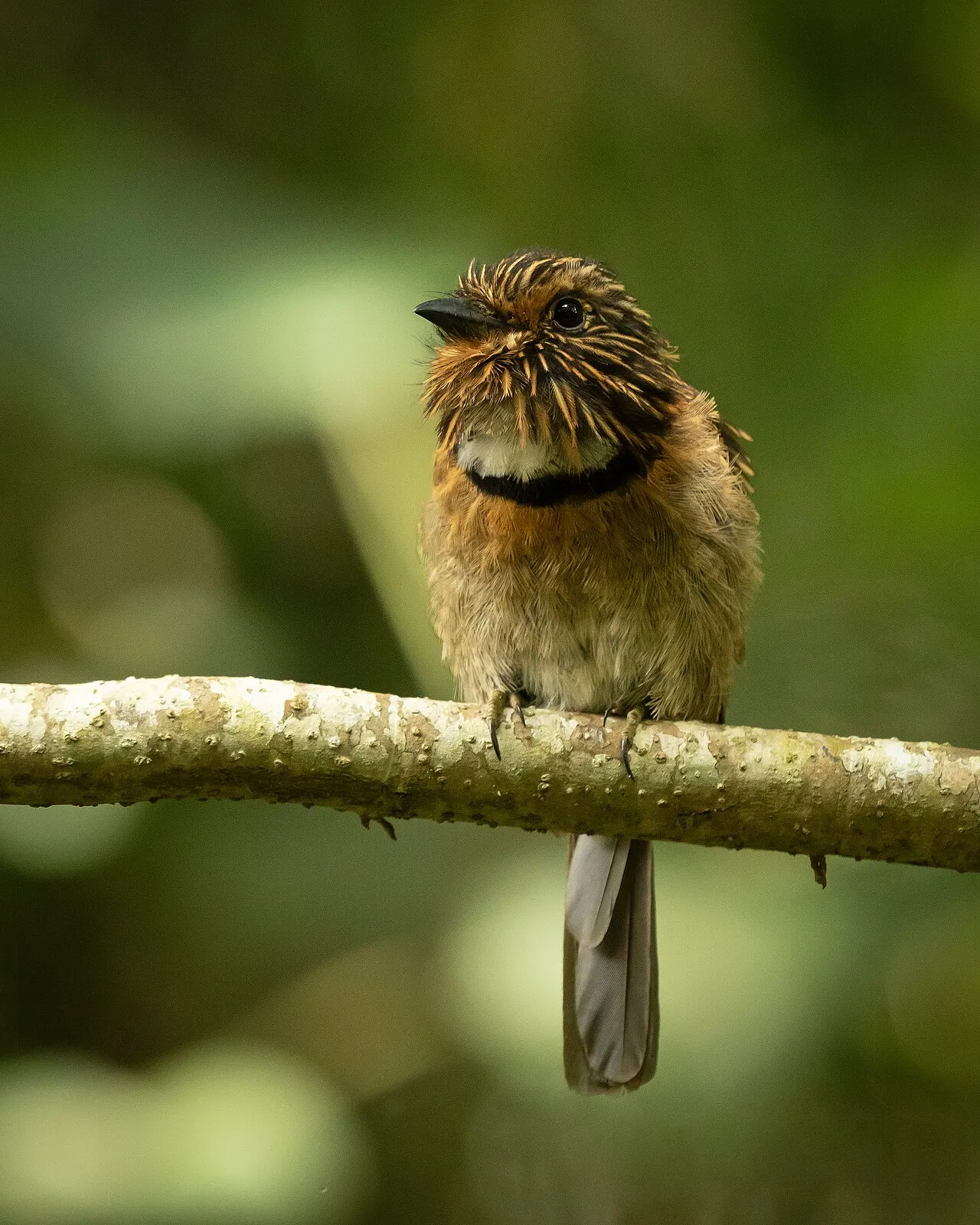
Lesser Crescent-chested Puffbird
Malacoptila minor
The lesser crescent-chested puffbird (Malacoptila minor) is a small, stocky bird of lowland forest in northeastern Brazil, found only in a patchy range in Maranhão and PiauÃ. The IUCN Red List assessed it as Endangered in 2023 because its forest is being cleared fast.
How to recognise it
This puffbird is smaller than the crescent-chested puffbird (Malacoptila striata), which it was once lumped with. Its breast band is brighter, and its underparts are whiter and unbarred.
It was described by Sassi in 1911. Taxonomy is not settled. BirdLife's Handbook of the Birds of the World and the IUCN treat it as its own species, while the SACC, IOC and Clements checklists class it as a subspecies, Malacoptila striata minor.
Where it lives
The species is endemic to Brazil, with a small and disjunct range in the Northeast Region, in the states of Maranhão and PiauÃ. The Red List puts its extent of occurrence at about 37,400 square kilometres, and counts 11 to 100 locations and between 2 and 10 subpopulations.
Its habitat in the Red List is tropical and subtropical moist lowland forest. Descriptions of the crescent-chested puffbird group say these birds favour semi-open places such as forest edges, logged forest and secondary growth, including roadsides, and rarely enter the forest interior. That's described for the group as a whole, not measured for this form alone.
Pins are Wikidata “endemic to” fields. Orange dots, when present, are GBIF occurrence tiles — survey bias included.
How it lives
Little is documented about this form specifically. Across the crescent-chested puffbirds, diet is thought to be mostly invertebrates, birds usually forage alone, and they have occasionally been seen following army ant swarms. Nesting records, in burrows in earth banks from about October to January, come from the nominate form, not from this one. Generation length is estimated at 3.6 years.
Why it is in trouble
The Red List estimates the population is shrinking, with no total count. It records a past reduction of about 39 to 42 percent and an ongoing and projected reduction of about 51 to 56 percent, all attributed to loss of area, range and habitat quality.
The threats named are agro-industrial farming, agro-industrial grazing and ranching, roads and railroads, and large-scale unintentional effects from harvesting (logging). Each is rated as affecting most of the range, and three of them as causing rapid declines. The causes of the decline are understood and haven't ceased.
What is being done
The species is known from at least one protected area, and conservation sites have been identified across its entire range. The assessment calls for protecting more suitable habitat. No recovery plan, harvest plan, systematic monitoring scheme or captive programme is in place.
Sources
Written for this catalog in our own words from the sources below, checked against them on 12 November 2026. Population figures are estimates and carry the year they were made. Status and assessment year: IUCN. 2026. The IUCN Red List of Threatened Species. Version 2026-1. iucnredlist.org.




