Endangered
Magnificent brood frog
Pseudophryne covacevichae
The magnificent brood frog (Pseudophryne covacevichae) is a coin-sized, boldly marked frog from the uplands of north Queensland, Australia. The IUCN Red List rated it Endangered in 2022. It lives around seepages in open eucalypt forest, and its small, scattered populations are still shrinking.
How to recognise it
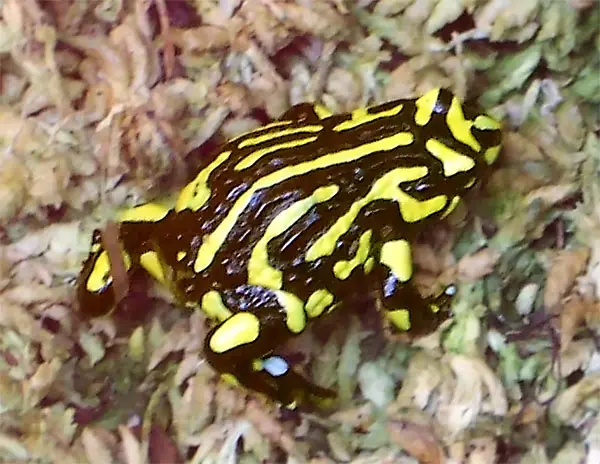
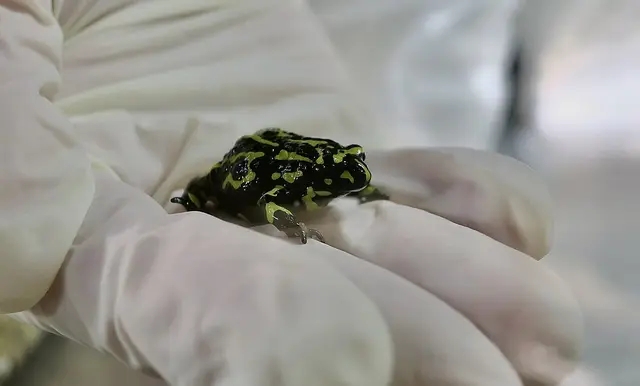
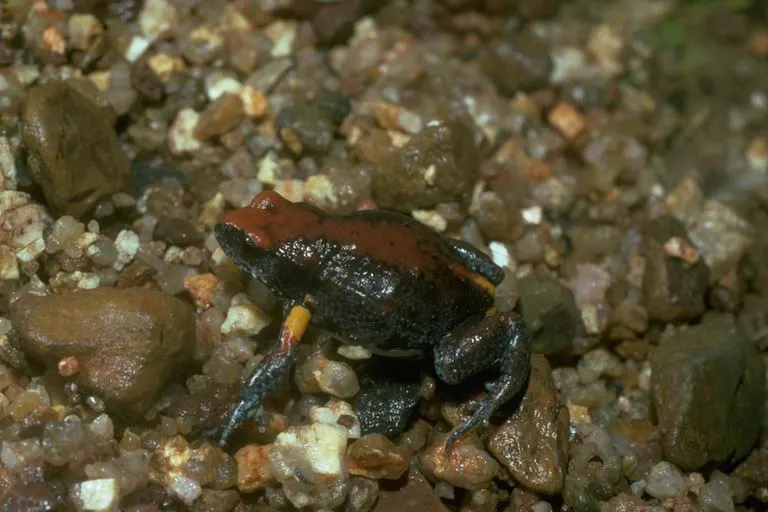
This is a tiny frog, 24 to 28 mm from snout to vent. Descriptions of the back vary, from bright rufous brown or yellow with faint dark lines to a blue-grey ground colour with a yellow stripe. The constant features are a large yellow patch around the vent that runs forward as a thin yellow line, black flanks, a yellow upper arm and a belly marbled black and white.
The upper half of the eye is yellow to gold. The species was only formally described in 1994, and its name honours the Australian herpetologist Jeanette Covacevich.
Where it lives
It is found only in Queensland. The main population is centred on Ravenshoe, on the southern Atherton Tableland. Frogs were later found about 160 km to the south-southeast, at Mount Spec in the Paluma Range (reportedly in 2013), and that range extension was reported in 2015 in Australian Zoologist.
Records come from seepages beside small streams in open eucalypt forest, on rocky volcanic ground at about 800 m or higher. The Red List places its extent of occurrence in the band of 1,851 to 4,999 square kilometres and describes the population as severely fragmented.
Pins are Wikidata “endemic to” fields. Orange dots, when present, are GBIF occurrence tiles — survey bias included.
How it lives
Males call from the base of grass tussocks in seepages, mostly on wet nights between about December and April. Eggs are laid on moist soil in or near the seepage, and the male usually stays to guard them, which is where the name brood frog comes from.
When rain floods the nest, the tadpoles wash down the seepage into small first-order streams and finish developing in little pools. Beyond this, very little is known. Bush Heritage Australia reported in 2021 that nothing had been published on its ecology or behaviour.
Why it is in trouble
The Red List says the population is decreasing and its habitat is still shrinking. Listed pressures include small-scale grazing, mining and quarrying, road building and dumped rubbish.
The rock it lives on makes building costly. Bush Heritage noted in 2021 that works there often involve drilling, blasting and imported fill, which can bring sediment and change groundwater. At that time large parts of its range were earmarked for development.
What is being done
The frog occurs in at least one protected area, and it is listed as Vulnerable under Australia's national environment law. A recovery plan written in 2000 was never funded, and no formal recovery team existed for more than 20 years.
A working group met for the first time in February 2021. Its first goals were better survey methods, since surveys rely on listening for calling males, and re-surveys of old sites, most of them last checked over a decade earlier. Whether the Paluma frogs and the similar southern species Pseudophryne major are fully distinct also remains an open question.
Sources
Written for this catalog in our own words from the sources below, checked against them on 12 November 2026. Population figures are estimates and carry the year they were made. Status and assessment year: IUCN. 2026. The IUCN Red List of Threatened Species. Version 2026-1. iucnredlist.org.