Critically Endangered
Madascincus arenicola
Madascincus arenicola
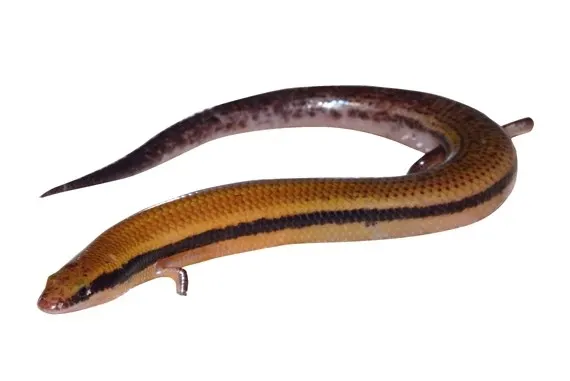
Madascincus arenicola is a slender bronze skink known only from a few coastal sites in far northern Madagascar. Scientists named it in 2011, and the IUCN Red List rated it Critically Endangered in 2012. Its name means sand dweller, and its known range is tiny.
How to recognise it
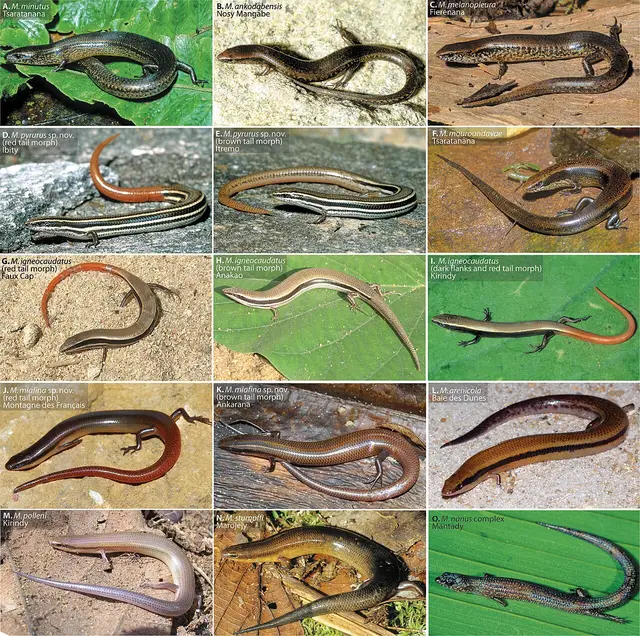
This is a slender, long-bodied skink with two pairs of five-toed legs. The back is light bronze with two dark stripes down the sides, and the snout is distinctive. Adults in the type series measured 61.5 to 81.7 mm from snout to vent.
The clearest feature for specialists is the absence of postnasal scales, the small plates beside the nostril. Within the genus Madascincus, only this species lacks them.
Where it lives
It is endemic to Madagascar and has been recorded only in Antsiranana Province, in the north: the Ampombofofo region, Baie des Dunes, Baie des Sakalava and the Forêt d'Orangea area. The type locality is Baie des Sakalava, about 5 km south-east of Ramena, at 25 m elevation. Known records lie between 25 and 28 m, according to the Red List.
The Red List gives its habitat as lowland moist forest and moist shrubland, and the original description came from the coastal dune area. The Latin name joins arena (sand) and incola (inhabitant), a nod to its sandy home.
Pins are Wikidata “endemic to” fields. Orange dots, when present, are GBIF occurrence tiles — survey bias included.
How it was found
Aurélien Miralles, Jörn Köhler, Frank Glaw and Miguel Vences described the species in 2011 in the journal Zootaxa. Their paper combined mitochondrial (ND1) and nuclear (RAG2) DNA with an examination of body features in the Madascincus polleni species complex, and found at least four distinct lineages, of which M. arenicola was the new one.
The holotype is an adult male collected on 20 February 2008. Eight paratypes came from three localities in the province (Ampombofofo region, Baie des Dunes and Baie des Sakalava), collected between 2006 and 2008.
Why it is in trouble
The 2012 assessment rated the skink Critically Endangered because it occupies a very small area, an extent of occurrence of about 58 square kilometres at a single location, with a continuing decline in that area. The population trend was recorded as unknown, and no population count exists.
Listed threats are shifting agriculture and unintentional effects of small-scale harvest.
What is being done
The assessment records that the skink occurs in at least one protected area, and its action list names site protection and site management. No programme specific to this lizard is documented.
Sources
Written for this catalog in our own words from the sources below, checked against them on 12 November 2026. Population figures are estimates and carry the year they were made. Status and assessment year: IUCN. 2026. The IUCN Red List of Threatened Species. Version 2026-1. iucnredlist.org.